Stop Bar Adjustment

Re: Stop Bar Adjustment

The downward pressure can make the bridge collapse. I’ve repaired a few like that.

17b4ec3321ab649df1a31f9658dddfdb.jpg


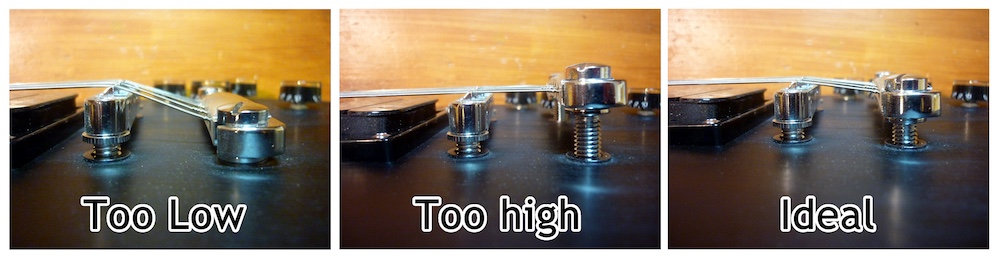
The stop tail is adjustable because it’s not supposed to be touching the body. They don’t come from the factory like that. You adjust it according to how high your bridge is adjusted.

Touching the body or over wrapping serves no purpose.

f35503e608fec810fd872747b0ce71aa.jpg


Sent from my iPhone using Tapatalk

I don't doubt the collapse of the bridge at all, but your insinuation that it is because of the string hitting the back of the bridge is totally false. Pure physics is involved here! The bridge is supported on each end. Any downward force between those two points has the same affect whether it is on the body of the bridge or on the saddle.

Yes there is an "ideal" position for the stop bar relative to the bridge for tone or function, but it has nothing to do with the string hitting the body of the bridge.
 
Re: Stop Bar Adjustment

Can cause string breakage.


Sent from my iPhone using Tapatalk Pro

No, not at all! the body of the bridge is actually smoother and rounder than the saddle and LESS likely to cause the string to break at that point.
 
Re: Stop Bar Adjustment

I don't doubt the collapse of the bridge at all, but your insinuation that it is because of the string hitting the back of the bridge is totally false. Pure physics is involved here! The bridge is supported on each end. Any downward force between those two points has the same affect whether it is on the body of the bridge or on the saddle.

Yes there is an "ideal" position for the stop bar relative to the bridge for tone or function, but it has nothing to do with the string hitting the body of the bridge.

Not the string hitting the back of the bridge. It’s from too much downward pressure by having the stop tail lowered too far. The fact that the strings are hitting the back of the bridge is just an indication that it’s too low. It wasn’t made for that. You only need a 3° break angle.

Also the whole notion that you want to couple the strings’ vibration to the body for more sustain is flawed. The body absorbs energy from the strings. It puts nothing back into the vibrating strings.

This is why Alembic and Ibanez (who copied them) put a heavy brass “inertia block” under the bridge. It served to isolate the bridge from the body.

As a demonstration of this, look at a banjo. Almost all the energy from the strings goes into vibrating the head. You get a loud acoustic output and almost no sustain.

The opposite is a heavy solid body like a Les Paul. You get minimal acoustic output but maximum sustain. That’s because the body has more mass and is not easily excited by the vibration of the strings. So more of the strings’ energy (i.e. vibrations) stay in the string.

That’s physics.


Sent from my iPhone using Tapatalk
 
Re: Stop Bar Adjustment

Not sure how well this photo will show ...

This is the stock tailpiece and studs on my LP. I like to use a spacer under the studs. So the spacer is sandwiched between the bottom of the stud and top of the body insert. I just snug it down, not cranked. The spacer is the same O.D. as the bottom "ring" of the stock tailpiece studs and 3/16" thick. I can't say for sure that it makes a whole lot of tonal difference but it stabilizes the studs.

View attachment 88683

I just use washers and use as many as needed to get the break angle I want and to have the stop bar firmly against the body.
 
Re: Stop Bar Adjustment

Not the string hitting the back of the bridge. It’s from too much downward pressure by having the stop tail lowered too far. The fact that the strings are hitting the back of the bridge is just an indication that it’s too low. It wasn’t made for that. You only need a 3° break angle.

Also the whole notion that you want to couple the strings’ vibration to the body for more sustain is flawed. The body absorbs energy from the strings. It puts nothing back into the vibrating strings.

This is why Alembic and Ibanez (who copied them) put a heavy brass “inertia block” under the bridge. It served to isolate the bridge from the body.

As a demonstration of this, look at a banjo. Almost all the energy from the strings goes into vibrating the head. You get a loud acoustic output and almost no sustain.

The opposite is a heavy solid body like a Les Paul. You get minimal acoustic output but maximum sustain. That’s because the body has more mass and is not easily excited by the vibration of the strings. So more of the strings’ energy (i.e. vibrations) stay in the string.

That’s physics.


Sent from my iPhone using Tapatalk

I never said it would increase sustain.

But thanks for clarifying what you meant by the string hitting the back of the bridge is only an "indication" of too much downward pressure. I can certainly agree with that (to an extent). I think the break angle has more to do with feel than anything else. Not to say that it doesn't have any other affect, but for me, feel is more important than possible sustain or potential damage to the bridge.
 
Re: Stop Bar Adjustment

I never said it would increase sustain.

But thanks for clarifying what you meant by the string hitting the back of the bridge is only an "indication" of too much downward pressure. I can certainly agree with that (to an extent). I think the break angle has more to do with feel than anything else. Not to say that it doesn't have any other affect, but for me, feel is more important than possible sustain or potential damage to the bridge.

People seem to screw it down and claim it’s for increasing sustain or coupling. Then they top wrap which is the same as having the tail piece raised up.

What goes on behind the bridge and nut don’t change the string tension. If it did you would be out of tune! The tension for a given string gauge (also counting core size and wraps) is always the same at a certain scale length and pitch.

The strings might feel more pliable because the string slips pass the anchor point. Being too stiff at the anchor point can also lead to the string’s harmonics sounding out of tune. This is part of the idea behind compensated nuts and zero frets. It’s also why they stretch tune pianos.


Sent from my iPhone using Tapatalk
 
Re: Stop Bar Adjustment

People seem to screw it down and claim it’s for increasing sustain or coupling. Then they top wrap which is the same as having the tail piece raised up.

Well, not entirely...

They claim the increased sustain is from the tailpiece being firmly anchored to the body to transmit more vibration, not from the break angle. Therefore, you could have the tail top wound to decrease break angle yet get extra sustain from it being anchored to the body.

What goes on behind the bridge and nut don’t change the string tension.

Not so. It absolutely can change the tension. Take an extreme example...a guitar that has a 25 1/2" scale between nut and bridge with a wraparound bridge (thus no string length behind the bridge), compared to a guitar (same scale) with 4 foot long strings (the tailpiece anchored an additional 2 feet beyond the bridge). That string will be WAY easier to bend than on the first guitar. You can even notice the difference on a LP compared to a semi with short trapeze tailpiece. Or LP compared to a Strat with additional string length beyond the bridge and the nut.

If it did you would be out of tune! The tension for a given string gauge (also counting core size and wraps) is always the same at a certain scale length and pitch.

No, you would still tune up to "pitch", but a longer string would not only be easier to bend, but would have a different/more mellow "tone" (same string gauge and pitch).

The strings might feel more pliable because the string slips pass the anchor point. Being too stiff at the anchor point can also lead to the string’s harmonics sounding out of tune. This is part of the idea behind compensated nuts and zero frets. It’s also why they stretch tune pianos.

The bridge is not the anchor point, the tailpiece is. Strings don't "slip past the anchor point".
I don't know how the tension affects the harmonics being out of tune.

And no, that is not the idea behind compensated nuts. I've been involved with the theory behind compensated nuts for over 50 years. I've been designing and making them for nearly 20 years. It all has to do with attempting to keep each string more in tune at all positions on the fretboard. It's not a perfect solution, but it is more accurate than a straight nut. Ever notice how you can perfectly tune your guitar open, but when you play the "G" string (that's the most obvious and notorious string) at other frets it sounds sharp? A compensated nut helps to correct that.

It also has nothing to do with how pianos are tuned (my cousin is a professional piano tuner and tunes ours every month. We have had lots of conversations about this). Stretch tuning is a good idea for every stringed instrument, however.
 
Last edited:
Re: Stop Bar Adjustment

I just use washers and use as many as needed to get the break angle I want and to have the stop bar firmly against the body.

I don't know if sustain is increased or not by having the stop bar firm against the body. But, if it is, it would seem that it would be more effective to use after market studs that don't capture the tailpiece. Those studs without the bottom "ring" like Faber, Callaham and others sell. That way the tailpiece is actually locked down directly to the spacers or washers. I'm just using the stock studs, which again, I'm fine with.

Something like these, without the bottom "ring" would seem to allow for more direct "coupling" ...

3000-bandc-368x276.jpg
 
Re: Stop Bar Adjustment

I don't know if sustain is increased or not by having the stop bar firm against the body. But, if it is, it would seem that it would be more effective to use after market studs that don't capture the tailpiece. Those studs without the bottom "ring" like Faber, Callaham and others sell. That way the tailpiece is actually locked down directly to the spacers or washers. I'm just using the stock studs, which again, I'm fine with.

Something like these, without the bottom "ring" would seem to allow for more direct "coupling" ...

3000-bandc-368x276.jpg

I may be completely wrong, but I believe the same thing here. I like the fact that the studs pictured above, like Callaham and Faber do allow the tail piece to be tightened down more securely than the standard Gibson tail piece with the top and bottom stop that the bridge sits between. Those are never completely tight and often bend forward with string tension. I just think having as little movement and as much solid contact in your guitar hardware as possible has to be a good thing.

I don't know enough to argue the physics of what does or does not increase sustain or effect tone. I just use my ears to tell me what I like and my fingers to tell me what I prefer to feel. Therefore I like the Callaham/Faber stud design for no tail piece movement, I like locking bridges and I prefer the feel of my strings when they are top wrapped. It may only make a difference in my head, but I can live with that.

Cheers and thanks to everyone for the good info in this thread. I always learn from these and I appreciate the knowledge and experience so many of you have.
 
Last edited:
Re: Stop Bar Adjustment

People seem to screw it down and claim it’s for increasing sustain or coupling. Then they top wrap which is the same as having the tail piece raised up.

No, it's not the same. They claim that having the tailpiece tight against the body is what increases sustain so even if it is top-wrapped it's still tight to the body. It's not like raising it up off the body.

What goes on behind the bridge and nut don’t change the string tension. The tension for a given string gauge (also counting core size and wraps) is always the same at a certain scale length and pitch.

Not true. For example, compare two guitars with 24" scale length (from nut to bridge). One has 24" strings anchored at the nut and bridge, the other has 48" strings (same gauge and type) anchored one foot beyond the nut and one foot beyond the bridge. They are both tuned to the same pitch (same beats). The second guitar is much easier to bend strings on. Why?

If it did you would be out of tune!

Of course you would tune your strings.


The strings might feel more pliable because the string slips pass the anchor point.

What?! The tailpiece is the "anchor point" not the bridge (unless it's a wraparound bridge). If you've got strings slipping past the anchor point you've got bigger problems than what we are talking about here.

Being too stiff at the anchor point can also lead to the string’s harmonics sounding out of tune.

What!? This statement has no sense to it. But, whatever you are meaning, I don't know about any affect on harmonics going out of tune because of being "too stiff at the anchor point".

This is part of the idea behind compensated nuts and zero frets.

Absolutely not. I've been involved in the theory behind "compensation" for over 50 years and have been designing and making compensated nuts for 20 years. It only has to do with attempting to keep any particular string more in tune as you play in different positions on the fretboard. Have you ever noticed that you can open tune your guitar perfectly, but when you play the "G" string (the most obvious and notorious offender) at the 5th fret it is sharp? Or if you tune that string perfectly at the 5th fret, if you play it open it sounds flat? That is what the compensated nut is trying to eliminate. It's not a perfect solution, but it is better than a straight nut.

And the zero fret has nothing to do with anything that we are talking about (tension, stiffness, harmonics out of tune). It's purpose is to eliminate the potential problems associated with "bad" nuts (binding causing inconsistent tuning/pitch).

It’s also why they stretch tune pianos.

No, again. My cousin is a professional piano tuner and tunes ours every few months. We discuss tuning piano relative to tuning guitars (he also plays guitar). It is done to stabilize the tuning, has nothing to do tension and harmonics.

Look, you can have the same type and size of string tuned to the same pitch at different scale lengths. So what IS the difference comparing, say, 10" to 50" if they are both at the same pitch? Is the note (pitch) the same? Certainly, that is a constant in our example. Are they at the same "tension"? Is the tone the same? No. The shorter string will have a much brighter tone at the same pitch. Why? If the two strings are at the same tension they will have the same vibration pattern, node length (sin wave).

You seem like a reasonably intelligent person, so I'll let you do some research and find the answers to those questions. It will have greater impact on you and you'll remember it longer if you figure it out.
 
Last edited:
Re: Stop Bar Adjustment

I find that a roller bridge helps in bending
The bend flexes better over the roller and returns much easier
The height of the stop bar, may make some difference
But in my experience, a lower stop bar keeps the string seated in the roller or groove of the bridge

Just as an angled headstock does at the nut
Stratocaster nuts without string trees are horrible at this
 
Re: Stop Bar Adjustment

People seem to screw it down and claim it’s for increasing sustain or coupling. Then they top wrap which is the same as having the tail piece raised up.

No, it's not the same. They claim that having the tailpiece tight against the body is what increases sustain so even if it is top-wrapped it's still tight to the body. It's not like raising it up off the body.

What goes on behind the bridge and nut don’t change the string tension. The tension for a given string gauge (also counting core size and wraps) is always the same at a certain scale length and pitch.

Not true. For example, compare two guitars with 24" scale length (from nut to bridge). One has 24" strings anchored at the nut and bridge, the other has 48" strings (same gauge and type) anchored one foot beyond the nut and one foot beyond the bridge. They are both tuned to the same pitch (same number of beats). The second guitar is much easier to bend strings on. Why?

If it did you would be out of tune!

Of course you would tune your strings Whether you have more or less length beyond the bridge.


The strings might feel more pliable because the string slips pass the anchor point.

What?! The tailpiece is the "anchor point" not the bridge (unless it's a wraparound bridge). If you've got strings slipping past the anchor point you've got bigger problems than what we are talking about here.

Being too stiff at the anchor point can also lead to the string’s harmonics sounding out of tune.

This statement has no sense to it. But, whatever you are meaning, I don't know about any effect of harmonics going out of tune because of being "too stiff at the anchor point".

This is part of the idea behind compensated nuts and zero frets.

Absolutely not. I've been involved in the theory behind "compensation" for over 50 years and have been designing and making compensated nuts for 20 years. It only has to do with attempting to keep any particular string more in tune as you play in different positions on the fretboard. Have you ever noticed that you can open tune your guitar perfectly, but when you play the "G" string (the most obvious and notorious offender) at the 5th fret it is sharp? Or if you tune that string perfectly at the 5th fret, if you play it open it sounds flat? That is what the compensated nut is trying to eliminate. It's not a perfect solution, but it is better than a straight nut.

And the zero fret has nothing to do with anything that we are talking about (tension, stiffness, harmonics out of tune). It's purpose is to eliminate the potential problems associated with "bad" nuts (binding causing inconsistent tuning/pitch).

It’s also why they stretch tune pianos.

No, again. My cousin is a professional piano tuner and tunes ours every few months. We discuss tuning piano relative to tuning guitars (he also plays guitar). It is done to stabilize the tuning, has nothing to do tension and harmonics.

Look, you can have the same type and size of string tuned to the same pitch at different scale lengths. So what IS the difference comparing, say, 10" to 50" if they are both at the same pitch? Is the note (pitch) the same? Certainly, that is a constant in our example. Are they at the same "tension"? Is the tone the same? No. The shorter string will have a much brighter tone at the same pitch. Why? If the two strings are at the same tension they will have the same vibration pattern, node length (sin wave).

You seem like a reasonably intelligent person, so I'll let you do some research and find the answers to those questions. It will have greater impact on you and you'll remember it longer if you figure it out.
 
Re: Stop Bar Adjustment

No, it's not the same. They claim that having the tailpiece tight against the body is what increases sustain so even if it is top-wrapped it's still tight to the body. It's not like raising it up off the body.

Which is what I said. Now explain why the stop bar touching the body would make any difference to sustain? The body does not contribute to sustain. Sustain is a product of how stiff the neck is, and how much energy from the strings is NOT being lost by the neck flexing and body absorbing the energy (vibrations) of the strings.

The more parts that vibrate, the less sustain. So as an example, a banjo has a loud acoustic output and almost zero sustain. All the energy from the strings is being converted to moving the drum head.

The opposite is a heavy, stiff solid body. Minimum acoustic output and maximum sustain. Because of mechanical impedance, the body has too much mass to be excited by the strings.

So isolating the strings from the body improves sustain. This is why Alembic and Ibanez had brass “inertia” blocks under their bridges.

So screwing the stop bar to the body improves nothing.


Not true. For example, compare two guitars with 24" scale length (from nut to bridge). One has 24" strings anchored at the nut and bridge, the other has 48" strings (same gauge and type) anchored one foot beyond the nut and one foot beyond the bridge. They are both tuned to the same pitch (same number of beats). The second guitar is much easier to bend strings on. Why?

You say “not true” but you don’t know why the strings are more pliable. The tension of the string at 24”, at pitch, is the same regardless of how much string is behind the nut and bridge saddles. Most string makers list the tension of that string at pitch. That tension doesn’t change or the pitch would change.

Most luthiers agree the reason is the core of the string can slip past the saddle a little in a bend. So the rest of the string flexes like a shock absorber, and the strings are more pliable.

But try it on a guitar with a locking nut. It feels the same regardless if the nut is locked or not.

-snip-

This statement has no sense to it. But, whatever you are meaning, I don't know about any effect of harmonics going out of tune because of being "too stiff at the anchor point".

You have just disqualified yourself from this conversation.

First off, read up on stretch tuning. Because you don’t know what that means or why they do it.

“Intervals and inharmonicity

In tuning, the relationship between two notes (known musically as an interval) is determined by evaluating their common harmonics. For example, we say two notes are an octave apart when the fundamental frequency of the upper note exactly matches the second harmonic of the lower note. Theoretically, this means the fundamental frequency of the upper note is exactly twice that of the lower note, and we would assume that the second harmonic of the upper note will exactly match the fourth harmonic of the lower note.

On instruments strung with metal wire, however, neither of these assumptions is valid, and inharmonicity is the reason.

Inharmonicity refers to the difference between the theoretical and actual frequencies of the harmonics or overtones of a vibrating tine or string. The theoretical frequency of the second harmonic is twice the fundamental frequency, and of the third harmonic is three times the fundamental frequency, and so on. But on metal strings, tines, and reeds, the measured frequencies of those harmonics are slightly higher, and proportionately more so in the higher than in the lower harmonics. A digital emulation of these instruments must recreate this inharmonicity if it is to sound convincing.

The theory of temperaments in musical tuning do not normally take into account inharmonicity, which varies from instrument to instrument (and from string to string), but in practice the amount of inharmonicity present in a particular instrument will effect a modification to the theoretical temperament which is being applied to it.”

“If you try bending a short piece of piano wire or guitar string slightly with your fingers, you can feel the wire's resistance to bending. In a vibrating string, that resistance adds to the effect of string tension in returning a given part of the string toward its rest position. The result is a frequency of vibration higher than the theoretical frequency. And because the wire's resistance to bending increases as its length decreases, its effect is greater in higher harmonics than in lower.”

https://en.wikipedia.org/wiki/Stretched_tuning

Now we go to tuning systems like:

“The Buzz Feiten Tuning System solves tuning and intonation problems with 2 simple steps:

1. Shelf Nut
Our exclusive Buzz Feiten Tuning System¨ (BFTS) Shelf Nut moves the strings closer to the first fret according to our Patented Formula. This eliminates sharp notes at the first three frets.”

Same with the Earvanna nut.

Why are the notes sharp by the anchor point (the nut)? Inharmonicity

Famous luthier Rick Tuner wrote while discussing zero frets:

“There is also...and this relates to some other threads, the fact that strings do not necessarily come straight off of either a nut nor zero fret in a perfectly straight direction. There is a bit of a curve where the string is biased up and away from being directly even with the nut, zero fret, or fret. And that is one of the major reasons why the termination of the string is "fuzzy"...requiring intonation compensation. The working string length literally gets shorter at increasing harmonic modes; this because of the string's stiffness having progressively greater effect at higher harmonics.”


So, to recap; a string is stiffer at its anchor points than in the middle of the string. This is obvious. Where the string is stiffer, it’s harmonics are not in tune with the fundamental. This is why they stretch tune pianos. The harmonics on the thick bass strings behave more like a metal rod, which is why that has a more dissonant “clang.” So the treble strings are tuned progressively sharper. The tuning is “stretched” so the treble strings sound in tune with the sharp harmonics on the bass strings.


Sent from my iPhone using Tapatalk
 
Re: Stop Bar Adjustment

Well, I can say this much, you're pretty good at quoting. Not very good at understanding or expressing.

This is getting ridiculous. I'm out.
 
Re: Stop Bar Adjustment

What's that kid swinging around? Looks like a golf ball retriever. I've done that dance once or twice with one of them things.
 
Re: Stop Bar Adjustment

Yes, the stop bar will roughly follow the side-to-side tilt on the bridge when set up for even string feel. It won't be exact, because the lower strings are thicker than the higher strings, but it will be close.

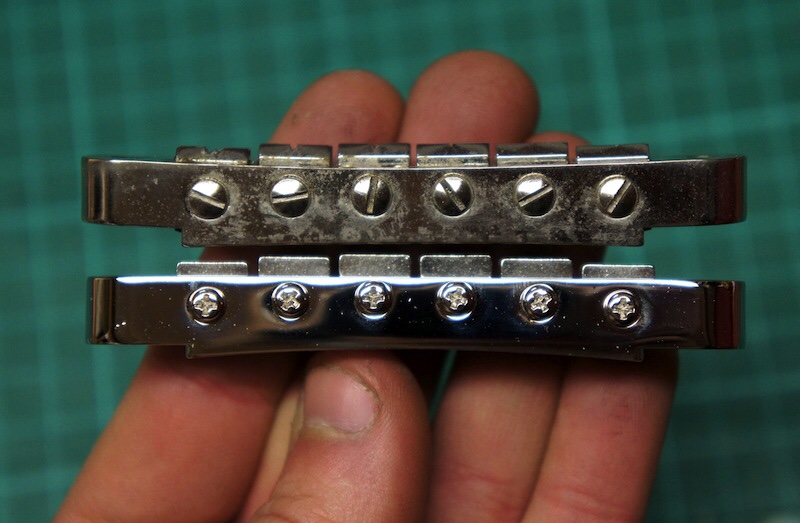
As for where to set it, that's a metal matter of personal choice. That's why it's adjustable. Use your common sense, though. Obviously you don't want it set so high that the strings routinely pop out of their saddles. Going the other way, you don't want it so low that the strings are hitting the rear edge of the bridge...however, it's not the end of the world if they do. This latter reason is why some people prefer the older ABR-1 bridge design. It's a little bit narrower, so it lets you jack the tailpiece down more without the strings resting on the bridge frame. In your case, however, it sounds like you actually want to go higher, not lower, so that's not really a consideration for you.

The tailpiece studs really should use acme threads…but they don't. I've never obsessed over having the studs all the way in, or using those little spacers to fill the gaps. I think the guitars sound perfectly fine with the studs at any height.
 
Last edited:
Re: Stop Bar Adjustment

Does 'sustain' here mean how long the note rings out? If so, does it even matter in real life cause there are pickups, amps, and pedals.
 
Back
Top