The real influence of wood in tone

Re: The real influence of wood in tone

^ As much as I liked some of the playing in that clip, the tone was pure bollocks. Wanna convince me? Make a guitar like that, that sounds like the Epiphone Les Paul I've been playing this morning through a $109 Line6 combo.
 
Re: The real influence of wood in tone

I never said wood in a guitar's construction doesn't affect "tone". What I'm highlighting is that it's much lower on the chain of elements that contribute to how an electric guitar will sound than most people give it credit for. Many players view the wood and type of wood as the primary factor in determining the "tone" of a guitar and that's simply not true.

Me, personally, I have NO interest in a concrete/rock/titanium/aluminum/acrylic or body-less guitar. There's an unspoken warmth and life and inspiration that comes from a vibrating piece of wood (just ask my girlfriend).
 
Re: The real influence of wood in tone

I think you might be overestimating how highly most players rank wood among factors determining a guitar's tone. Let's say it's the largest single factor. Does it outweigh everything else combined? I'd be interested to see how people rate on agreeing or disagreeing with that.
 
Re: The real influence of wood in tone

If that's a woody sound, i seriously need to reassess my concepts of good sound. Of course it might help in these circumstances to actually hear a guitar without all the damn processing. That was truly horrible and didn't even have the resonance of two mosquitos in a tin can. Anyway, sorry for the interuption, back to the scientists .....

The Gittler wasn't designed to sound like a pair of vintage PAFs with 50 year old wiring played through a 1960s tube amp. In fact, the pickups used in the Gittler aren't what we're used to at all. Still, with minimal mass, non-traditional pickups and absolutely no wood, it still sounds like an electric guitar. That's the basic point I'm making with that example (also, the Gittler isn't even going on sale until later this summer, so there aren't any real clips of it yet).

Vinta9e - I agree with you on many points. But, you're over-expanding the primary issue and, in turn, slightly contradicting yourself. Do strings affect the "tone"? Yes. Does the bridge material affect the "tone"? Yes. Does a bolt-on wood Strat type design vs. a welded, body-less, hollow titanium washboard design affect the "tone"? Of course. I'm saying that the order of importance of these elements is what is misconceived by most players.

Little Pigbacon - look at the title of this thread. And, yes, the majority (I'm not saying all) of suggestions for pickups made on these forums factor in the wood composition as the most important tell-tale element of how a guitar will react and sound. Head over to the pickup lounge and you'll see this every day...
 
Last edited:
Re: The real influence of wood in tone

look at the title of this thread. And, yes, the majority (I'm not saying all) of suggestions for pickups made on these forums factor in the wood composition as the most important tell-tale element of how a guitar will react and sound. Head over to the pickup lounge and you'll see this every day...

I think it's because people are lazy, and it's some of the easiest information to gather. The other details of construction and hardware are sometimes addressed, but not nearly as often -- possibly because it takes more words. Besides, I think a lot of people who post in the Pickup Lounge are just seeing how quickly they can get an open shot to recommend someone else trying what they themselves already like.
 
Last edited:
Re: The real influence of wood in tone

A quality guitar made with New growth wood is bright and hard sounding ,even the good stuff is not as warm and dimensional sounding as a vintage or old growth quality guitar tonewood, and the budget cheaper stuff sounds frankly pretty flat , hard and bright . This tends to diminish the difference you hear between species , or even between the same model of guitars with the same type and quality of wood . I would say that particularly for a late model low to mid end guitar, that pickups count for more than whatever 3,4 , or 5 pieces of wood that they grew as fast as they could, and slathered glue in it and gobs of filler all over it , and slapped it together, although its still a synergystic relationship amongst all the parts of a guitar .

Heres a 'frinstance'- my Agile was typically flat sounding and very hard and bright new guitar , but I dropped the right humbucker pickup in it, and it got a very thick and round sound, and new hardware also helped quite a bit, so the wood, even though its still proabably still the heart of any Guitar, needed some soul with the special pickup and stuff.
On a 50 year old piece of old Growth Honduran, for example, you'd be crazy to use anything except an old Paf, becasue your not trying to do anyhtihng but bring out the beuatiful warm and complex nature of the tone wood.

None of this stuff even matters if your playing Uber metal with an amp with the gain so high and tight you could be using a cinderblock for a body.

Thats all just an opinion based on my personal obvservation, so TIFWIW.
 
Last edited:
Re: The real influence of wood in tone

LOL. But don't distort my thoughts, my original question was if THE TYPE of woods really matter MUCH on SOLID body guitars...Like if the pickups and the construction don't matter MORE than the woods...

I've been through this entire thread and something that might have been implied but not explicitly pointed out is something I've observed across all my solid-body electric guitars. The electronics seem more influential on tone, but the effect of the wood/body/neck seems more to be on which notes of a chord stick out; how even the sound is - or if there are hot-spots while playing up and down the neck.
 
Re: The real influence of wood in tone

Beau - Well stated!

Woods (and other materials) can definitely help us fine-tune the way our instruments react and, thus, sound, but the electronic makeup (including pickup placement and mechanical adjustment) is responsible for the major part of the creation of what most consider to be an electric guitar's "tone".

At least as far as the output jack. Once that signal hits the cable and amp, there's a lot more at play.
 
Last edited:
Re: The real influence of wood in tone

As for the often-repeated notion that EMG's make all guitars sound the same said:
We're talking about VERY subtle differences in tone, with that premiss accepted EMG's do not make all guitars sound the same, the tonal properties of the wood will always reflect on EMG's tone as in any other pickup, only in a more fine way.
 
Re: The real influence of wood in tone

http://m.youtube.com/watch?v=JCZtcP29uDo

Everything identical except for woods.
Ash and rosewood on one,
Alder and maple on the other.
Identical hardware, strings, electronics, amp and settings.
You could argue the difference is in the wind of the pickups or something like that but the difference between the two instruments, the difference between the tones, fits what someone would say the wood would dictate, in addition to that the pickups are wound for consistent quality and tone, so this difference would be too extreme for a subtle change in the wind, plus the change is consistent for each pickup so every pickup on the set would have to be wound one precise way while the other set wouldn't be close in terms of eq, so that's not really a good response. Both still sound stratty though.
 
Re: The real influence of wood in tone

I've been through this entire thread and something that might have been implied but not explicitly pointed out is something I've observed across all my solid-body electric guitars. The electronics seem more influential on tone, but the effect of the wood/body/neck seems more to be on which notes of a chord stick out; how even the sound is - or if there are hot-spots while playing up and down the neck.

Thanks for the info Beau!

http://m.youtube.com/watch?v=JCZtcP29uDo

Everything identical except for woods.
Ash and rosewood on one,
Alder and maple on the other.
Identical hardware, strings, electronics, amp and settings.
You could argue the difference is in the wind of the pickups or something like that but the difference between the two instruments, the difference between the tones, fits what someone would say the wood would dictate, in addition to that the pickups are wound for consistent quality and tone, so this difference would be too extreme for a subtle change in the wind, plus the change is consistent for each pickup so every pickup on the set would have to be wound one precise way while the other set wouldn't be close in terms of eq, so that's not really a good response. Both still sound stratty though.

Thanks too Fall Off!

My personal opinion after watching the video is that wood might really make a difference. Like, in my personal perception, they do sound different between themselves.

"The blue one has a sharper attack and a lot of sustain, but has a bassier, more scooped sound overal. The maple has a smoother attack but is clearer overall, it has a lot of definition to chords."

^This is the definition of the owner of the guitars. Do you guys agree?
 
Re: The real influence of wood in tone

Thanks for the info Beau!


Thanks too Fall Off!

My personal opinion after watching the video is that wood might really make a difference. Like, in my personal perception, they do sound different between themselves.

"The blue one has a sharper attack and a lot of sustain, but has a bassier, more scooped sound overal. The maple has a smoother attack but is clearer overall, it has a lot of definition to chords."

^This is the definition of the owner of the guitars. Do you guys agree?

When people say that maple usually has a brighter attack, I KIND of agree, but I've always thought of it as an upper mid chirp, or cluck. This is what I've heard across MANY videos and MANY guitars I've played. Also Ash can be VERY inconsistent. Ash can be lighter than basswood and heavier than mahogany, and sound like both depending where on the tree they got it from. Usually the sweet spot for swamp ash is right in the middle of the tree, which is what most manufacturers use. This is the one that is usually described. Alder on the other hand is very consistent from body to body. In other words 2 identical ash guitars can sound pretty different while 2 identical alder guitars will sound pretty much identical. And again the types of pickups used make a huge difference, an unpotted and low output and mildly microphonic seth lover will be effected by wood more so than a compressed and driven invader or an active pickup. There's hard evidence on both sides that say wood does and doesn't effect tone, so it's almost impossible to conclude but I lean towards the wood doing something on solid electrics. But hey, maybe this guy set up the guitars differently or a set of strings or pickups was off or something. I respect all beliefs on what effects what. But you'd think as soon as guitar luthiers found out about this they would stop importing woods that cost more and get them in trouble with the government and fire the tonewood selectors and just use whatever material is lightest, most durable and easiest to work with, at least with solid finished instruments. Same goes with pickup companies like Duncan, why would they care, you'd think if they thought that honestly that the wood doesn't do anything they would use that to support their pickups. But no, they buy it too apparently. And they would know of all people what sounds good in what, designing and testing pickups for and in specific woods and all. I just don't think that more than 99% of the electric guitar industry would be that stupid or die hard conservative.

But to answer your question about the sounds of each yes, Ash is usually more bass and treble focused with more sustain while alder is more concentrated in the upper mids. This is what their properties are GENERALLY considered as. Certainly sounds like it because that alder has more of the cluck sound I was talking about which the board would lend as well as the mids from the alder, the ash is a bit snappier at the top and simultaneously darker and more encompassing, but that's just my opinion.
 
Re: The real influence of wood in tone

Wood is a fundamental aspect of the tonal recipe. I never first audition a guitar plugged in. I also seldom practice plugged in, I want to hear the tone of the instrument. Density of the wood, the orientation of the grain, i.e. flat or quarter sawn, thickness of the body and species are all at play even before construction issues come to play.
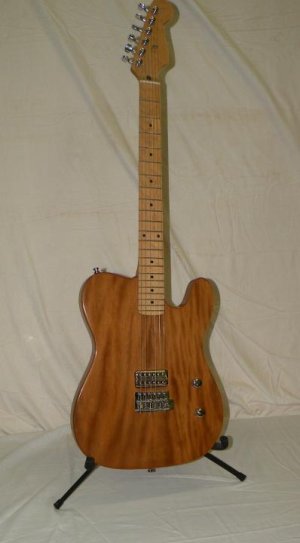
As a "tele" guy, my touchstone is a swamp ash G&L. It is a fantastic sounding guitar. I vend a conifer, Ancient Kauri, that has very interesting attributes. Cut as a tele, it imparts a fulness in the lower mids that pushes the tele design closer to a LP Jr. ( which I also adore). In general, the stiffer and more dense woods will transmit attack and high end faster, i.e. maple, rosewood, etc. Conifers and other lighter species will allow slower (deeper) sound waves to move through the body.
Heavier examples of each species seem to come from lower in the tree as the wood is compressed from the job of holding up the rest of the tree.
Ultimately, let your ear decide. One mans warm is another mans muddy.
I am happy to see a resurgence in conifers in general. Many builders are exploring spruce, cedar and pine for electric bodies. Our Ancient Kauri is gaining recognition as well.
I hope this helps!AncientKauriTele.jpg
Jordan
 
Re: The real influence of wood in tone

Do strings affect the "tone"? Yes. Does the bridge material affect the "tone"? Yes. Does a bolt-on wood Strat type design vs. a welded, body-less, hollow titanium washboard design affect the "tone"? Of course. I'm saying that the order of importance of these elements is what is misconceived by most players.
Sure. However, there is no fixed order of importance because every guitar is different. The shapes, proportions, materials and coupling between the elements are design/model specific, while things like internal structure, mass and stiffness distribution are unique to each piece of wood. Every neck has a set of impulse responses, which are evaluated by listening to tap tones. Depending on where and how strong it's struck, a neck might produce a different tone. If that's the case, the neck will respond with a specific voice, a combination of resonant modes, depending on what notes you fret and how hard you pick.

Synthetic materials usually lack this kind of responsiveness, but their ability to produce a clean, pure, sustaining tone might be employed to focus the energy elsewhere, for example into the body. The basic idea has been around for a while, we've seen necks made of aluminum, and carbon fiber, but also wooden necks with synthetic fretboards, or stiffening rods inside or a composite shell outside.
The question whether the body or the neck is more important for tone does not have a simple answer, because a Telecaster is so very different to a Status, as is a King V to a Les Paul, as is a "bodyless" Steinberger to an Explorer or an ML. Furthermore, no body is ever going to work without a neck (and a bridge). But notes played in the highest registers can be practically devoid of neck resonance. Now that might seem as if I'm contradicting myself but that is just because plucking a few inches of a 0.010" string is a totally different set of conditions than slamming an open E chord. Nonetheless, a good guitar is expected to respond well to both and everything in between.

The strings and the neck+body system are so alike coupled pendulums. The hardware provides coupling points so by choosing the materials, you can filter the string tone and consequently the wave driving the wood resonance. But even though Graphtech saddles can tame some treble, they won't make up for a true lack of low end punch. The first rule of old school sound engineering is "crap in = crap out", which means you can't just equalize a bad take into a good one.
Bolting on hardware also means adding a bit of mass here and there. There's the fatfinger, the badass bridges, the 2tek, the big blocks, the jetfretz but there's also hipshot lightweight tuners and pigtail aluminum wraparound, titanium bridge parts. In present times you've got so many ways to add or subtract some weight to either end of the string, isn't that wonderful? Everyone who owns a big tube amp knows moving mass is difficult. We can assume things aren't any different to sound waves. What that means, is that a heavy bridge will tend to vibrate less and reflect sound waves within the string, so the body will be driven more through the neck and less through the bridge. Will a big block help a dead, thuddy sounding body? No, it won't. Will that and an L-500XL help? No, they won't. They will just make it thud a bit louder and clearer.

I think you might be overestimating how highly most players rank wood among factors determining a guitar's tone. Let's say it's the largest single factor. Does it outweigh everything else combined? I'd be interested to see how people rate on agreeing or disagreeing with that.
That's a good point. A guitar is a rather complex system, that should be evaluated as a whole, because every part is connected to others in some way. There is no single piece of a jigsaw that lets you see the whole picture.
Now "to contradict myself slightly", let me tell you that to me, wood is the most important. Because that is what inspires me to play, because its effects come through in my tone and because if it's dead, it's dead and only fit for a campfire. It is the primary source of tone because it resonates sympathetically with the strings, dampens these oscillations within self and feeds them back to the wires, giving the guitar a spectral and dynamic foundation before amplification.

We're talking about VERY subtle differences in tone, with that premiss accepted EMG's do not make all guitars sound the same, the tonal properties of the wood will always reflect on EMG's tone as in any other pickup, only in a more fine way.
EMG preamps introduce quite a bit of coloration which might mask the wood's resonance noticeably. Comparing them in a couple of Corts and Epiphones through a pod or a practice amp doesn't really help tell the whole story. I wouldn't bother to use anything else if they could make an el cheapo Ibby sound like Reb Beach's... but they don't.
 
Re: The real influence of wood in tone

My old lady says that hard wood set the tone for making great music much better than any old soft wood, especially after drinking a lot of Jack Daniels...


heheheh
 
Back
Top