Thoughts on pickup compression compared to compression from gear

Bowtomecha

Active member
I read in a forum that Dimarzio humbucker tend to have a faster more immediate attack because they are more compressed. As opposed to lower output or vintage humbuckers that have a bit of sag to the attack with a bloom to the note over time. I find myself gravitating towards pickups with an immediate and brighter attack without being too hot. But is there another approach to this? As in an amp setup that can take a modest pickup and give it a bright and fast attack depending on my playing? Is this something that gain staging with an amp and a drive pedal does?
 
I read in a forum that Dimarzio humbucker tend to have a faster more immediate attack because they are more compressed. As opposed to lower output or vintage humbuckers that have a bit of sag to the attack with a bloom to the note over time. I find myself gravitating towards pickups with an immediate and brighter attack without being too hot. But is there another approach to this? As in an amp setup that can take a modest pickup and give it a bright and fast attack depending on my playing? Is this something that gain staging with an amp and a drive pedal does?

I dislike adding compression on the front end of my signal chain. I mostly use vintage output single coils, no compressor, and get my compression from cranking the output section of my amps. I love the chewy natural compression of cranking an amp with a tube rectified power section for more vintage tones, but right now I am lacking a tube rectified amp.
 
IME sag and bloom and attack have all been functions of the amp architecture, tubes, speakers, amp setup, and settings of guitar and amp to balance how you are hitting the stages. The role the pickup plays has more to do with whether it puts out thick lower end or is thinner and brighter, then balancing that with levels as you hit the amp.
 
It depends on if your playing relies on dynamics or not. Hotter pickups will nullify a lot of picking dynamics which is what you might like in heavier styles. Clean or low gain styles would want compression after the pickups for a boost or sustain.
 
But is there another approach to this? As in an amp setup that can take a modest pickup and give it a bright and fast attack depending on my playing? Is this something that gain staging with an amp and a drive pedal does?

I'm not aware of an amp with a variable sag effect, personally. In my mind, some circuits sound immediate and stiff (like a JC120 or a Fender Twin with big iron ultralinear OT), others do the opposite (like small Fender tweed amps with undersized transformers and tube rectification). One would have to design some dynamic way to emulate the transition from a tube rectifier to a diodes rectifier or something like that...

If you're in this kind of things, Boss processors have the potential to alter many settings thx to a triggering due to playing dynamics.


Now and regarding what was said about pickups: the Internet stance that you sum up is the opposite of my experience and POV...

I understand "compression" as limiting the amplitude of the first transient and slowering what follows, to tell it simplistically.

For some reasons of design that I won't dig here, such traits are more present with typical DiMarzio HB's than with vintage humbuckers, IME/IMO. :-)

Listen the first note of the following track: that's the typical attack of a real vintage P.A.F.

https://youtu.be/fMj_HnvJKXk?si=q7bdmbTlDEdd_C4A

IME of these last 4 decades, typical DiMarzio don't do that: they always feel to me as normalizing the dynamics and giving the impression to play by themselves, as other pickups do through a compressor.

I'm not criticizing such products: I just testify about my own findings. Subjective experiences and mileages may vary. :-)
 
IME sag and bloom and attack have all been functions of the amp architecture, tubes, speakers, amp setup, and settings of guitar and amp to balance how you are hitting the stages. The role the pickup plays has more to do with whether it puts out thick lower end or is thinner and brighter, then balancing that with levels as you hit the amp.

Yeah, I have to agree with this. If a pickup is "compressed" I think it implies that the signal from the pickup hits the frequency band of your amp that compresses the most.
 
It has already been discussed here... I had shared about the fact that IME, Foucault currents do generate what is felt as "compression".

But I'll avoid to repeat myself and to fall in further tedious explanations by quoting Dr Scott Lawing (who is not my source for the idea above: his detailed explanations just happen to echo in their own special way my humble experimental conclusions) :
https://www.thegearpage.net/board/i...kups-compress-naturally.2276749/post-32990508
 
I read in a forum that Dimarzio humbucker tend to have a faster more immediate attack because they are more compressed.

It has nothing to do with brand.

Hotter pickups are generally more "compressed" because the signal is maxed out across frequencies - no matter what it was before it hit the pickups. Lower output allows for more room to "hear" the differences.

The more you compress early in a signal chain, the more consistent the sound through the chain. The later in the chain, the more impact everything that can have an effect will have an effect.

Other big sources of compression include: Compressor pedals, Distortion/OD pedals, and the amp itself.
 
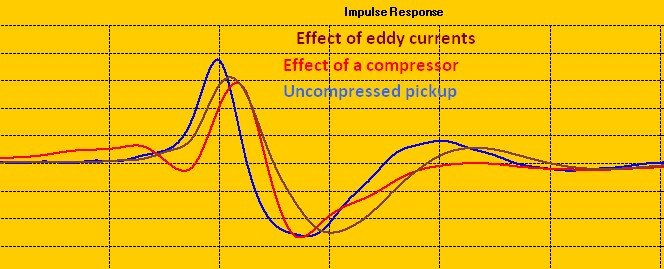
As a footnote to my previous post, I share below the impulse response of a pickup "uncompressed" (in blue) vs the same pickup through a typical compressor (in red) then with eddy currents due to a modification in the magnetic circuit (in brown). These Foucault currents limit the amplitude and slower the transient, not so far from what the compressor does...

There are other factors at play with what is felt as "compression": of course, the amp has its responsability in this story! But on the pickup side, eddy currents aforementioned and inductive-capacitive specs are to take in account. I had shared several posts and pics about that in the following topic:
https://forum.seymourduncan.com/for...ups-really-more-dynamic?p=6236157#post6236157

What is related to the brand with DiMarzio is their use of brass baseplates, generating eddy currents IME... :-)

CompFromPU.jpg
 
To tell it in the simplest way, a compressor needs to receive the signal before to do its job... That's what is seen in the pic. ;-)
 
Depends on the circuit... A Distortion+ doesn't slower much the attack compared to a Guv'nor, for example.
 
i agree. even with amps. there are some amps, even cranked up, that have a tight response and some that are softer. i think some komet amps even have an option to switch between two response types for example
 
I read in a forum that Dimarzio humbucker tend to have a faster more immediate attack because they are more compressed. As opposed to lower output or vintage humbuckers that have a bit of sag to the attack with a bloom to the note over time. I find myself gravitating towards pickups with an immediate and brighter attack without being too hot. But is there another approach to this? As in an amp setup that can take a modest pickup and give it a bright and fast attack depending on my playing? Is this something that gain staging with an amp and a drive pedal does?

There is no such thing as pickup compression. I don't know where that started but its not a thing. Maybe, a hot pickup can push an amp hard enough to generate some compression IN THE AMP.. The pickup does not compress.
 
BTW, even cable capacitance contributes to what is felt as "compression" with passive pickups... I've a folder somewhere with other experimental data about that but not enough free time to search and share it right now. Later maybe...
 
What you read about compression for the DMZ is correct in my experiences but I don't think it has more defined attack compared to the vintage correct designs like SD and Gibson. I find the true vintage style (in every detail like baseplate material) to be more percussive and attack sensitive.
 
Back
Top