Tonepot ceramic capacitor - should I change it?

Re: Tonepot ceramic capacitor - should I change it?

Same. I hear the difference in different value caps, but not different types. And sometimes I don't hear the difference with different values if they're close (I replaced some well worn Emerson PIO caps in my LP with Orange Drops and went from .015 to .022 on the neck, and heard zero difference).

I wonder if the most revealing part might be with knob on 10. This you cannot do anything about if wanting to go brigther.
I heard before and also listened to YT vids where they disconnected tone circuit, with clearly audible brigther tone.
So it is filtering even as knob on 10.

This is where those zero-something pots come in, where swiper touch no carbon at all at 10, so same as disconnected.
So depending which direction you want to go you set capacitor value as starting condition, unless you have this disconnect functionality.

I saw some example where they put .015 uF at neck, to have is slightly brighter, and .022 at bridge circuit since it need no extra treble boost.

Others go 1 Mohm on volume pot in neck, DiMarzio has one, to also make it just a bit brigther. All components are part of the circuit - including the cable.

So depending on guitar and pickups you can adjust some things around pickups to make it brighter.
- if not using low capacitance cable like GeorgeL with 19 pF/foot or 60 pF/meter - you could start using that
- go to 1 Mohm volume pot
- set tone cap to smaller value like .015 uF instead of .022 uF

All these things are cheaper than swapping pickups.
 
Last edited:
Re: Tonepot ceramic capacitor - should I change it?

I heard before and also listened to YT vids where they disconnected tone circuit, with clearly audible brigther tone.
So it is filtering even as knob on 10.

Yes, and it can be measured. I've the bad habit to mount custom home made tone circuits : when I put a switch allowing to from from a Q filter to a standard tone cap, the inductance of the pickup(s) changes on the meter, even with the tone pot full up...

... and in a counter-intuitive way, small value caps (below 10nF) are the most detectable in this case (!).

To answer a bit too late to your initial question, my experience with tone caps is that...

1-nothing replaces personal experience with such things;

2-there's no legal rule when it comes to guitar circuits - but it's always possible to "tune" a wiring to optimize the specific pickups mounted in a specific guitars for the specific needs of any player. It requires to apply the point 1 above, IMHO;

3-soldering irons develop potentially destructive heat, pliers can make damages, wires exhibit or generate more or less stray capacitance, time shifts the specs of some components and so on... For such reasons, "simple" guitar wiring might have unexpected "parasitic" properties that some measurements make clear. Possible reasons why I've seen some tone circuits reacting in an apparently illogical way on the screen of a frequency analyzer;

4-For some reasons above in my point 3, I prefer to deal with "big" caps on thick legs: as long as they aren't "Tropical fish" models from the 70's, they won't crumble like some small caps do and they're less prone to be damaged by a bad (re)wiring job... or even by a loose knob whose rotation is potentially able to break or to desolder / pull off the leg of a tiny cap (!);

5-some caps are more sensitive to interferences (for example, some ceramic caps favor HF noise). Cheap components are not cheap without reasons...

6-generally, guitar tone caps are simply... a huge can of worms in online discussions;

7-my point 6 redirects towards point 1. LOL.


FWIW : my 2 cents. :-)
 
Last edited:
Re: Tonepot ceramic capacitor - should I change it?

I wonder if the most revealing part might be with knob on 10. This you cannot do anything about if wanting to go brigther.
I heard before and also listened to YT vids where they disconnected tone circuit, with clearly audible brigther tone.
So it is filtering even as knob on 10.

This is where those zero-something pots come in, where swiper touch no carbon at all at 10, so same as disconnected.
So depending which direction you want to go you set capacitor value as starting condition, unless you have this disconnect functionality.

I saw some example where they put .015 uF at neck, to have is slightly brighter, and .022 at bridge circuit since it need no extra treble boost.

Others go 1 Mohm on volume pot in neck, DiMarzio has one, to also make it just a bit brigther. All components are part of the circuit - including the cable.

So depending on guitar and pickups you can adjust some things around pickups to make it brighter.
- if not using low capacitance cable like GeorgeL with 19 pF/foot or 60 pF/meter - you could start using that
- go to 1 Mohm volume pot
- set tone cap to smaller value like .015 uF instead of .022 uF

All these things are cheaper than swapping pickups.

You’re mixing different things here. Lower capacitance cables and a higher resistance volume pot will will retain more of the treble part of the signal.

Lower tone cap values will not make the overall signal brighter. The value of the tone cap changes the corner frequency that the treble rolls off when turning the knob toward zero. As such, the difference between tone caps is most evident when the tone is completely rolled off to zero. When the tone control is on ten, it’s doing almost nothing, sending almost no signal through the tone cap to ground, so differences in tone cap values when the tone is on ten are not detectable with the ear.
 
Re: Tonepot ceramic capacitor - should I change it?

When the tone control is on ten, it’s doing almost nothing, sending almost no signal through the tone cap to ground, so differences in tone cap values when the tone is on ten are not detectable with the ear.

But that "almost" is actually audible - and in the range worth considering if you feel you need tiny bit more treble.
So yes, it is detectable by ear, from many sources on forums since 15 years or so and YT vids.
https://www.youtube.com/watch?v=XS3eAS1miKg
Ignore it if you want.
 
Re: Tonepot ceramic capacitor - should I change it?

Use a Fender Esquire if you want to test tone on 10 versus no tone in real world use. They have had that wiring since 1950.

An Esquire is my number one, and has been since 2002. I can only hear the hairiest hair of difference, if I am playing by myself in a sonically isolated environment, and really, really, REALLY listening for it. If I didn’t know I was flicking the switch, it would be impossible for me to tell the difference...and I have pretty good ears for that sort of thing. And that’s with a 250 KOhm pot. The differences are even smaller with a higher value pot.

Add a single other sound to the mix, let alone a whole band, and/or stop looking hard for it, and you’ve got no difference worth talking about in real world use. That is why my middle setting on the Esquire is with the tone pot rolled down a bit. Because if I left it all the way up, my number one and number two positions would sound the same in the mix.

“15 years“ of people online claiming they have golden ears or posting pretty graphs showing minuscule differences (that they then proclaim we can hear in a real world mix), while sitting alone in their bedrooms amounts to a hill of beans in my book. Of course there are slight differences; I even agree that they can be heard. The question is always whether or not they are appreciable in the real world, when we are actually using out instruments as they were built to be used.

And FWIW, I’ve been playing my Esquire for over 17 years, and I’ve only been deaf from using the no tone position for 15 or 16 of them, so I know what the hell I’m talking about! :D
 
Last edited:
Re: Tonepot ceramic capacitor - should I change it?

10mn of pause in my work online...

As a footnote to my last post and for my geeky nerdy fun (if not for yours)...

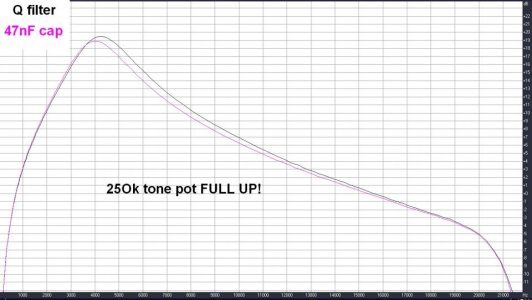
I share below the resonant peak of a Strat pickup through a standard wiring harness + cable in a 1M input.

The black line shows the Rz when the tone pot is connected to ground through a home made Q filter.

The pink line is the same Rz when the tone pot is connected to ground through a standard 47nF cap.

The tone pot is a 250k control set FULL UP (10/10) in both cases...

Tone pot FULL UP & various components.jpg

No need to say that the difference pictured can be heard when the guitar is played. :-)

IF time permits, I'll share another slice of my experimental data, showing the difference between a 1nF cap and a standard tone cap with the same 250k tone control FULL UP - with this paradox that the 47nF cap, which is obviously making the tone much darker @ 0/10, is also what makes the sound a wee bit BRIGHTER when the tone control is @ 10/10.

There is a discussion about this paradoxal phenomenon and its explanation somewhere on guitarnutz2, for the record... but I've not enough time to search the related link right now (and anyway, the ambiance on guitarnutz2 is sometimes close-minded and based on ego-promoting naysaying so there's no reason for me to echo their discourse).

FWIW (2 other cents). :-)

So, more later maybe - although I strongly hesitate to dig further in the can of worms... :-))
 
Last edited:
Re: Tonepot ceramic capacitor - should I change it?

But that "almost" is actually audible - and in the range worth considering if you feel you need tiny bit more treble.
So yes, it is detectable by ear, from many sources on forums since 15 years or so and YT vids.
https://www.youtube.com/watch?v=XS3eAS1miKg
Ignore it if you want.

Again, you are mixing up the difference between pot values and cap values. Pot values have more impact on making the guitar brighter with the controls on ten than the tone cap value will.
 
Re: Tonepot ceramic capacitor - should I change it?

Again, you are mixing up the difference between pot values and cap values. Pot values have more impact on making the guitar brighter with the controls on ten than the tone cap value will.

It's not a mixup.
Look at the circuit.
Pickup with it's internal resistance and impedance due to coil.
Parallell over pickup is volume pot.
Then also in parallell over pickup and volume pot is the tone circuit, which is a resistance and cap in series to ground.
Some tone circuits are connected to wiper on volume pot, but still is the same having volume on 10.

Some frequencies are drained on the signal always being connected - and what those tried it found, it is audible even.
Some do modify tone pot itself, and carve away carbon on one end, so wiper does not connect - or just isolate wiper in that spot.
Some buy the zero-something named pots for tone that have wiper disconnected at 10.

So total circuit with cable as well - being a capacitance straight over end - become a LP filter, than severely affect tone loss turning volume down.
So some make a bleed circuit over volume pot - same type as tone circuit, but other values - resistance and cap in series with signal over to wiper.

It's rather intricate - and in passive circuits one change affect it all.
 
Re: Tonepot ceramic capacitor - should I change it?

Fender no-load tone pots
https://guitarelectronics.com/fender-no-load-guitar-tone-pot-split-shaft/

"This eliminates the path to ground that exists with standard pots in the full setting. The result is increased power and brightness at the "full treble" setting. "

If you can hear probably is down to your ears and what sound you usually go for. The cleaner more bluesy tone, more probability you hear it.

If you never go for that Clapton woman tone, with tone knob all the way down - you might just choose a smaller cap value so tone on 10 raise crossover frequency for the filter as such. But you still can knock off a lot of treble turning tone down.

Half the cap value and you move crossover frequency with an octave. And difference in the circuit or not matter less - and you can turn it down.

Thinking about going for another pickup to get some more brittle in there - other things can be done to remedy that - cables, higher resistance volume pots or raise the bar for tone circuit.
 
Re: Tonepot ceramic capacitor - should I change it?

Here is an article on no-load tone pot
http://www.wiredguitarist.com/2017/05/08/what-is-a-no-load-tone-pot/

Say you don't hear it - examine hearing loss maybe which I thought I had after too many hours in rehearsals way to loud when I was young.
But doing more recording and mixing I found I was quite alright in my hearing still. Maybe it repair over years.

You clearly don’t know who you are talking to. And now you are talking only about the pot, not the tone cap, which I clearly distinguished in my previous post.
 
Re: Tonepot ceramic capacitor - should I change it?

I wonder if the most revealing part might be with knob on 10. This you cannot do anything about if wanting to go brigther.
I heard before and also listened to YT vids where they disconnected tone circuit, with clearly audible brigther tone.
So it is filtering even as knob on 10.

This is where those zero-something pots come in, where swiper touch no carbon at all at 10, so same as disconnected.
So depending which direction you want to go you set capacitor value as starting condition, unless you have this disconnect functionality.

I saw some example where they put .015 uF at neck, to have is slightly brighter, and .022 at bridge circuit since it need no extra treble boost.

Others go 1 Mohm on volume pot in neck, DiMarzio has one, to also make it just a bit brigther. All components are part of the circuit - including the cable.

So depending on guitar and pickups you can adjust some things around pickups to make it brighter.
- if not using low capacitance cable like GeorgeL with 19 pF/foot or 60 pF/meter - you could start using that
- go to 1 Mohm volume pot
- set tone cap to smaller value like .015 uF instead of .022 uF

All these things are cheaper than swapping pickups.

I have a PRS Custom 22 I modified with two Duncan Antiquity humbuckers. To get a clearer, more transparent sound from the neck pickup, I disconnected the tone control from the neck pickup. This works. There is definitely a difference in sound. I use a .02 Orange Drop for the tone cap, and the tone control works only on the bridge pickup or when both pickups are combined. But not when only the neck pickup is chosen.
 
Re: Tonepot ceramic capacitor - should I change it?

IF time permits, I'll share another slice of my experimental data, showing the difference between a 1nF cap and a standard tone cap with the same 250k tone control FULL UP - with this paradox that the 47nF cap, which is obviously making the tone much darker @ 0/10, is also what makes the sound a wee bit BRIGHTER when the tone control is @ 10/10.
Thanks.
The components involved are creating a more complex circuit that what is obvious at first.

I think I had a similar resonance fenomena doing a bleed circuit on a hollow body guitar.
Just trying various values where I found treble was not changed severly down to 5 on knob - resistor + cap in series as I recall.
But got some other change in sound, mids or so - so guessing some resonance in other parts of spectrum.
 
Re: Tonepot ceramic capacitor - should I change it?

I have a PRS Custom 22 I modified with two Duncan Antiquity humbuckers. To get a clearer, more transparent sound from the neck pickup, I disconnected the tone control from the neck pickup. This works. There is definitely a difference in sound. I use a .02 Orange Drop for the tone cap, and the tone control works only on the bridge pickup or when both pickups are combined. But not when only the neck pickup is chosen.

Yes, it's interesting, thanks.
Is that standard PRS way - that tone is just on bridge?

Seems clever to me. Gibson style make all a mess with double pickups and middle position, volume pots and tone circuits in parallell.
If it wasn't for that 3 humbuckers start to affect strings a bit too much, I would go for that and have middle position do only middle pickup - or something.
So I never use middle position now - it does not sound right to me.

It would be to make Peter Green mod, and make them out of phase and dial in volume balance for sweet spot.
With DiMarzio I can separate shield from coil wires - which original Burstbuckers didn't allow only having shield and hot.
 
Re: Tonepot ceramic capacitor - should I change it?

Again, you are mixing up the difference between pot values and cap values. Pot values have more impact on making the guitar brighter with the controls on ten than the tone cap value will.

You just don't accept that tone circuit with knob on 10 actually has an impact that is audible. You only talk about it that it matters when turned down. That is what i read in your post.
That is not the case.

The talk about tone pot as well, since part of tone circuit to ground - is relevant in the context that disconnecting pot or using smaller cap values will both benefit highs.

But as said - depending on which genre and sound you usually play with - that little benefit might not make a difference to some people.
 
Re: Tonepot ceramic capacitor - should I change it?

I have a PRS Custom 22 I modified with two Duncan Antiquity humbuckers. To get a clearer, more transparent sound from the neck pickup, I disconnected the tone control from the neck pickup. This works. There is definitely a difference in sound. I use a .02 Orange Drop for the tone cap, and the tone control works only on the bridge pickup or when both pickups are combined. But not when only the neck pickup is chosen.

i did this on my hamer monaco elite as well and it works well for that guitar
 
Re: Tonepot ceramic capacitor - should I change it?

You just don't accept that tone circuit with knob on 10 actually has an impact that is audible. You only talk about it that it matters when turned down. That is what i read in your post.
That is not the case.

The talk about tone pot as well, since part of tone circuit to ground - is relevant in the context that disconnecting pot or using smaller cap values will both benefit highs.

But as said - depending on which genre and sound you usually play with - that little benefit might not make a difference to some people.

You aren’t reading my posts. I chose my words carefully. I said the pot value has an affect on 10, the cap has negligible effect. Know the difference.

Earlier you even equated a treble bleed circuit with a tone circuit, which is false. Reading your posts, it sounds like you only know things you read on the internet or saw in a YouTube video and haven’t ever actually wired a guitar.
 
Re: Tonepot ceramic capacitor - should I change it?

You aren’t reading my posts. I chose my words carefully. I said the pot value has an affect on 10, the cap has negligible effect. Know the difference.

Earlier you even equated a treble bleed circuit with a tone circuit, which is false. Reading your posts, it sounds like you only know things you read on the internet or saw in a YouTube video and haven’t ever actually wired a guitar.

I did not equate bleed - I told a story about how a bleed circuit makes the full circuit even more complicated creating resonant peaks.
And most importantly it was a comment to somebody else.

There are two pots - one that is used as a pot for volume and one that is used as variable resistans in series with cap for tone circuit.
Even though it's all one circuit since pickup is parallell to both volume pot and tone circuit and goes out the cable to amp with a capacitance that is part of circuit too.

I think you should focus on extending your signature - it only takes half space in this thread.
 
Re: Tonepot ceramic capacitor - should I change it?

I did not equate bleed - I told a story about how a bleed circuit makes the full circuit even more complicated creating resonant peaks.
And most importantly it was a comment to somebody else.

You made the following comment in a post quoting my post.

So some make a bleed circuit over volume pot - same type as tone circuit, but other values - resistance and cap in series with signal over to wiper.

Treble bleed is not the same as a tone circuit. In a treble bleed, the resistor and cap are not in series, they are parallel, and they do not go to ground but are inline with the hot signal. It’s a different circuit that serves a different purpose. The only thing they have in common is that they are defined as RC networks which function as a filter, either high pass or low pass. And a treble bleed does not create a resonant peak.
 
Re: Tonepot ceramic capacitor - should I change it?

You made the following comment in a post quoting my post.

Treble bleed is not the same as a tone circuit. In a treble bleed, the resistor and cap are not in series, they are parallel, and they do not go to ground but are inline with the hot signal. It’s a different circuit that serves a different purpose. The only thing they have in common is that they are defined as RC networks which function as a filter, either high pass or low pass. And a treble bleed does not create a resonant peak.

The bleed circuit can just as well be R+C i series and in parallell. It's the time constant that matter. I've done a couple as series bleed circuits.
And since I experienced it myself, how not only highs were affect by bleed - coils in pickup play a roll.

It's all one circuit - where different parts serve different purposes.
- pickup serve as generalting tone from strings
- volume knob allow to adjust volume level
- bleed circuit, if there, compensate loss of highs as volume is turned down
- tone circuit allow to send more highs to ground, making tone more mellow
- cable allow to transfer of guitar signal to amp

changing parameter in one of these above - will affect the full circuit and what signal to amp contain.
With volume on 10 bleed circuit is shortcircuited.

and since pickup is coils that is part of circuit as well - you can see, as freefrog added diagram, you see that pickup coil also play a roll and can create resonances.

Dealing with active pickups that circuit is more like out of the equation. But for passive circuits it's all affecting each other changing one component.
 
Back
Top