
You are using an out of date browser. It may not display this or other websites correctly.
You should upgrade or use an alternative browser.
You should upgrade or use an alternative browser.
Tremelo Question?
- Thread starter LazyLightning
- Start date

Bludave
New member
Re: Tremelo Question?
The Clapton Strats come blocked from the factory. They use a piece of Alder which is what the body is made out of. As others have said is tighten the claw a little bit at a time until the bridge is resting firmly on the body. I use a piece of paper and adjust it to where I can't pull the paper out. I have most of my Strats setup this way. So even Unblocked I can only push the arm down. If you block it; it won't move at all. Once the bridge is resting on the body you can measure the space behind the block and cut a piece of wood so it fits tight. Slide the block of wood behind the block of the bridge & your done. Easy fix...
The Clapton Strats come blocked from the factory. They use a piece of Alder which is what the body is made out of. As others have said is tighten the claw a little bit at a time until the bridge is resting firmly on the body. I use a piece of paper and adjust it to where I can't pull the paper out. I have most of my Strats setup this way. So even Unblocked I can only push the arm down. If you block it; it won't move at all. Once the bridge is resting on the body you can measure the space behind the block and cut a piece of wood so it fits tight. Slide the block of wood behind the block of the bridge & your done. Easy fix...

DreX
New member
Re: Tremelo Question?
There are two different types of sustain, especially in relation to pickups 1) actual acoustic sustain you'll hear plugged or unplugged, as a result of less magnetic pull on the strings, and 2) perceived sustain, where even though the guitar is dropping in volume rapidly due to magnetic pull, the pickup is still delivering a rather strong, compressed and even signal to the amp (whether it be compression inherent to the pickup, or the front end of the amp).
I've always found the acoustic sustain increase from using A2's, or Lace Sensors, to be more true on paper (a salesman's talking point) than heard with human ears. I have some Strat pickups with A2 and A3 pole pieces, and I perceive them to sustain less than Strat pickups with A5, likely because the hotter A5 pickups compress more and sounds like they sustains longer. Take the new SD Slug for example, it places a giant ceramic bar right below the strings. Does it cause the guitar to go silent after five seconds? Or is it a pickup that produces a lot of perceived sustain? At the end of the day, perceived sustain matters. Nobody is going to hear what an electric guitar is doing acoustically.
Maybe I just don't understand the inner workings of the electronic ( in respect to the pickups )
Every time I saw someone be it a vendor or owner of a block mentioning how it improved the sustain, etc.. I couldn't help but wonder how, I mean pickups are magnets?
There are two different types of sustain, especially in relation to pickups 1) actual acoustic sustain you'll hear plugged or unplugged, as a result of less magnetic pull on the strings, and 2) perceived sustain, where even though the guitar is dropping in volume rapidly due to magnetic pull, the pickup is still delivering a rather strong, compressed and even signal to the amp (whether it be compression inherent to the pickup, or the front end of the amp).
I've always found the acoustic sustain increase from using A2's, or Lace Sensors, to be more true on paper (a salesman's talking point) than heard with human ears. I have some Strat pickups with A2 and A3 pole pieces, and I perceive them to sustain less than Strat pickups with A5, likely because the hotter A5 pickups compress more and sounds like they sustains longer. Take the new SD Slug for example, it places a giant ceramic bar right below the strings. Does it cause the guitar to go silent after five seconds? Or is it a pickup that produces a lot of perceived sustain? At the end of the day, perceived sustain matters. Nobody is going to hear what an electric guitar is doing acoustically.
Re: Tremelo Question?
for some reason, wood affects tone. I have a Carvin DC135, which, even unplugged, screams harmonics in any flavor, natural, artificial, even screaming squeelies on high-E 15th fret. Well, this is pronounced when plugged in even more. I cannot explain it electrically, scientists still study this
Maybe I just don't understand the inner workings of the electronic ( in respect to the pickups )
Every time I saw someone be it a vendor or owner of a block mentioning how it improved the sustain, etc.. I couldn't help but wonder how, I mean pickups are magnets?
I mean I understand how types of wood, etc... would affect the sound from an acoustic/hollow body, or even an electric ( if not plugged in ) but once an amp gets thrown into the mix I don't see how any of that influences the sound output. Maybe I am looking at it wrong.:dunno:
for some reason, wood affects tone. I have a Carvin DC135, which, even unplugged, screams harmonics in any flavor, natural, artificial, even screaming squeelies on high-E 15th fret. Well, this is pronounced when plugged in even more. I cannot explain it electrically, scientists still study this
DreX
New member
Re: Tremelo Question?
I thought there was a night and day difference myself. I would strum a floating Strat, then left up on the arm to bring the pull bridge down against the body, and it seemed to me that sustain and volume nearly doubled, like the guitar became acoustically loud all of the sudden, and sustain was audible for another 5 to 10 seconds longer than it had been floating. After discovering that, I clamped all my Strats and put in the full five springs. I still keep the trem arms on them, but mostly for looks.
To be fair, concerning the afore mentioned guitar of mine with the Tremol-No, I DID notice some increase in both volume and sustain when I had it locked as opposed to having it free-floating, it wasn't a night and day difference but it was there.
I thought there was a night and day difference myself. I would strum a floating Strat, then left up on the arm to bring the pull bridge down against the body, and it seemed to me that sustain and volume nearly doubled, like the guitar became acoustically loud all of the sudden, and sustain was audible for another 5 to 10 seconds longer than it had been floating. After discovering that, I clamped all my Strats and put in the full five springs. I still keep the trem arms on them, but mostly for looks.

ItsaBass
New member
Re: Tremelo Question?
If you don't use it, you could gain a few things by blocking it. For one, when you bend, you will no longer flatten the non-bent strings. That's only useful if you play notes on non-bent strings at the same time as you are bending a different string. For another, if you ever break a string, the whole guitar won't go hopelessly out of tune. For a third, if you palm mute heavily, you will not be able to accidentally send the whole guitar sharp.
However, the thing about Strats is that they sound like Strats because they have that vibrato. Even when you aren't actively using it, it is always in operation, passively. So, block it, and you lose a lot of what makes for a classic Strat tone.
When you block the vibrato, you also need to run your saddles a bit higher than normal, which puts them at a sharper angle to the bridge plate and steepens the break angle of the strings.
Blocking it completely simply involves cutting a piece of wood to fit tightly between the rear wall of the spring cavity (the end closest to the butt end of the guitar) and the bridge block. It's best to size and install the block with the strings loosened enough so that the springs pull the bridge against the top of the guitar. After the block is in, you can remove your springs and claw if you want to.
P.S. It's properly spelled like so: tremolo, not tremelo. And it is not actually a tremolo unit. Tremolo is a misnomer popularized used by Fender that has become commonly accepted. It's actually a vibrato unit.
If you don't use it, you could gain a few things by blocking it. For one, when you bend, you will no longer flatten the non-bent strings. That's only useful if you play notes on non-bent strings at the same time as you are bending a different string. For another, if you ever break a string, the whole guitar won't go hopelessly out of tune. For a third, if you palm mute heavily, you will not be able to accidentally send the whole guitar sharp.
However, the thing about Strats is that they sound like Strats because they have that vibrato. Even when you aren't actively using it, it is always in operation, passively. So, block it, and you lose a lot of what makes for a classic Strat tone.
When you block the vibrato, you also need to run your saddles a bit higher than normal, which puts them at a sharper angle to the bridge plate and steepens the break angle of the strings.
Blocking it completely simply involves cutting a piece of wood to fit tightly between the rear wall of the spring cavity (the end closest to the butt end of the guitar) and the bridge block. It's best to size and install the block with the strings loosened enough so that the springs pull the bridge against the top of the guitar. After the block is in, you can remove your springs and claw if you want to.
P.S. It's properly spelled like so: tremolo, not tremelo. And it is not actually a tremolo unit. Tremolo is a misnomer popularized used by Fender that has become commonly accepted. It's actually a vibrato unit.
Re: Tremelo Question?
On the matter of sustain and tone, please stick with me;....this is a LONG one!
My old Les Paul with thick mahogany and maple top vibrates when I pluck the note, of course, and some woods vibrate longer; ergo, Normal Les Pauls vibrate not only longer with both of those woods, but the "tone" of mahogany vibrates at a lower frequency than the maple, which vibrates at a higher frequency, at least to my ears. My LP sounds not only low and full (mahogany) but also I hear a tighter, higher frequency (maple). Thus Les Pauls' decades of dominance in the guitar world. Yes, some mahogany and maple are more dense and less dense. I can hear this through an amp up to a certain level, but when you have multiple gain stages and pedals, it can get lost.
O.K. As they used to say. Dig this: Hendrix played through 2 or 3 Marshall stacks. When you hear him without his fuzz face on, it is clear his tone, while powerful, is still "crisp": A Stratocaster made with higher frequency woods like alder or hard ash, with a decked vibrato. So you CAN hear the real sound of wood and metal even loud. So, when you listen to Eric Clapton in Cream, he was also playing 2 Marshall stacks sometimes, but with no "fuzz" pedals, you can hear how much fuller his guitar sounds, that is mahogany and maple. A lot of times he would use an SG, made out of mahogany, again a low frequency wood. The bridge and saddles of the "Clapton" type guitars is really screwed into and really a part of the whole. Therefor they (strings) vibrate longer, the wood vibrating longer means the strings will vibrate longer and at different frequencies than a Strat, which will not vibrate as long, as the bridge is not nearly a part of the guitar as is a Gibson. Thus the thinner Stratocaster sound: higher frequency wood and less vibration.
Thus comes the idea of "hey, lets make a thicker, harder block so the Strat will sound "deeper" and maybe vibrate more, i.e. sustain. Brass and steel are not only pretty good choices, but being metal, their is not a LOT of choices. Titanium is just to far out there for me. What's next? A block made from the Jetsons' metal spaceship? I hope you get my well meaning sarcasm. I do use a brass block, I personally think it sounds better, a little deeper tone, but as far as sustain goes, not so much.
I know that a humbucker will make a big difference by making the sound much fuller, but it still sounds like a strat. I A/B'd my Humbucker strat against my humbucker Les Paul and there was no contest. My strat, while sounding fuller, still sounds like a strat.
Leslie West had a Mahogany Les Paul Jr., no pedals, and a one piece bridge. His strings would vibrate long enough for the amp to start ringing back in sympathy (meaning the same note) with the guitar ringing winding up in a controlled feedback on almost any note. Ever noticed you can get a lower note to feedback at that frequency than a high note that will feed back but sometimes it is more of a squeal and not the same note! Lower notes are more likely to feedback as they cause a bigger vibration in the wood that causes the wood to vibrate longer, thus the string vibrates longer, increasing the chance of sympathetic feedback.
Yes, I ramble a lot, but I think if you follow my reasoning, you will understand why many people will spend a lot of money to make their strats sustain and sound deeper. Also this post I hope explains why decking a strat makes more vibration (sustain) as decking it causes the bridge to become more of a transfer point of string vibration to the strat body, again, causing the strings to help the wood vibrate longer and thus making the strings themselves vibrate longer. This paragraph is my attempt to sum it all up. If I said anything wrong I am sure I will hear about it, but I feel my explanation is worth reading. I repeated myself a couple times, but only to help.
SJB
On the matter of sustain and tone, please stick with me;....this is a LONG one!
My old Les Paul with thick mahogany and maple top vibrates when I pluck the note, of course, and some woods vibrate longer; ergo, Normal Les Pauls vibrate not only longer with both of those woods, but the "tone" of mahogany vibrates at a lower frequency than the maple, which vibrates at a higher frequency, at least to my ears. My LP sounds not only low and full (mahogany) but also I hear a tighter, higher frequency (maple). Thus Les Pauls' decades of dominance in the guitar world. Yes, some mahogany and maple are more dense and less dense. I can hear this through an amp up to a certain level, but when you have multiple gain stages and pedals, it can get lost.
O.K. As they used to say. Dig this: Hendrix played through 2 or 3 Marshall stacks. When you hear him without his fuzz face on, it is clear his tone, while powerful, is still "crisp": A Stratocaster made with higher frequency woods like alder or hard ash, with a decked vibrato. So you CAN hear the real sound of wood and metal even loud. So, when you listen to Eric Clapton in Cream, he was also playing 2 Marshall stacks sometimes, but with no "fuzz" pedals, you can hear how much fuller his guitar sounds, that is mahogany and maple. A lot of times he would use an SG, made out of mahogany, again a low frequency wood. The bridge and saddles of the "Clapton" type guitars is really screwed into and really a part of the whole. Therefor they (strings) vibrate longer, the wood vibrating longer means the strings will vibrate longer and at different frequencies than a Strat, which will not vibrate as long, as the bridge is not nearly a part of the guitar as is a Gibson. Thus the thinner Stratocaster sound: higher frequency wood and less vibration.
Thus comes the idea of "hey, lets make a thicker, harder block so the Strat will sound "deeper" and maybe vibrate more, i.e. sustain. Brass and steel are not only pretty good choices, but being metal, their is not a LOT of choices. Titanium is just to far out there for me. What's next? A block made from the Jetsons' metal spaceship? I hope you get my well meaning sarcasm. I do use a brass block, I personally think it sounds better, a little deeper tone, but as far as sustain goes, not so much.
I know that a humbucker will make a big difference by making the sound much fuller, but it still sounds like a strat. I A/B'd my Humbucker strat against my humbucker Les Paul and there was no contest. My strat, while sounding fuller, still sounds like a strat.
Leslie West had a Mahogany Les Paul Jr., no pedals, and a one piece bridge. His strings would vibrate long enough for the amp to start ringing back in sympathy (meaning the same note) with the guitar ringing winding up in a controlled feedback on almost any note. Ever noticed you can get a lower note to feedback at that frequency than a high note that will feed back but sometimes it is more of a squeal and not the same note! Lower notes are more likely to feedback as they cause a bigger vibration in the wood that causes the wood to vibrate longer, thus the string vibrates longer, increasing the chance of sympathetic feedback.
Yes, I ramble a lot, but I think if you follow my reasoning, you will understand why many people will spend a lot of money to make their strats sustain and sound deeper. Also this post I hope explains why decking a strat makes more vibration (sustain) as decking it causes the bridge to become more of a transfer point of string vibration to the strat body, again, causing the strings to help the wood vibrate longer and thus making the strings themselves vibrate longer. This paragraph is my attempt to sum it all up. If I said anything wrong I am sure I will hear about it, but I feel my explanation is worth reading. I repeated myself a couple times, but only to help.
SJB
Last edited:

LazyLightning
New member
Re: Tremelo Question?
Again thanks everyone for all the very helpful input, tips and tricks. It is great to know different ways of addressing it and the impact each will have.
Sorry I typo'ed it in my thread title ItsaBass.:sad:
LazyLightning
Again thanks everyone for all the very helpful input, tips and tricks. It is great to know different ways of addressing it and the impact each will have.
Sorry I typo'ed it in my thread title ItsaBass.:sad:
LazyLightning

DreX
New member
Re: Tremelo Question?
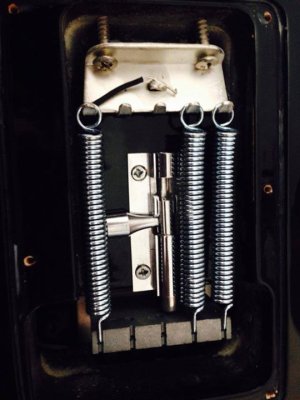
That's backwards, as far as a typical Strat trem works. The steel block would move away from the pin as you press down on the trem bar, not into, or towards it. This looks like a Floyd Rose mod to make it so you can only bend the the tremolo forward, and I'm guessing you have to re-tune every time latch or unlatch the pin.
this is how to block your tremolo for cheap
View attachment 57576
That's backwards, as far as a typical Strat trem works. The steel block would move away from the pin as you press down on the trem bar, not into, or towards it. This looks like a Floyd Rose mod to make it so you can only bend the the tremolo forward, and I'm guessing you have to re-tune every time latch or unlatch the pin.
Re: Tremelo Question?
Hi,
The issue and question of the OP is how to block, so the picture he shows, if the springs are tight enough, is in fact a stuck in place or non-moving (albeit unconventional) non-floating (or by definition, a "blocked" vibrato), even if from a different side. Don't move=blocked. Again, the screws and springs must be very tight, but that should not be a deal breaker in what the OP is asking for. If he must struggle to make it move down, it is essentially blocked.
SJ
Hi,
The issue and question of the OP is how to block, so the picture he shows, if the springs are tight enough, is in fact a stuck in place or non-moving (albeit unconventional) non-floating (or by definition, a "blocked" vibrato), even if from a different side. Don't move=blocked. Again, the screws and springs must be very tight, but that should not be a deal breaker in what the OP is asking for. If he must struggle to make it move down, it is essentially blocked.
SJ
Re: Tremelo Question?
problem might by with exotically heavy string gauges, baritone gauges 13++. In my strat with 9's now i have 2 springs, 1 week ago with beefy slinky's 11-54 i had to add all springs, what if i fitted some 13+ gauges? I have the impression that the trem's block should be blocked. Springs alone might not be enough.
Hi,
The issue and question of the OP is how to block, so the picture he shows, if the springs are tight enough, is in fact a stuck in place or non-moving (albeit unconventional) non-floating (or by definition, a "blocked" vibrato), even if from a different side. Don't move=blocked. Again, the screws and springs must be very tight, but that should not be a deal breaker in what the OP is asking for. If he must struggle to make it move down, it is essentially blocked.
SJ
problem might by with exotically heavy string gauges, baritone gauges 13++. In my strat with 9's now i have 2 springs, 1 week ago with beefy slinky's 11-54 i had to add all springs, what if i fitted some 13+ gauges? I have the impression that the trem's block should be blocked. Springs alone might not be enough.

ErikH
Well-known member
Re: Tremelo Question?
The most I've ever done to deck and block a Strat trem is to put in 4-5 springs and tighten the claw so it doesn't raise up without some effort. Putting a small block of wood between the block and back of the cavity is extra assurance it won't go anywhere.
The most I've ever done to deck and block a Strat trem is to put in 4-5 springs and tighten the claw so it doesn't raise up without some effort. Putting a small block of wood between the block and back of the cavity is extra assurance it won't go anywhere.
Re: Tremelo Question?
In Greekdude's scenario, he has a point. A block of wood in the backside too would make sure nothing goes anywhere ever, even after a nuclear blast, Keef couldn't bend those strings even with all his cockroach friends that survived with him.
13's are pretty high for a top gauge, but hey, I started with Gibson Sonomatic strings on my first guitar. For all I remember, they could have had a wound G!
I just couldn't let that door lock picture go without at least a little praise for originality! EDX was probably kidding, for all I know. OP, I think you got it all covered.
SJ
In Greekdude's scenario, he has a point. A block of wood in the backside too would make sure nothing goes anywhere ever, even after a nuclear blast, Keef couldn't bend those strings even with all his cockroach friends that survived with him.
13's are pretty high for a top gauge, but hey, I started with Gibson Sonomatic strings on my first guitar. For all I remember, they could have had a wound G!
I just couldn't let that door lock picture go without at least a little praise for originality! EDX was probably kidding, for all I know. OP, I think you got it all covered.
SJ
LazyLightning
New member
Re: Tremelo Question?
Since string gauge has been brought up I should clarify I currently and typically use 9's.
Since string gauge has been brought up I should clarify I currently and typically use 9's.

octavedoctor
New member
Re: Tremelo Question?
That's true of pretty much most stuff you see advertised. Lemon oil smells nice but baby oil does the job just as well, possibly better. Useful as a general purpose lubricant for trem pivots, tuners etc and won't give you cancer. I always worry when something they are expecting you to our on your fingerboard has a warning label saying "contains petroleum distillate; avoid contact with skin and eyes"
Big Bends Nut Sauce? I just use some dry soap. Or candle wax.
So a trem block does nothing to help tone as I have seen advertized in a few places? Is it just a gimmick to try and get new players to buy needless items?
That's true of pretty much most stuff you see advertised. Lemon oil smells nice but baby oil does the job just as well, possibly better. Useful as a general purpose lubricant for trem pivots, tuners etc and won't give you cancer. I always worry when something they are expecting you to our on your fingerboard has a warning label saying "contains petroleum distillate; avoid contact with skin and eyes"
Big Bends Nut Sauce? I just use some dry soap. Or candle wax.
Re: Tremelo Question?
Dear octavedoctor,
While I agree totally with your nut sauce opinion, I must 100% disagree with your statement as it applies to brass blocks. I replaced a sh*tty zinc block with the nicer steel (or whatever the metal is) block I got from my J.Beck guitar, and it instantly sounded deeper, much more musically rich in sound and noticeably more vibrant in feel from the touch. The brass I used on my J.Beck was even MORE musically rich and vibrant than the steel. I swear this to be true as I couldn't believe BECAUSE I doubt hype all the time. I took a lot of time going back and forth and all things wee the same. Respectively yours,
SJB
Dear octavedoctor,
While I agree totally with your nut sauce opinion, I must 100% disagree with your statement as it applies to brass blocks. I replaced a sh*tty zinc block with the nicer steel (or whatever the metal is) block I got from my J.Beck guitar, and it instantly sounded deeper, much more musically rich in sound and noticeably more vibrant in feel from the touch. The brass I used on my J.Beck was even MORE musically rich and vibrant than the steel. I swear this to be true as I couldn't believe BECAUSE I doubt hype all the time. I took a lot of time going back and forth and all things wee the same. Respectively yours,
SJB
octavedoctor
New member
Re: Tremelo Question?
So do I. Or would, if I'd said anything about brass blocks. That's because I don't regard this as a "gimmick".
It's sometimes hard to tell what is a gimmick and what is a legitimate improvement, but generally speaking if something is packaged, overpriced and offers a result that is more easily arrived a through simpler, cheaper and unbranded methods (which have often been around decades or centuries before the gimmick was packaged and marketed), then to me it's a gimmick.
Dry soap is a traditional method of lubricating saws when cutting wood. I just repurpose it. There are very sound technical reasons why a brass or steel block is going to perform better than a light alloy one. Sympathetic resonance damping is one, energy restitution is another.
See, not a gimmick; just sound science and engineering.
Don't get me started on digital tuners though...
Dear octavedoctor,
While I agree totally with your nut sauce opinion, I must 100% disagree with your statement as it applies to brass blocks.
So do I. Or would, if I'd said anything about brass blocks. That's because I don't regard this as a "gimmick".
It's sometimes hard to tell what is a gimmick and what is a legitimate improvement, but generally speaking if something is packaged, overpriced and offers a result that is more easily arrived a through simpler, cheaper and unbranded methods (which have often been around decades or centuries before the gimmick was packaged and marketed), then to me it's a gimmick.
Dry soap is a traditional method of lubricating saws when cutting wood. I just repurpose it. There are very sound technical reasons why a brass or steel block is going to perform better than a light alloy one. Sympathetic resonance damping is one, energy restitution is another.
See, not a gimmick; just sound science and engineering.
Don't get me started on digital tuners though...
Similar threads

- Replies
- 3
- Views
- 375

- Replies
- 51
- Views
- 1K


