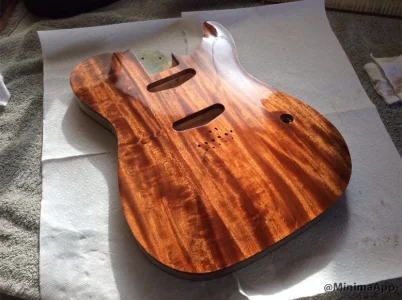
Tru Oil finish?

Chistopher

malapterurus electricus tonewood instigator
I'm looking at applying a tru oil finish on my primavera tele body. What is the strategy here?

Light coats with wet fine grit sanding in between?
 
I usually apply 3 coats using my fingers (no lint), let them cure overnight, lightly sand and apply 3 more coats until level. TruOil can be applied thickly enough to buff out to a shiny finish. (not mine - but a colleague).
 

Attachments

  • TruOil Tele.webp
    TruOil Tele.webp
    95.6 KB · Views: 4
The wood I'm using is very closed grain, how big of a concern does grain filling tend to be with tru oil?
 
If you want a smooth finish - fill the grain using your choice of materials and methods. Alder, maple, and the like require no grain fill. Ash, mahogany, etc. would require it for a smooth finish.
 
Hmm... any attempts with a wiping varnish? I forgot I have some on hand and may try it on some scrap wood
 
TruOil or any petro based finish is not the best thing to apply by hand, health wise fwiw

be careful with any rags etc used with it, they can catch fire quite easily, Soak them in soapy water when you are done and get them out of the house.

I have used wiping polys but never a varnish with very good results. Take your time and practice on something to see what you like best.
 
Essentially, TruOil is a wiping varnish.

And the material safety data sheet on TruOil mentions NO health hazards.
 
I've had good luck with tru oil applying two thin coats, waiting a day, lightly sanding with fine grit (800 I think?) and then repeating several times. I didn't bother with wet sanding and all was good. It comes out looking pretty nice and glossy. I always grain fill before finishing if I want a smooth finish depending on the number of coats you do and the tightness of the wood grain it may or may not matter, but why risk it?
 
You can add about 30% poly to TruOil to get a more durable finish. Apply the same as pure TruOil.

I usually wipe on 3-6 coats then wet sand with 600-800 grit using the TruOil instead of water. This helps to fill pores. Then continue as many coats as you desire to get the finish you want.
 
Essentially, TruOil is a wiping varnish.

And the material safety data sheet on TruOil mentions NO health hazards.

I thought Truoil was petro based, it is not, my bad. It is linseed oil based. Not a true varnish then though
 
Last edited:
Correct, Truoil is not a varnish, but the thinner portion of it is petroleum distillates (paint thinner essentially). Like I said earlier, you can add some polyurethane to it to make a wiping varnish. It actually works pretty good, I learned about this from Chris of Highline Guitars.
 
I'm going to experiment with the truoil coat on my scrap wood, but I was wondering how many coats until it doesn't make the wood darker any more? Should really just be the first coat right?
 
The first coat will make the piece of wood you're working on a little more yellow and show grain a bit better. After that, each successive coat maybe adds a tiny bit more yellow. I think it's total thickness though that determines final colour. Multiple light coats won't be different than a couple very thick coats.
 
My current stain looks perfect before it dries. Once it dries it looks too light. Would it be accurate to say that the TruOil on top of it will make it look similar to how it does when wet?

I can take some pictures when I get back home from work to better explain
 
Most excellent. I see examples on harderwoods where it does almost nothing. But on pine for example, completely changes the color
 
The darkest wood I've applied it to is walnut - there was a small darkening (it went from being light brown to medium brown maybe?), not huge by any means. Unfinished pine or maple you're going to see the most darkening simply because those are light coloured woods to begin with. I bet you wouldn't see any change with rosewood.
 
Back
Top