Tuning stability : nut, trees, saddles and nut files.

On a regular non locking trem. I watched years ago a luthier teach that you bend all the strings for a return point.
Assuming the nut is cut correctly. You would strat by stretching in your strings real good. Then at each saddle just ahead of were the string exits push the string down good a couple tines to sharpen that bend. Then push down real good on both sides of the nut real good. Then were the strings exit the tuner capstan bend the string sideways to sharpen the exit bend were tge string comes off the capstan. Do all strings.
This creates a return point for each string to return to. After whammy diving etc if the guitar goes out a little just pull up the bar it goes right back in.
The luthier was doing shit with that bar that looked like one of Blackmores temper tantrums...then hed pull the bar up and nice in tune. Ive tried it for what little trem I use and it worked.
I know what you talking. Actually, I started doing this recently, having learned it from a luthier. The first time I did this was on my bass. It turned out that after putting new strings on, my action was higher. The new string was pushed up through the nut. I simply pressed it in that spot and it bent into the correct position.
And Blackmore also stayed in Strat tuning. Apparently, there are many subtleties worth paying attention to, and you can stay in tune. I've never liked the sound of Floyd Rose/Edge guitars. There are guys who think it sounds great, but I always preferred my hardtail or vintage tremolo.
 
The best tuning stability is with a double locking trem system

Undoubtedly, but , for example, I don't like double locking for several reasons:
1. You need tools for changing strings, not for me, I want to be free to do it on the fly without thinking 'did I took the Allen key??' Or loosing 15 minutes in finding it in the guitar case or in a pocket
2. I often detune the E, it's a mess unless you have that evh tool but it doesn't seems it always work perfectly
3. The bridge block is always much lighter than standard vintage fender type, I clearly hear a difference in terms of sustain and tone, is it psychoacoustics? Maybe, but I don't think so
4. The fretboard must have exactly the same radius of the bridge, I don't know if I'm just unlucky but I've never had a guitar with a Floyd type perfectly matched, and I had several
5. The detuning of the double locks I had was always too much aggressive and deep even with a good setup, it's very difficult to obtain the same smoothness of a well setup fender type (and jazzmaster level is simply impossible to obtain)
 
You use shims under the saddles to set the radius
Yeah, but the nut also has a radius, and the locking nut is non-adjustable per string.

As far as blocks are concerned, they certainly make an audible different by material. By size, I haven't tested, but I assume yes as well.
 
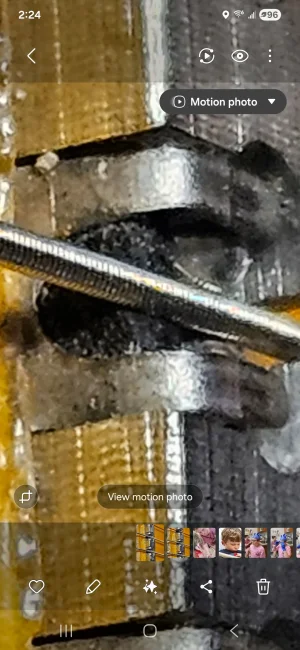
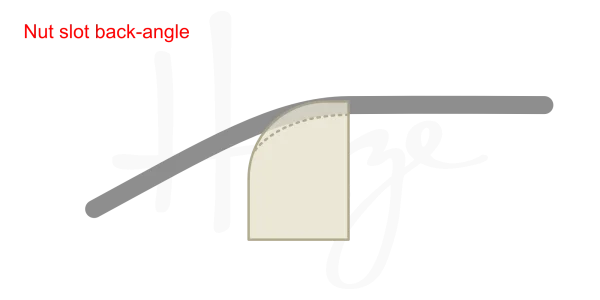
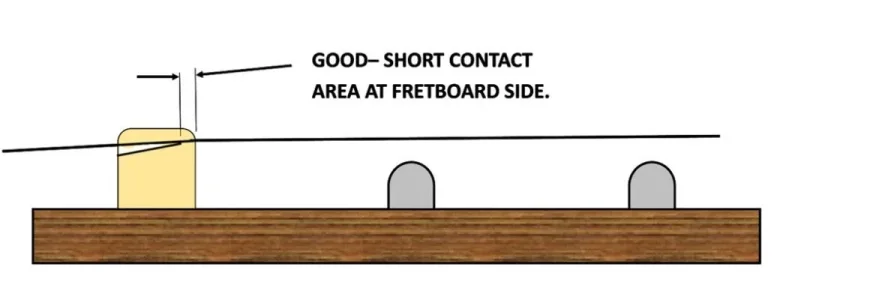
I have another question. How should the nut groove be cut properly? One school of thought says to follow the string angle, ensuring full contact with the nut. The other school of thought says the string should be in contact with the nut from the very beginning. According to visualizations, this is sometimes 1/3 of the thickness. Chat GPT even tells me the contact should be 0.5mm. In that case, why do I need a 5mm thick nut on an Ibanez, lol?
 
Undoubtedly, but , for example, I don't like double locking for several reasons:
1. You need tools for changing strings, not for me, I want to be free to do it on the fly without thinking 'did I took the Allen key??' Or loosing 15 minutes in finding it in the guitar case or in a pocket
2. I often detune the E, it's a mess unless you have that evh tool but it doesn't seems it always work perfectly
3. The bridge block is always much lighter than standard vintage fender type, I clearly hear a difference in terms of sustain and tone, is it psychoacoustics? Maybe, but I don't think so
4. The fretboard must have exactly the same radius of the bridge, I don't know if I'm just unlucky but I've never had a guitar with a Floyd type perfectly matched, and I had several
5. The detuning of the double locks I had was always too much aggressive and deep even with a good setup, it's very difficult to obtain the same smoothness of a well setup fender type (and jazzmaster level is simply impossible to obtain)

Ah, I get you. Yeah, double locking is not for everything. It's super annoying if you want to play in a different tuning.

There are a few ways to deal with the sensitivity. With heavy strings and five springs in the back I've been able to get setups where the whammy bar requires a decent amount of force to deflect so it becomes a lot easier to do subtle expressive stuff.

I have two floyd'ed guitar setup with three low output single coils, and am quite happy with the tone and sustain of both . . . although YMMV on that one.
 
Hello - Are you trying to solve an issue on a guitar you have now, or looking for information and recommendations to build a new one?

There are many possible answers and very few universally agreed upon.

In the last question. I didn't understand the two schools of thought. What does 1/3 thickness refer to? If you mean the slot depths, general rule of thumb is half of the string should sit in the nut for wound strings and full for plain strings. Deeper on those so aggressive bends don't pop them out of the slot.

I'll take this opportunity to say AI's are unreliable on these topics. All they do is summarize what they find on the internet, and the majority of whats out there on these topics is hit and miss quality not by pros.
 
Cześć - Czy próbujesz rozwiązać jakiś problem z gitarą, którą posiadasz, czy może szukasz informacji i zaleceń dotyczących zbudowania nowej?

Istnieje wiele możliwych odpowiedzi, ale tylko nieliczne z nich cieszą się powszechną akceptacją.

W ostatnim pytaniu. Nie zrozumiałem dwóch szkół myślenia. Co oznacza 1/3 grubości? Jeśli masz na myśli głębokość szczeliny, to generalna zasada jest taka, że połowa struny powinna być w siodełku w przypadku strun zwijanych, a cała w przypadku strun zwykłych. Głębiej w przypadku tych, które są tak agresywne, nie wyskakują ze szczeliny.

Skorzystam z okazji i powiem, że sztuczna inteligencja jest w tych kwestiach zawodna. Po prostu podsumowuje to, co znajdzie w internecie, a większość dostępnych informacji na te tematy to chybione, nie rzetelnie opracowane treści.
I'm wondering how much of the string should be in contact with the nut groove. Some people believe it's the entire surface, others say it's a small surface. I think Stew Mac also did this: he first cut the grooves at a steep angle and then adjusted the height with a smaller angle. In fact, maybe 1/3 of the groove was in contact with the string. This seems logical in terms of reducing friction. Many people praise the zero-fret design because it has little contact with the string, so there's less friction.
 

Attachments

  • siodełko 4.webp
    siodełko 4.webp
    24.8 KB · Views: 1
  • siodełko.webp
    siodełko.webp
    18 KB · Views: 1
Last edited:
Thanks now I understand..

My question is still what guitar are you doing this on? Or are you trying to learn in general?

Both of those videos are big honking acoustics with 3/16" (4.8mm) or wider nuts and deep angled headstocks. Staying in tune with string bends and tremolo dives isn't a factor on those. Some fine setup principles apply to all guitars, some don't.

That amount of convex curve is extreme to me. I go for maximum contact. Cutting a nut by hand will naturally cause a very slight curve which a metal string will confirm too. On a Fender style 3mm or 1/8 narrow nut, there is no need. I'm sure other builders and techs here can give their thoughts too.

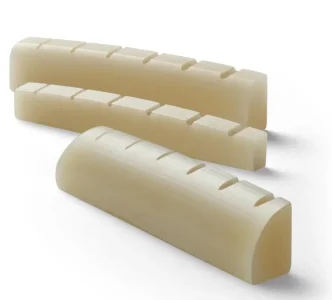
The TusqXL or Graphite nuts don't have curved slots. Amusingly, despite those videos, Stew-Mac sells pre-slotted bone nuts which don't have curved slots.

nut-slots.webp


You can see how reading the internet you will find conflicting opinions on everything. Another way is find a guitar that stays in tune well and note is features. I'll use PRS as an example. Locking tuners, straight string pull, medium headstock angle, low friction nut, and most important knife edge pivot points AND screws.

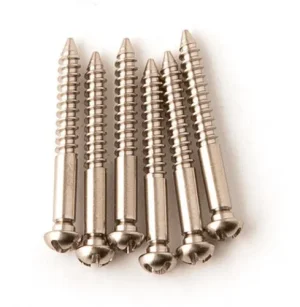
The last point is most important to me. I have a guitar I've swapped tremolos on several times. Now it has a Goeldo PRS clone bridge which didn't come with knife edge screws, I could see the bridge wiggling up and down on the screw shafts not returning to the same place from minor string bends. I installed the Mann Made PRS replacement screws and it solved that immediately.

screws-edge.webp
 
Back
Top