S
Solarflares
Guest
Bugger that.What if you wanted to see what a Rat sounded like with extra gain and a Big Muff tone control?
That would be like using an information Highway to send pics of your last meal.

Bugger that.What if you wanted to see what a Rat sounded like with extra gain and a Big Muff tone control?
It's actually very simple. It's kind of like how you can put a picture on a screen using a bunch of small RGB LEDs, except you are making a circuit using a bunch of small units of varying inductance, resistance, and capacitance. There's more to it than that, but it's not exactly reinventing the wheelBugger that.
That would be like using an information Highway to send pics of your last meal.
No. I know exactly what you’re talking about.It's actually very simple. It's kind of like how you can put a picture on a screen using a bunch of small RGB LEDs, except you are making a circuit using a bunch of small units of varying inductance, resistance, and capacitance. There's more to it than that, but it's not exactly reinventing the wheel
That is what a lot of companies are doing now. I know for a fact the QuadCortex does that. It doesn't exactly work with non-linear systems though. You couldn't model a Fuzz Factory through your method, you could with mine however.No. I know exactly what you’re talking about.
I can only bounce back and point out that another way is to intelligently predict the effect a virtual circuit would have on a complex waveform, and redraw it.
Define non-linear systems.That is what a lot of companies are doing now. I know for a fact the QuadCortex does that. It doesn't exactly work with non-linear systems though. You couldn't model a Fuzz Factory through your method, you could with mine however.

Nonlinear means you can't apply a constant transformation to a signal. More generally, changes in input don't produce proportional, and easily predictable changes in output.Define non-linear systems.
You are not being clear.
The end result is an altered waveform, whatever method.

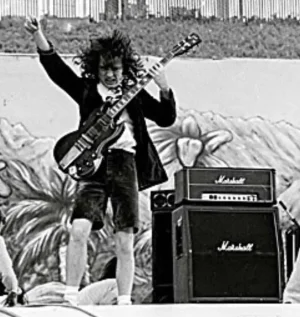
i love ac/dc and think the brothers both get great tone, but theres nothing ground breaking about an sg into a cranked marshall played with attitude, even if it kicks ass. now the shorts... that might be a firstOne could argue this.
View attachment 6326769
Define non-linear systems.
You are not being clear.
The end result is an altered waveform, whatever method.
I can see that FPGA has relevance in a hybrid system, if we consider it to be an analogue substitute.Also FPGA is real-time. Not even the best algorithm can match that

Yeah, I could also see them working in parallel. FPGA's weakness is that it models the hardware but doesn't "know" the sound, and Quad Cortex has the opposite problem.I can see that FPGA has relevance in a hybrid system, if we consider it to be an analogue substitute.
Which leaves me thinking that the next obvious move would be quantum technology with an FPGA buffer at each end.
Now you’re getting there.Yeah, I could also see them working in parallel. FPGA's weakness is that it models the hardware but doesn't "know" the sound, and Quad Cortex has the opposite problem.

Also FPGA is real-time. Not even the best algorithm can match that
i have a nice stable of tube amps, doubt ill need anything else in the foreseeable futurethe more I read the more I love my small tube old Princeton
All I want Jeremy, is for my Mullard 161’s, and Seymour Duncan Convertible 100 to keep going until my final breath.i have a nice stable of tube amps, doubt ill need anything else in the foreseeable future
Don't underestimate how much compute power modern CPUs have.

How would this make any sense at all? All you can do with FPGAs is look up Boolean logic tables; guitar signals aren't discretes, they're not gates and muxes, so this doesn't even begin to work unless you think you have an FPGA with a LUT large enough to do an entire analog-to-digital conversion, an entire ampsim's worth of programming logic, and a digital-to-analog conversion.I think the future of amplifier technology is FPGAs


