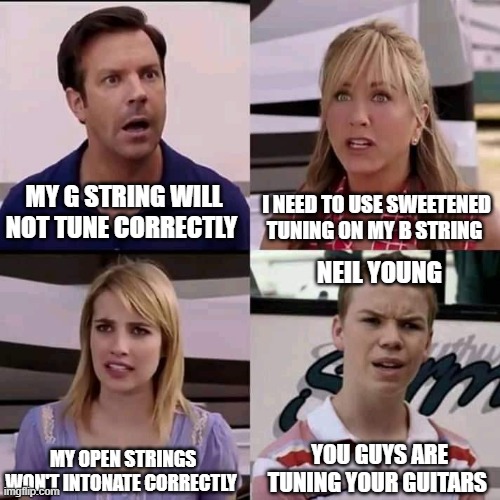
Why do open G strings sound out of tune

I suppose that the compensated nut is a thing. But then, you'd also need that crazy fretwork. The cost/benefits aren't worth it to me.

Sent from my SM-A115A using Tapatalk

I’ve tried to understand the compensated nut. Again it comes down to the things I mentioned above, is it attempting to solve the differences due to string gauge and tuning? Is it trying to solve equal temperament vs just intonation? None of the websites explicitly say what they are trying to do, so I’m dubious.
 
Just use a zero fret if you're concerned about intonation. It also makes it so the open strings don't sound worse than fretted notes.
 
It's not a rabbit hole that I'm going down.

Sent from my SM-A115A using Tapatalk

The engineer side of me is extremely interested in it, but the practical dad/guitar player side says any time with a guitar should be making music at this point in my life. So other than a few late night reads it all lives in my mind only and my guitars are all very straightforward.
 
I experienced the 'off G string' on my guitars in different grades - from not that bad to much worse. I sit on the fence to buy a earvana nut for one guitar, which seem to have it worse than the others.
 
  • Like
Reactions: '59
I’ve tried to understand the compensated nut. Again it comes down to the things I mentioned above, is it attempting to solve the differences due to string gauge and tuning? Is it trying to solve equal temperament vs just intonation? None of the websites explicitly say what they are trying to do, so I’m dubious.

Why have an adjustable bridge (or should I say, a bridge with adjustable saddles)? It's used to help intonate the guitar, right? So an open note will sound on pitch with its octave. But physics will show you that a bridge's intonation affects the strings mainly above the 12th fret and to some minor extent below the 12th fret. Compensation in the nut affects mainly the strings played below the 12 fret. With a properly made compensated nut you have better tuning below and above the 12th fret. The nut and the saddles work in conjunction with each other.

This doesn't give you a perfect sounding instrument, just a better approximation than without it. But I will not make a guitar (or even own a "store-bought guitar") without a compensated nut. The "wavy" frets is really the best solution. But before you go out and get a guitar with those frets can you imagine what a fret leveling would cost? And when you need to replace the worn frets...? How do they even cut those fret slots?

Earvana's compensated nuts are ok, but they're not great. I even have a few guitars with their nuts because I was too lazy at the time to make them (it takes me about 3 hours to make a good bone compensated nut). But I got so frustrated with their (Earvana's) imperfections that I now just routinely spend the extra time and make compensated nuts for every guitar...the extra cost is built into the price of the guitars I make and I won't make one without it.
 
I appreciate the very good comments/explanations of why guitars are imperfect and especially why the "G" string is such a big culprit. Your explanations were right on.
 
6z820r.jpg
.
 
After further analysis (ie fiddling around with half a dozen different guitars at the guitar store) I've found the thing I'm attempting to describe seems to be that the open G string just has a ton of overtones, which varies from guitar to guitar.

If I mute the string even slightly, the "tuning" problem goes away. All of my guitars have the overtones a few cents sharp, but a few of the ones I tried had the overtones a few cents flat. Time to figure out what that's all about...
 
After further analysis (ie fiddling around with half a dozen different guitars at the guitar store) I've found the thing I'm attempting to describe seems to be that the open G string just has a ton of overtones, which varies from guitar to guitar.

If I mute the string even slightly, the "tuning" problem goes away. All of my guitars have the overtones a few cents sharp, but a few of the ones I tried had the overtones a few cents flat. Time to figure out what that's all about...

Are the guitars you're trying 3+3 headstocks? The G string has the longest section above the nut that's a plain string (plain strings seem to have more overtones usually), could be contributing to what you hear.
 
Wow. All this talk about the need for compensated nuts and inherently bad tone for a G string. Makes me wonder how did anyone even get away with making a recording of a plain old guitar in the 70s and 80s or even before that.

I also believe in a wound G for a better fundamental and stable intonation. But I mean if you want to bend fretted notes it's a lot harder.
 
Last edited:
I say compensated nut. Unless you like those wolf tones, then just a new nut with a shallower groove.
 
Wow. All this talk about the need for compensated nuts and inherently bad tone for a G string. Makes me wonder how did anyone even get away with making a recording of a plain old guitar in the 70s and 80s or even before that.

This concern is why no popular guitar based music was made in the 70s and 80s. :P
 
Wow. All this talk about the need for compensated nuts and inherently bad tone for a G string. Makes me wonder how did anyone even get away with making a recording of a plain old guitar in the 70s and 80s or even before that.

I also believe in a wound G for a better fundamental and stable intonation. But I mean if you want to bend fretted notes it's a lot harder.

Even with an acoustic, the sympathetic vibration goes away when you plug it in. Every knows the reason cranked amps were a big thing back then was so the guitarist couldn't hear scary open G noises.
 
Back
Top