
You are using an out of date browser. It may not display this or other websites correctly.
You should upgrade or use an alternative browser.
You should upgrade or use an alternative browser.
Another Reason Compensated Claw is a MYTH
- Thread starter SJ318
- Start date

ginormous
Understatmentologist
Re: Another Reason Compensated Claw is a MYTH
David Collins, your point is well-stated. It would seem that there are so many variables, that any one particular factor couldn't be that overwhelmingly influential.
I'm trying to understand, however, whether there is any overall standard to tremolo performance, as opposed to the individual factors you indicate.
David Collins, your point is well-stated. It would seem that there are so many variables, that any one particular factor couldn't be that overwhelmingly influential.
I'm trying to understand, however, whether there is any overall standard to tremolo performance, as opposed to the individual factors you indicate.

Agileguy_101
Master of his Domain
Re: Another Reason Compensated Claw is a MYTH
I just don't see how taking an extra 5-10 minutes during setup to angle the claw (should that be your preference) is not preferable to having the $60 that the claw costs in your pocket.
Well again, nobody is saying this is the only way to set up a floating tremolo...just that this method works.
If another method works for you, than use it.
This one works the best and sets up the most easily for me.
I just don't see how taking an extra 5-10 minutes during setup to angle the claw (should that be your preference) is not preferable to having the $60 that the claw costs in your pocket.
Last edited:
David Collins
New member
Re: Another Reason Compensated Claw is a MYTH
Thanks, and no, there really isn't any generalized standard. I'm not aware of any tremolos designed for hard stops tunable for individual strings (like a pedal steel or B-bender). Different trem designs deliver varying levels of overall offsets, but these are not typically intentionally tuned for individual string stops. I've seen some Bigsby-style rollers with different diameters for each string to try and work closer to this goal, but it's still imprecise. Basically, all tremolos I know of are designed for dynamic vibrato, not set pitch changes.
You could make a system to achieve this, but it would have to be much more complicated either with individually adjustable spring loaded string stops, or a string bar separate from the saddles with individually adjustable cams or stops. It would have to be adjusted differently of course depending on the individual setup, goals, and string gauge arrangement.
What determines the pitch shift for each string is essentially a combination of the string gauge, it's modulus of elasticity, and the distance it is stretched. If a string core is larger diameter, or the saddle is adjusted further out from the bridge fulcrum (higher height or flatter intonation adjustment), then it will sharpen more than a thinner string or a saddle point closer to the fulcrum. Adjusting the trem claw asymmetrically of course affects none of these variable so long as the fulcrum of the bridge is still touching the screws or posts, so it contributes nothing at all toward any change.
It would be an interesting product to design though, an individually tunable offset tremolo. I can see a few ways it could be done, but it would be much simpler to do with a separate bridge/tailpiece than a single piece Fender/Floyd style tremolo.
David Collins, your point is well-stated. It would seem that there are so many variables, that any one particular factor couldn't be that overwhelmingly influential.
I'm trying to understand, however, whether there is any overall standard to tremolo performance, as opposed to the individual factors you indicate.
Thanks, and no, there really isn't any generalized standard. I'm not aware of any tremolos designed for hard stops tunable for individual strings (like a pedal steel or B-bender). Different trem designs deliver varying levels of overall offsets, but these are not typically intentionally tuned for individual string stops. I've seen some Bigsby-style rollers with different diameters for each string to try and work closer to this goal, but it's still imprecise. Basically, all tremolos I know of are designed for dynamic vibrato, not set pitch changes.
You could make a system to achieve this, but it would have to be much more complicated either with individually adjustable spring loaded string stops, or a string bar separate from the saddles with individually adjustable cams or stops. It would have to be adjusted differently of course depending on the individual setup, goals, and string gauge arrangement.
What determines the pitch shift for each string is essentially a combination of the string gauge, it's modulus of elasticity, and the distance it is stretched. If a string core is larger diameter, or the saddle is adjusted further out from the bridge fulcrum (higher height or flatter intonation adjustment), then it will sharpen more than a thinner string or a saddle point closer to the fulcrum. Adjusting the trem claw asymmetrically of course affects none of these variable so long as the fulcrum of the bridge is still touching the screws or posts, so it contributes nothing at all toward any change.
It would be an interesting product to design though, an individually tunable offset tremolo. I can see a few ways it could be done, but it would be much simpler to do with a separate bridge/tailpiece than a single piece Fender/Floyd style tremolo.
Last edited:

Lewguitar
New member
Re: Another Reason Compensated Claw is a MYTH
Forget about the Claw. Just angle your existing claw. I don't use the brass Claw in any of my guitars.
I did try it and liked it and felt that the tone changed slightly with the brass claw. Perhaps the additional weight and/or mass gave it a slightly more solid tone.
Kind of like how a TonePros tailpiece on a Gibson (I know - we were talking about Fenders) changes the tone slightly and you might like it better and see it as being an improvement or you might like the original "vintage" tone of a lightweight aluminum tailpiece better.
If you like that change in tone that a brass Claw makes, then there's your reason to use it.
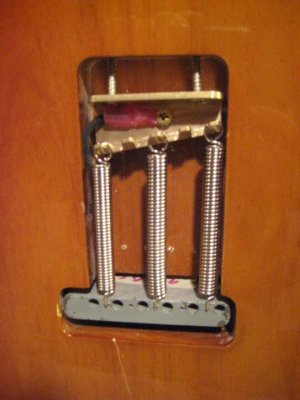
However, after comparing both, I decided to stick with vintage.
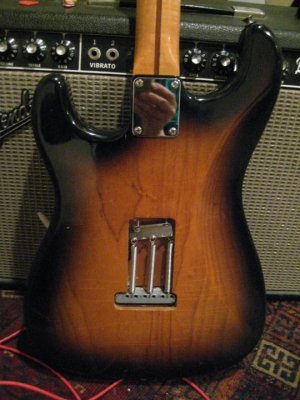
I just don't see how taking an extra 5-10 minutes during setup to angle the claw (should that be your preference) is not preferable to having the $60 that the claw costs in your pocket.
Forget about the Claw. Just angle your existing claw. I don't use the brass Claw in any of my guitars.
I did try it and liked it and felt that the tone changed slightly with the brass claw. Perhaps the additional weight and/or mass gave it a slightly more solid tone.
Kind of like how a TonePros tailpiece on a Gibson (I know - we were talking about Fenders) changes the tone slightly and you might like it better and see it as being an improvement or you might like the original "vintage" tone of a lightweight aluminum tailpiece better.
If you like that change in tone that a brass Claw makes, then there's your reason to use it.
However, after comparing both, I decided to stick with vintage.
Last edited:
David Collins
New member
Re: Another Reason Compensated Claw is a MYTH
That is simply one of the biggest pieces of snake oil BS I've ever seen. I guarantee that the only difference a brass claw like that could make would be whatever difference you believe it will make. 100% placebo, snake oil, nonsense. And as we've clearly and I would say irrefutably established, angling the existing trem claw is equally moot. If you want to do it and believe it makes a difference, that's up to you, but I assure you that in reality it has no direct effect compared to a straight claw adjusted to the same sum tension.
That is simply one of the biggest pieces of snake oil BS I've ever seen. I guarantee that the only difference a brass claw like that could make would be whatever difference you believe it will make. 100% placebo, snake oil, nonsense. And as we've clearly and I would say irrefutably established, angling the existing trem claw is equally moot. If you want to do it and believe it makes a difference, that's up to you, but I assure you that in reality it has no direct effect compared to a straight claw adjusted to the same sum tension.
Lewguitar
New member
Re: Another Reason Compensated Claw is a MYTH
There ya go. I was waiting for the mask to come off and for you to go on the attack.
That is simply one of the biggest pieces of snake oil BS I've ever seen. I guarantee that the only difference a brass claw like that could make would be whatever difference you believe it will make. 100% placebo, snake oil, nonsense. And as we've clearly and I would say irrefutably established, angling the existing trem claw is equally moot. If you want to do it and believe it makes a difference, that's up to you, but I assure you that in reality it has no direct effect compared to a straight claw adjusted to the same sum tension.
There ya go. I was waiting for the mask to come off and for you to go on the attack.
Last edited:

Kais
New member
Re: Another Reason Compensated Claw is a MYTH
Homer: $5 for bear patrol! That's the biggest tax hike in history!
Lisa: Actually that's the smallest tax hike in history...
Homer: Not a bear in sight. The Bear Patrol must be working like a charm.
Lisa: That’s specious reasoning, Dad.
Homer: Thank you, dear.
Lisa: By your logic I could claim that this rock keeps tigers away.
Homer: Oh, how does it work?
Lisa: It doesn’t work.
Homer: Uh-huh.
Lisa: It’s just a stupid rock.
Homer: Uh-huh.
Lisa: But I don’t see any tigers around, do you?
[Homer thinks of this, then pulls out some money]
Homer: Lisa, I want to buy your rock.
[Lisa refuses at first, then takes the exchange]
Homer: $5 for bear patrol! That's the biggest tax hike in history!
Lisa: Actually that's the smallest tax hike in history...
Lewguitar
New member
Re: Another Reason Compensated Claw is a MYTH
I've also been "assured" and "guaranteed" by scientifically minded folks that when the volume control of a guitar is turned all the way up that's there's no difference in tone between a volume and tone circuit with "modern wiring" as compared to "50's Mod" wiring.
But there is.
I've also been "assured" and "guaranteed" by scientifically minded folks that when the volume control of a guitar is turned all the way up that's there's no difference in tone between a volume and tone circuit with "modern wiring" as compared to "50's Mod" wiring.
But there is.

PFDarkside
of the Forum
Re: Another Reason Compensated Claw is a MYTH
Regardless, I think for my application in order to get the desired pitch rise I'll end up with one or more strings that will be far less playable in a traditional sense. I still may try one gauge lighter on the G to see what happens.
I'm not familiar with the specifics of it, but didn't the Steinberger TransTrem try to do something like this?David Collins said:What determines the pitch shift for each string is essentially a combination of the string gauge, it's modulus of elasticity, and the distance it is stretched. If a string core is larger diameter, or the saddle is adjusted further out from the bridge fulcrum (higher height or flatter intonation adjustment), then it will sharpen more than a thinner string or a saddle point closer to the fulcrum. Adjusting the trem claw asymmetrically of course affects none of these variable so long as the fulcrum of the bridge is still touching the screws or posts, so it contributes nothing at all toward any change.
It would be an interesting product to design though, an individually tunable offset tremolo. I can see a few ways it could be done, but it would be much simpler to do with a separate bridge/tailpiece than a single piece Fender/Floyd style tremolo.
Regardless, I think for my application in order to get the desired pitch rise I'll end up with one or more strings that will be far less playable in a traditional sense. I still may try one gauge lighter on the G to see what happens.
PFDarkside
of the Forum
Re: Another Reason Compensated Claw is a MYTH
Regardless, I think for my application in order to get the desired pitch rise I'll end up with one or more strings that will be far less playable in a traditional sense. I still may try one gauge lighter on the G to see what happens.
I'm not familiar with the specifics of it, but didn't the Steinberger TransTrem try to do something like this?David Collins said:What determines the pitch shift for each string is essentially a combination of the string gauge, it's modulus of elasticity, and the distance it is stretched. If a string core is larger diameter, or the saddle is adjusted further out from the bridge fulcrum (higher height or flatter intonation adjustment), then it will sharpen more than a thinner string or a saddle point closer to the fulcrum. Adjusting the trem claw asymmetrically of course affects none of these variable so long as the fulcrum of the bridge is still touching the screws or posts, so it contributes nothing at all toward any change.
It would be an interesting product to design though, an individually tunable offset tremolo. I can see a few ways it could be done, but it would be much simpler to do with a separate bridge/tailpiece than a single piece Fender/Floyd style tremolo.
Regardless, I think for my application in order to get the desired pitch rise I'll end up with one or more strings that will be far less playable in a traditional sense. I still may try one gauge lighter on the G to see what happens.
Lewguitar
New member
Re: Another Reason Compensated Claw is a MYTH
Try it. Please.
I'd like to know too.
The proof of the pudding is in the eating - not in staring at it and wondering if it'll taste good! :lmao:
I'm not familiar with the specifics of it, but didn't the Steinberger TransTrem try to do something like this?
Regardless, I think for my application in order to get the desired pitch rise I'll end up with one or more strings that will be far less playable in a traditional sense. I still may try one gauge lighter on the G to see what happens.
Try it. Please.
I'd like to know too.
The proof of the pudding is in the eating - not in staring at it and wondering if it'll taste good! :lmao:

thespricket
New member
Re: Another Reason Compensated Claw is a MYTH
I've found that angling the claw helps keep the trem stable while bending other strings. On many strats you simply cannot do double stop bends or unison bends because the string you're bending with pull the bridge to cause the string you're not bending to go out of tune. When you angle the claw you achieve equal string vs spring tension. Now I can float my bridge just enough to get some wobble out of chords but still keep it stable while bending other strings. One or two techs said it couldn't be done.
Guitar->pedals->amp
I've found that angling the claw helps keep the trem stable while bending other strings. On many strats you simply cannot do double stop bends or unison bends because the string you're bending with pull the bridge to cause the string you're not bending to go out of tune. When you angle the claw you achieve equal string vs spring tension. Now I can float my bridge just enough to get some wobble out of chords but still keep it stable while bending other strings. One or two techs said it couldn't be done.
Guitar->pedals->amp
Lewguitar
New member
Re: Another Reason Compensated Claw is a MYTH
I've found that to be true as well. My double stop bends and pedal steel licks stay in tune better with the angled claw. The tremolo doesn't seem to move forward and throw the strings I'm holding as pedal tones as flat. A little bit - but not as much as when I'd play those same licks on a Strat with a floating tremolo set up in the conventional way.
Thanks for mentioning that.
I've found that angling the claw helps keep the trem stable while bending other strings. On many strats you simply cannot do double stop bends or unison bends because the string you're bending with pull the bridge to cause the string you're not bending to go out of tune. When you angle the claw you achieve equal string vs spring tension. Now I can float my bridge just enough to get some wobble out of chords but still keep it stable while bending other strings. One or two techs said it couldn't be done.
I've found that to be true as well. My double stop bends and pedal steel licks stay in tune better with the angled claw. The tremolo doesn't seem to move forward and throw the strings I'm holding as pedal tones as flat. A little bit - but not as much as when I'd play those same licks on a Strat with a floating tremolo set up in the conventional way.
Thanks for mentioning that.
Last edited:

ratherdashing
Kablamminator
Re: Another Reason Compensated Claw is a MYTH
Is electricity real?
How do you know?
Have you personally undertaken experiments to prove or disprove the existence of electrons and electricity?
How can you believe electricity exists if you've never personally observed it?
Try it. Please.
I'd like to know too.
The proof of the pudding is in the eating - not in staring at it and wondering if it'll taste good! :lmao:
Is electricity real?
How do you know?
Have you personally undertaken experiments to prove or disprove the existence of electrons and electricity?
How can you believe electricity exists if you've never personally observed it?
Lewguitar
New member
Re: Another Reason Compensated Claw is a MYTH
That's the ticket. Try it and see what happens. I really would like to know what you find out.
I still may try one gauge lighter on the G to see what happens.
That's the ticket. Try it and see what happens. I really would like to know what you find out.
David Collins
New member
Re: Another Reason Compensated Claw is a MYTH
There's no arguing with someone who refuses to accept reality.
Fact: there is no effect on pitch deviations between strings related to spring claw angle, or lateral distribution of spring tension on the back of the tremolo block.
For those interested in reliable advice, this is as irrefutable as the earth is round. Of course there are those who refute that as well, and their position is as valid as those who insist the angling the spring claw affects pitch change differentials across the strings. If you choose to reject reality and substitute your own that's quite fine, but please don't offer such nonsense as advice to others, because it is categorically incorrect. And Lew, I guarantee you are also hearing only what you want to believe regarding the 50's wiring on 10. This is very revealing.
There's no arguing with someone who refuses to accept reality.
Fact: there is no effect on pitch deviations between strings related to spring claw angle, or lateral distribution of spring tension on the back of the tremolo block.
For those interested in reliable advice, this is as irrefutable as the earth is round. Of course there are those who refute that as well, and their position is as valid as those who insist the angling the spring claw affects pitch change differentials across the strings. If you choose to reject reality and substitute your own that's quite fine, but please don't offer such nonsense as advice to others, because it is categorically incorrect. And Lew, I guarantee you are also hearing only what you want to believe regarding the 50's wiring on 10. This is very revealing.
Re: Another Reason Compensated Claw is a MYTH
Gentlemen,
Obviously my trem has to float a certain amount to acheive an up pull of G to A#. When I get that the rest follows, probably because the G saddle is highest and the rest get lower fromB to E. So my intervals are always the same, G to A#, B to C#, E to F. Again, no matter how I have the block angled. As long as I set it up - the float- from G to A#,the rest follows. I bet if you raised your E saddle to match the hieght of your G saddle, your E string would go up a lot more than it would normally. No one has said this yet, but I am sure that is why it all works regardless of block or claw angle.
Set the G, the rest will follow, as the saddles are lower on the B and E , this is another piece of the puzzle that uses physics to prove this point. And no, I am too tired to raise my E saddle right now, but I bet you as fellow guitarists, this would change the outcome. I just betcha!!!
Steve Buffington
Gentlemen,
Obviously my trem has to float a certain amount to acheive an up pull of G to A#. When I get that the rest follows, probably because the G saddle is highest and the rest get lower fromB to E. So my intervals are always the same, G to A#, B to C#, E to F. Again, no matter how I have the block angled. As long as I set it up - the float- from G to A#,the rest follows. I bet if you raised your E saddle to match the hieght of your G saddle, your E string would go up a lot more than it would normally. No one has said this yet, but I am sure that is why it all works regardless of block or claw angle.
Set the G, the rest will follow, as the saddles are lower on the B and E , this is another piece of the puzzle that uses physics to prove this point. And no, I am too tired to raise my E saddle right now, but I bet you as fellow guitarists, this would change the outcome. I just betcha!!!
Steve Buffington
Lewguitar
New member
Re: Another Reason Compensated Claw is a MYTH
Guess those techs were wrong, eh?
There's some real advantages to setting up a floating tremolo with the springs set for greater tension on the bass side - either by angling the claw or using more springs on the bass side.
That's why Eric Johnson does it, Carl Verheyan does it, I do it and you do it.
If a guy can't hear them, or doesn't have the playing style to put those advantages to use, I guess that's just the way it is. Tough.
I've found that angling the claw helps keep the trem stable while bending other strings. On many strats you simply cannot do double stop bends or unison bends because the string you're bending with pull the bridge to cause the string you're not bending to go out of tune. When you angle the claw you achieve equal string vs spring tension. Now I can float my bridge just enough to get some wobble out of chords but still keep it stable while bending other strings. One or two techs said it couldn't be done.
Guitar->pedals->amp
Guess those techs were wrong, eh?
There's some real advantages to setting up a floating tremolo with the springs set for greater tension on the bass side - either by angling the claw or using more springs on the bass side.
That's why Eric Johnson does it, Carl Verheyan does it, I do it and you do it.
If a guy can't hear them, or doesn't have the playing style to put those advantages to use, I guess that's just the way it is. Tough.
Last edited:
Similar threads

- Replies
- 56
- Views
- 2K


