Re: Can an Epi Les Paul Sound Like a Gibson?
For those that talk about poor fretwork and nuts on USA Gibson's, Gibson has Plek'd all of their USA guitars since 2012 or 2013. So, frets and nuts are cut perfectly and are perfectly level. Amazing technology.
The level is not the issue. Anyone can get frets level across the board. It's what you do after that that matters, and that's what Gibson skimps on. It's the crowns and the rough-cut beveled ends. The crowns are near nonexistent, and the beveled ends are not smoothed into the body of the fret. Their fret work and nut work is very coarse, to the level of seeming quite obviously incomplete.
The problem with a PLEK is not the PLEK itself. They are great tools when used properly. The problem is the habits in workmanship that they tend to breed. Many manufacturers tend to treat them as the only thing required for proper fret work, i.e. as an excuse to forego adequate human finishing of the frets. In fact, PLEKs just provide a good starting point for the fine finish work that must be done by hand.
With the nuts themselves, it's the often-excessive back angle and lack of fine finish detail that tend to be bad. PLEKs rough in the nut, but the nut still must be fine finished, cleaned up, and smoothed by hand.
Gibson is not the only perpetrator here. G&L's fretwork also went downhill after they started using a PLEK. I need to round the edges over on every new G&L I get nowadays. Then again, every other last thing on a G&L is pretty much perfect, from wood work to finish to hardware to electronics, and they are quite reasonably priced when weighed against the over all quality.
OTOH, my last couple of Fender AVs have had awesome fret work right outta the factory. This isn't always the case with Fender, but good on 'em for the last few I've got.
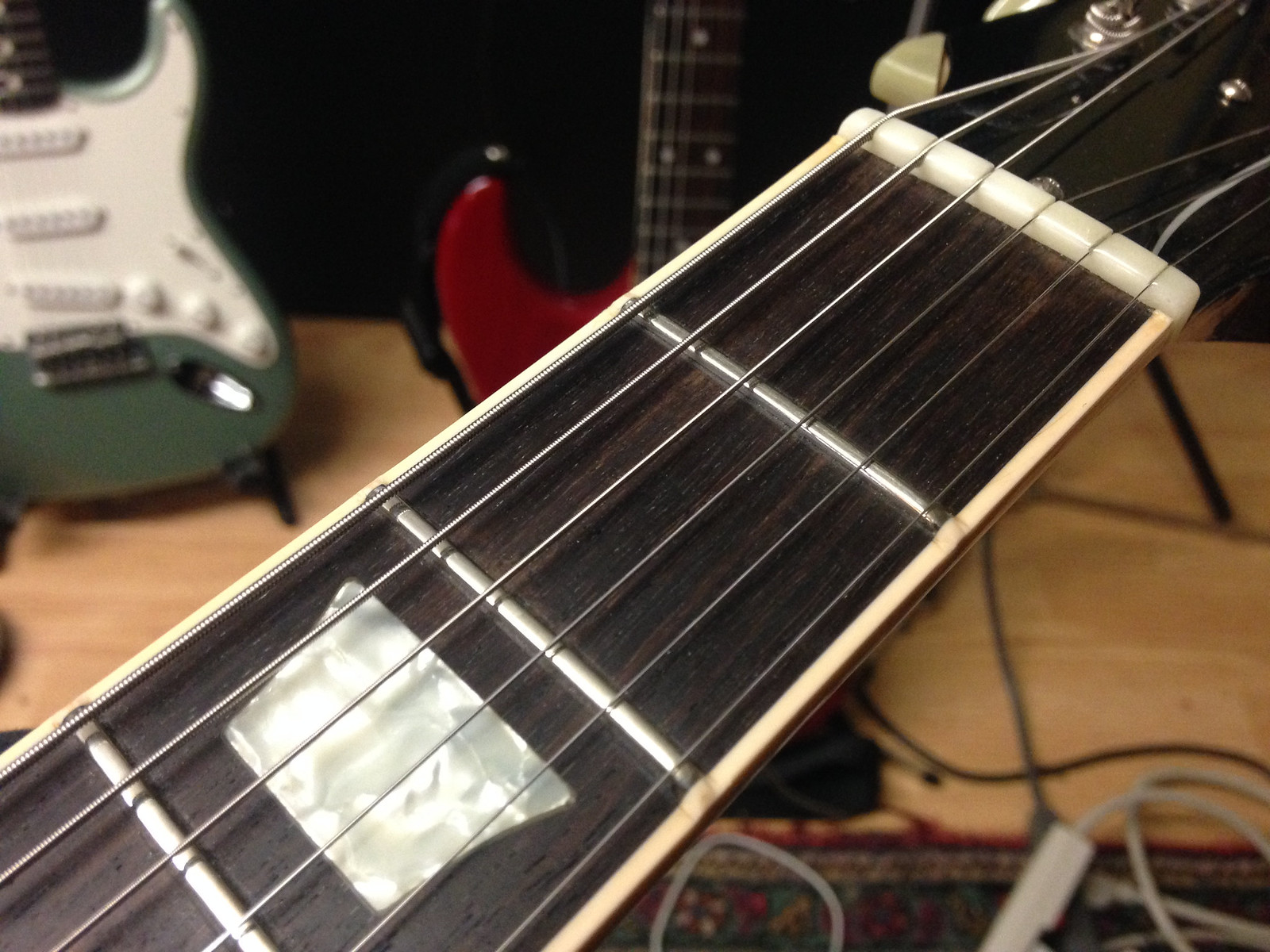
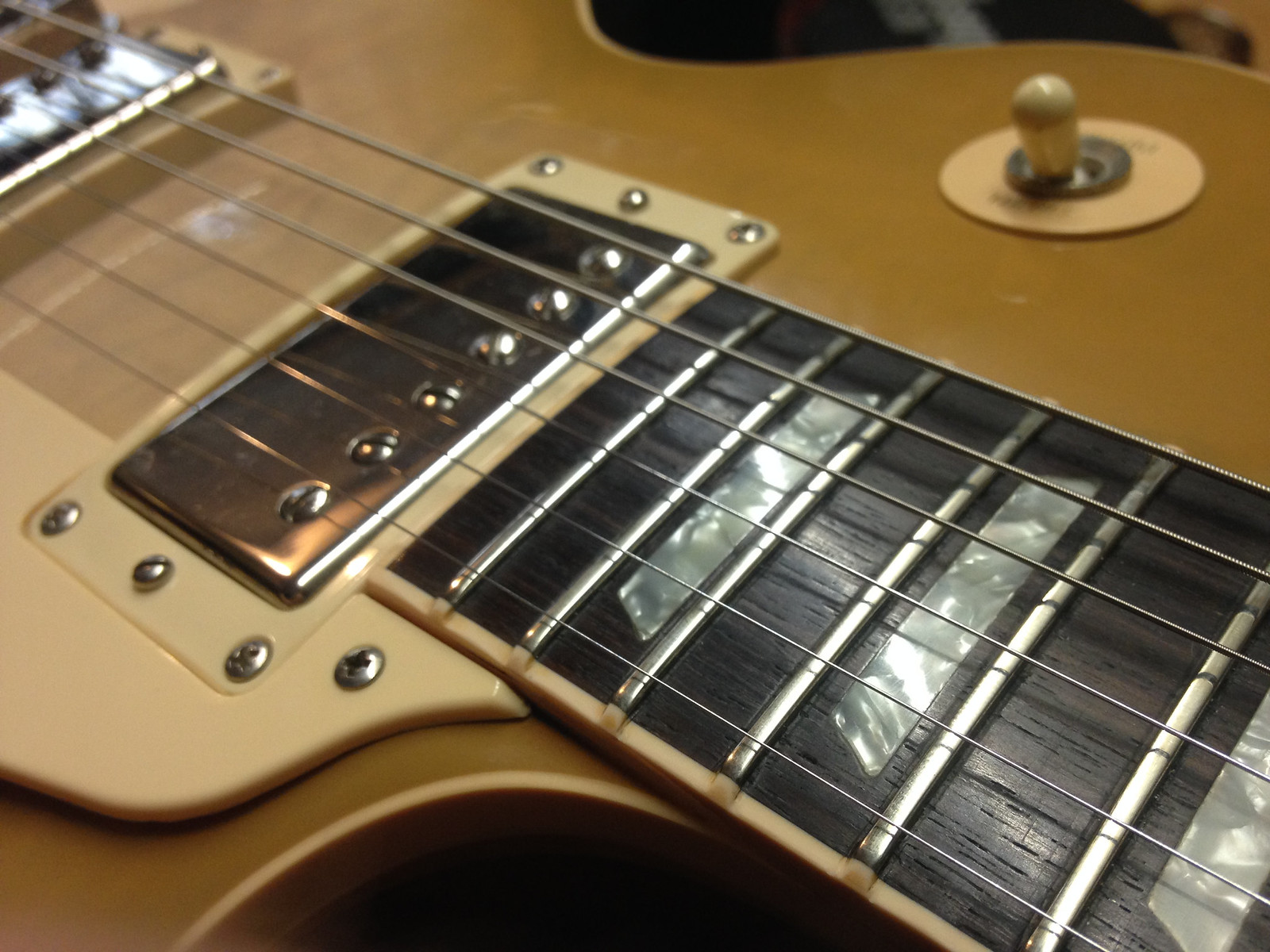
This is what my Standard looks like after having the frets dressed and nut replaced to my liking. (This was a $1,980 retail price guitar 15 years ago.) This is roughly what proper fret and nut work should look like out of the Gibson factory. Mind you, this is after fixing their initially crappy work, which made it hard to get these things *perfect* after the fact. But it's greatly improved over stock even though it ain't perfect.
Notice that some of the crappy original Gibson binding work still remains: a roughly sanded "staircase" of binding on each binding strip adjacent to the nut. I didn't bother to deal with it (will handle it at the first refret, when I sand the entire board at once with the frets and nut out). And the same type of roughness and stairstepping on the fret nibs, even after taking significant steps to smooth and minimize it. Eliminating it completely would have involved carving deeper into the binding than I was willing to do at the time, because the factory went too deep into the binding with their ham-handed factory end dressing (again, will be taken care of at the first refret, at which I will eliminate the nibs and install vintage Fender style 6230's).
Originally, the frets were extremely boxy, not well polished, and the ends/nibs were cut very squarely. The frets were practically uncrowned, and there was a little "jump" between most metal fret ends and their corresponding binding nubs, which would catch strings and your fingers.
The nut was back angled about 30 degrees, so the strings only rested on the apex of the nut. The slots were cut too shallowly to hold the strings well, and raggedly to boot, with little plastic bits that had to be pulled off. The slots were cut at the wrong depth, such that lower fret intonation and fretting ease was crap...and all the nut edges were sharp. It basically looked like a pre-slotted molded plastic nut was plopped in there, finished over, and then never really fine tuned.
Also, look at the fretboard around each fret. Lines on either side, and some depression of the board. They were likely all smashed in there at once with a press, using too much pressure.
The first thing I did with this guitar was to file better slots in the stock nut. I finally did all this other work many years later, after getting tired of letting the guitar sit because it played so crappily. It's still not at 100 percent of the level at which it should be, but it's waaaaaaay better than stock now. It's finally a joy to play.
During the improvement efforts on these frets, less effort was put into perfecting the fret nibs down on this end of the neck, so some of them are closer to how Gibson had shaped them. They are still greatly improved over stock, though.
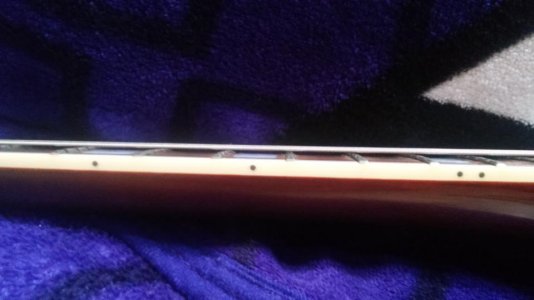
Unfortunately, this is probably the best pic I have of the frets before, but it does give you an idea of how boxy/uncrowned the frets were, how squarely the nibs were shaped, and how poorly the frets transitioned from metal to nib.
This is an interesting pic too. NONE of these are perfect, but they're all good and bad in varying ways...except the newest one, which is pretty much bad in every way. Early '00's Epi Japan on the left, '68 all-original Standard in the middle, '12 Special Faded on the right (possibly PLEK'd - not sure, but looks like classic "let the PLEK do all the work" craftsmanship).
The JDM Epi easily has the best nut and crowns, though even its bevels need to be more rounded over. But the simple fact that the frets are so well crowned eliminates most real-world problems with sharp bevels. (FWIW, this is a very high quality guitar, outside of the stock electronics.)
The '68 actually has a pretty so-so nut. They came with wide, low frets initially around that time, but the transitions off the flats are relatively smooth and well crafted. This guitar is old and beat, but it gives you some idea of the initial fret and nut work. I highly doubt fret work has ever been done on this guitar (though it needs a refret badly), because my father was the owner since 1975 or so, and it was in ultra clean shape when he got it.
Everything on the modern Special Faded looks like it got roughly chiseled into that shape, and is still awaiting the fine finish work. (That said, the nut is actually a lot better than the one on the LP Standard I posted above was when new.) You can even see abrasion lines on the frets. Look how boxy the frets are, and how the bevels were only rounded over along the length of the board – no rounding or transitioning into the sides of the frets – very sharp, boxy fret ends. Look at the shine (or rather, lack thereof) on the frets. The frets on this look like they were taken out of a PLEK and then practically nothing else was done to them.
The latter example is how most Gibsons come these days, and pretty much have been coming for almost 20 years that I can tell. People who say that Gibson fret and nut work is "perfect" are plainly stating to me that they don't know how frets and nuts are *supposed* to be finished. It's quite sad that so few people seem to have experienced truly quality fret and nut work on a guitar, leading them to tout clearly sub-par work as "perfect."
P.S. I posted these full res, so you could see the detail really well, but it appears they have not posted that way.