Can an Epi Les Paul Sound Like a Gibson?

Re: Can an Epi Les Paul Sound Like a Gibson?

More like total BS. Sounds like youtube
 
Re: Can an Epi Les Paul Sound Like a Gibson?

Having owned bunches of both the simple answer is yes.

If you are a corksniffer no amount of Interwebz talk will convince you. Are they the same, not likely but some are close for sure. I prefer my Gibsons generally but I have some Epi's that I love too. Good pickups, upgraded wiring and some detailing can go a long way in either brand.

Play what you like and don't worry about it
 
Re: Can an Epi Les Paul Sound Like a Gibson?

plugged in, you can make all kinds of great sounds depending on your pickups, pedals, amp, speakers etc.
A nice fret dress and setup can make nearly any guitar play great.
Play your guitars unplugged and you'll hear a much bigger difference between the resonance and natural abilities of any guitar. Some guitars simply sound better than others in this respect. Blindfolded, the name on the head stock wont make a difference, it will purely come down to whether or not it is a nice resonant, responsive instrument.

This is my experience
 
Re: Can an Epi Les Paul Sound Like a Gibson?

For those that talk about poor fretwork and nuts on USA Gibson's, Gibson has Plek'd all of their USA guitars since 2012 or 2013. So, frets and nuts are cut perfectly and are perfectly level. Amazing technology.
 
Re: Can an Epi Les Paul Sound Like a Gibson?

For those that talk about poor fretwork and nuts on USA Gibson's, Gibson has Plek'd all of their USA guitars since 2012 or 2013. So, frets and nuts are cut perfectly and are perfectly level. Amazing technology.

The level is not the issue. Anyone can get frets level across the board. It's what you do after that that matters, and that's what Gibson skimps on. It's the crowns and the rough-cut beveled ends. The crowns are near nonexistent, and the beveled ends are not smoothed into the body of the fret. Their fret work and nut work is very coarse, to the level of seeming quite obviously incomplete.

The problem with a PLEK is not the PLEK itself. They are great tools when used properly. The problem is the habits in workmanship that they tend to breed. Many manufacturers tend to treat them as the only thing required for proper fret work, i.e. as an excuse to forego adequate human finishing of the frets. In fact, PLEKs just provide a good starting point for the fine finish work that must be done by hand.

With the nuts themselves, it's the often-excessive back angle and lack of fine finish detail that tend to be bad. PLEKs rough in the nut, but the nut still must be fine finished, cleaned up, and smoothed by hand.

Gibson is not the only perpetrator here. G&L's fretwork also went downhill after they started using a PLEK. I need to round the edges over on every new G&L I get nowadays. Then again, every other last thing on a G&L is pretty much perfect, from wood work to finish to hardware to electronics, and they are quite reasonably priced when weighed against the over all quality.

OTOH, my last couple of Fender AVs have had awesome fret work right outta the factory. This isn't always the case with Fender, but good on 'em for the last few I've got.

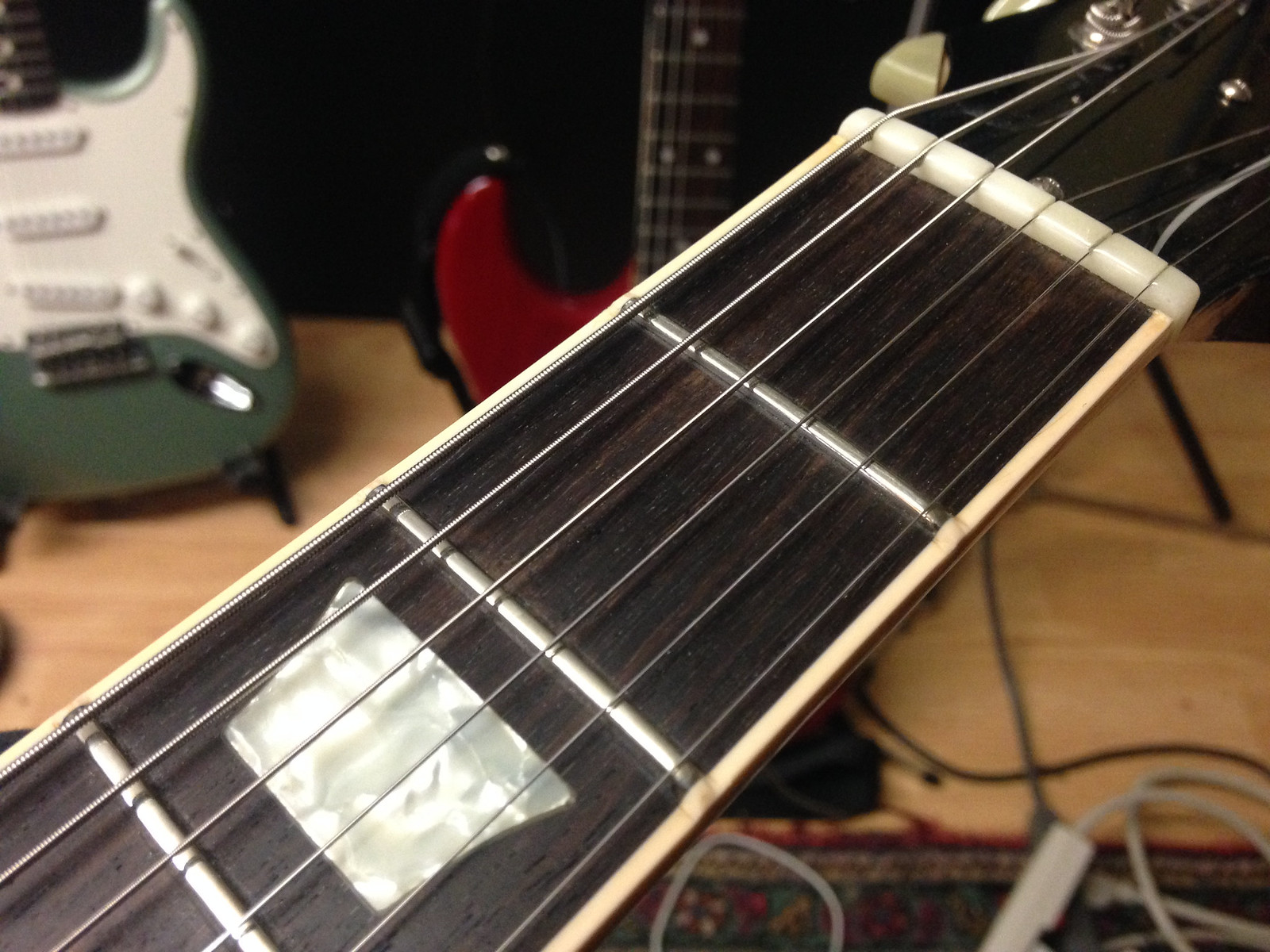
This is what my Standard looks like after having the frets dressed and nut replaced to my liking. (This was a $1,980 retail price guitar 15 years ago.) This is roughly what proper fret and nut work should look like out of the Gibson factory. Mind you, this is after fixing their initially crappy work, which made it hard to get these things *perfect* after the fact. But it's greatly improved over stock even though it ain't perfect.

Notice that some of the crappy original Gibson binding work still remains: a roughly sanded "staircase" of binding on each binding strip adjacent to the nut. I didn't bother to deal with it (will handle it at the first refret, when I sand the entire board at once with the frets and nut out). And the same type of roughness and stairstepping on the fret nibs, even after taking significant steps to smooth and minimize it. Eliminating it completely would have involved carving deeper into the binding than I was willing to do at the time, because the factory went too deep into the binding with their ham-handed factory end dressing (again, will be taken care of at the first refret, at which I will eliminate the nibs and install vintage Fender style 6230's).

Originally, the frets were extremely boxy, not well polished, and the ends/nibs were cut very squarely. The frets were practically uncrowned, and there was a little "jump" between most metal fret ends and their corresponding binding nubs, which would catch strings and your fingers.

The nut was back angled about 30 degrees, so the strings only rested on the apex of the nut. The slots were cut too shallowly to hold the strings well, and raggedly to boot, with little plastic bits that had to be pulled off. The slots were cut at the wrong depth, such that lower fret intonation and fretting ease was crap...and all the nut edges were sharp. It basically looked like a pre-slotted molded plastic nut was plopped in there, finished over, and then never really fine tuned.

Also, look at the fretboard around each fret. Lines on either side, and some depression of the board. They were likely all smashed in there at once with a press, using too much pressure.

The first thing I did with this guitar was to file better slots in the stock nut. I finally did all this other work many years later, after getting tired of letting the guitar sit because it played so crappily. It's still not at 100 percent of the level at which it should be, but it's waaaaaaay better than stock now. It's finally a joy to play.

26403814681_346dc94d91_h.jpg


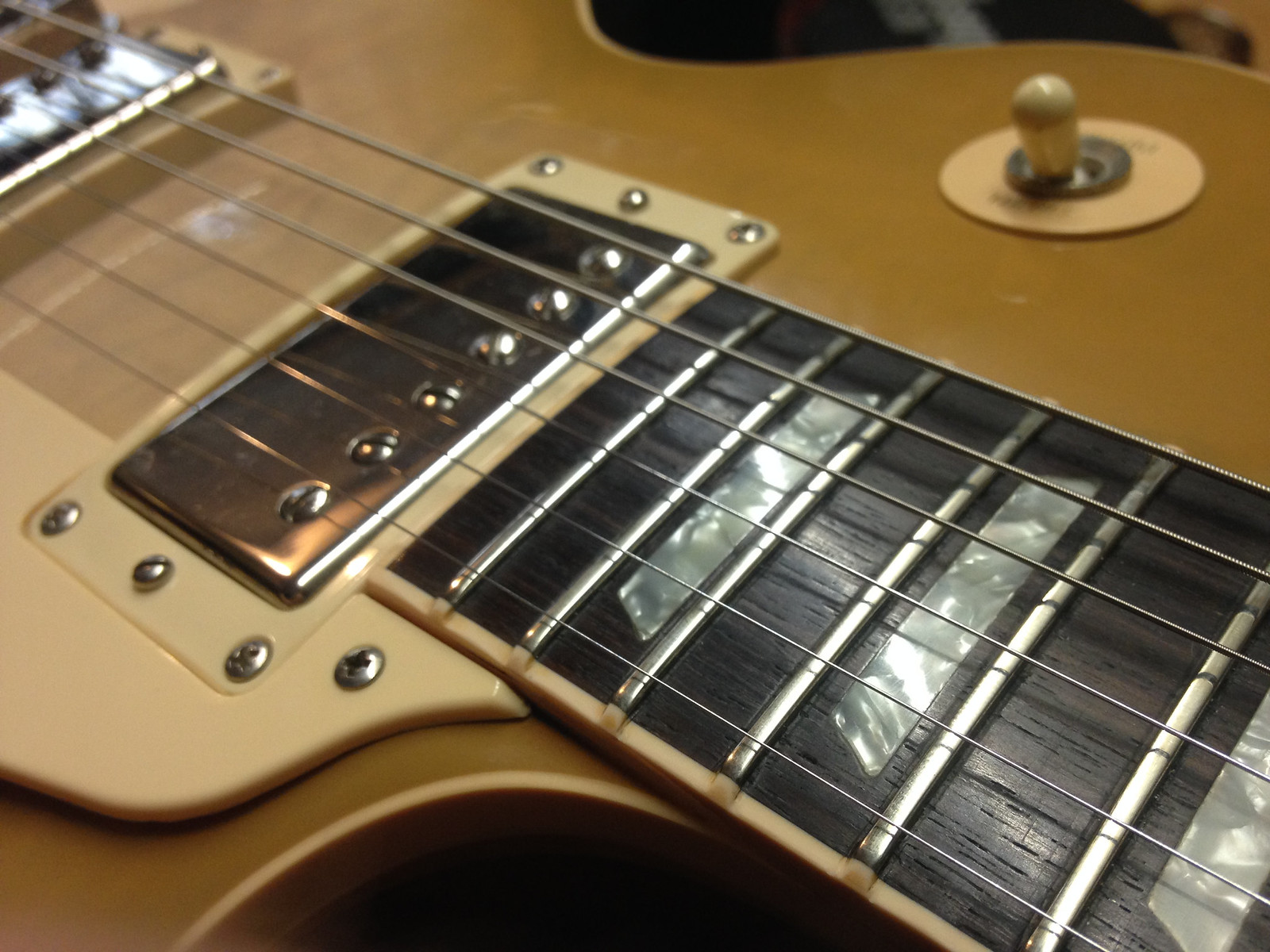
During the improvement efforts on these frets, less effort was put into perfecting the fret nibs down on this end of the neck, so some of them are closer to how Gibson had shaped them. They are still greatly improved over stock, though.

25867094333_19b8e8e0d9_h.jpg


Unfortunately, this is probably the best pic I have of the frets before, but it does give you an idea of how boxy/uncrowned the frets were, how squarely the nibs were shaped, and how poorly the frets transitioned from metal to nib.

15732338668_811f11dfd6_o.jpg


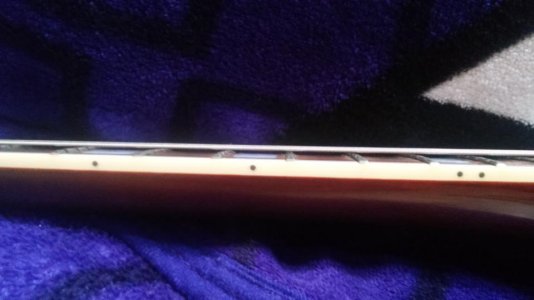
This is an interesting pic too. NONE of these are perfect, but they're all good and bad in varying ways...except the newest one, which is pretty much bad in every way. Early '00's Epi Japan on the left, '68 all-original Standard in the middle, '12 Special Faded on the right (possibly PLEK'd - not sure, but looks like classic "let the PLEK do all the work" craftsmanship).

The JDM Epi easily has the best nut and crowns, though even its bevels need to be more rounded over. But the simple fact that the frets are so well crowned eliminates most real-world problems with sharp bevels. (FWIW, this is a very high quality guitar, outside of the stock electronics.)

The '68 actually has a pretty so-so nut. They came with wide, low frets initially around that time, but the transitions off the flats are relatively smooth and well crafted. This guitar is old and beat, but it gives you some idea of the initial fret and nut work. I highly doubt fret work has ever been done on this guitar (though it needs a refret badly), because my father was the owner since 1975 or so, and it was in ultra clean shape when he got it.

Everything on the modern Special Faded looks like it got roughly chiseled into that shape, and is still awaiting the fine finish work. (That said, the nut is actually a lot better than the one on the LP Standard I posted above was when new.) You can even see abrasion lines on the frets. Look how boxy the frets are, and how the bevels were only rounded over along the length of the board – no rounding or transitioning into the sides of the frets – very sharp, boxy fret ends. Look at the shine (or rather, lack thereof) on the frets. The frets on this look like they were taken out of a PLEK and then practically nothing else was done to them.

The latter example is how most Gibsons come these days, and pretty much have been coming for almost 20 years that I can tell. People who say that Gibson fret and nut work is "perfect" are plainly stating to me that they don't know how frets and nuts are *supposed* to be finished. It's quite sad that so few people seem to have experienced truly quality fret and nut work on a guitar, leading them to tout clearly sub-par work as "perfect."

24286850875_38d5cb38bb_o.jpg


P.S. I posted these full res, so you could see the detail really well, but it appears they have not posted that way.
 
Last edited:
Re: Can an Epi Les Paul Sound Like a Gibson?

My Gibson had a few burrs on the frets
And the nut slot was narrow
It still.has a flakey switch
Where the neck pickup sometimes doesn't work
I'll sort that out when I change pickups
 
Re: Can an Epi Les Paul Sound Like a Gibson?

24286850875_38d5cb38bb_o.jpg


P.S. I posted these full res, so you could see the detail really well, but it appears they have not posted that way.

Right click over the image and select view image. You can then hit a + icon and it'll expand to full resolution.
 
Re: Can an Epi Les Paul Sound Like a Gibson?

Plenty of great info, you show a lot of knowledge. Are there any guitars new that meet your criteria? The problems you list, do they affect how well the guitar plays? I opened the back of my nut, and the guitar plays like butter and stays in tune. No rough frets on bends either. I just dont care for the pickups
 
Re: Can an Epi Les Paul Sound Like a Gibson?

I'm spoiled. As a young guy, I played acoustic guitar, worked and saved for years to buy my first electric, a Gibson Les Paul. And for years after that, all I owned were Gibsons. They were all stock and played and sounded fine to me. Years went by, I got more fussy and learned to work on my own guitars and started customizing them, usually with Seymour's fine pickups. I started working on friends' guitars and those were usually Epiphone LPs. I gutted them out and put in new electronics and Duncan pickups, and most often I was quite pleased with the results. Usually the upgrades produced a guitar that became gig-worthy with great tones. Occasionally they didn't turn out great, and I attributed that to the body and neck woods. I have experienced the same with Epi 335s and Sheratons. These projects were mostly done about 10 years ago. Structurally, the Epiphones were well made, and only needed a few upgrades to bring them up to snuff.
 
Re: Can an Epi Les Paul Sound Like a Gibson?

Plenty of great info, you show a lot of knowledge. Are there any guitars new that meet your criteria? The problems you list, do they affect how well the guitar plays? I opened the back of my nut, and the guitar plays like butter and stays in tune. No rough frets on bends either. I just dont care for the pickups

The things I talked about in my post above are 80 percent about how the guitar plays. That's the point. I don't care what frets look like for aesthetic reasons. I do care a little what string nuts look like, as that can be seen from farther away...but my nut complaints are mainly about playability too.

The grumbling is mainly about playability. But it's also about such work being an indicator of how the construction of the guitar as a whole was likely approached. If that's how they treat the "rubber meets the road" part of the guitar – the part that is all about how the thing plays; the part that's right out there in the open, and with which the user closely interacts – then what to they do with the stuff you can't see or don't know?

A lot of the criticism is also about bang for the buck, and about relative quality, compared to other "lower end" brands. When I can walk into any well stocked guitar store and find a simple, relatively affordable bolt-neck guitar with better crowned and polished frets than most Gibson Les Pauls – all while they are boosting themselves as a high-end guitar maker – that's when the criticism of Gibson notches up to a different level of harshness. When the quality slopes steadily downward, as prices are sloping steadily upward, that's when it goes to yet another level.

Point being, to my principles, you can put out a product with any level of build quality you want...but market it and charge for it accordingly. If you do put out a guitar with frets like that, fine. But don't tell me that only it is good enough, and charge me 2 or 3 times what the build quality should dictate. Have some pride, for heaven's sake. My pride as a general craftsman would not allow myself to put something out for sale at a certain price point, unless it could reasonably be seen to be crafted better than the less expensive options on the market. I'd simply be embarrassed to do so. Gibson doesn't think like this. They look at it as: Craft them and outfit them as poorly and cheaply as the market will let you get away with, banking on the market's extreme trust in your historical name and its general ignorance of what a quality guitar looks and feels like. Build up their trust and rebuild the brand's reputation, then as you are charging more, start quietly pulling the rug out, and they'll never notice!

As for new guitars that meet my criteria, very few are perfect, but like I just said, I can easily find something better than what Gibson does in any well stocked guitar store. Your run of the mill American Fender or G&L, though not perfect, are better, and at half the price. Even MIM Fenders and MIC Epis, while far from perfect, often have better dressed frets IME. The Fender AVs I mentioned in the post are actually very good – the best I've seen in a while. Gibson is pretty bad in the grand scheme, and also pretty bad for the money. They aren't so bad that they can't be fixed; they just don't finish the work that they start. In order to make them play their best, the user has to actually do a lot of Gibson's fine finish work for them. Again, if that's what they want to do, then fine...but charge accordingly, not BMW prices for a Ford.
 
Last edited:
Re: Can an Epi Les Paul Sound Like a Gibson?

Thanks for the response. The bang for the buck is a great point. I believe in the power of the free market. If Gibson charges what they charge and they continue to sell, I see nothing wrong with that. If they arent giving the paying customers what they pay for, then it will come back on them, maybe it already is. I doubt most of their financial woes were caused by their guitar line, but bad overall piss poor management and over diversification. I am somewhat a newb, so I go by what I hear and the ability to SOUND good. Its an instrument to make music after all. I also think people are way too critical of Gibson. Look at PRS for example, especially the SE line. My 1st guitar was a Meyers PRS SE, and IMO was by far inferior to any of the Epis I have owned. Sure it was pretty, but it sounded terrible. Talk about a POS for a nut and the pickups were worthless too. Maybe I got a bad one? Paul charges over 4 grand for a 10 top and I dont hear or read anyone complaining about a $1000 upgrade for a top that didnt cost him a dollar more. I can say the same about Gibson, but only Gibson takes the beating. Thanks again sir, tons of awesome info in your post!!
 
Re: Can an Epi Les Paul Sound Like a Gibson?

If Gibson guitars were so bad
They wouldn't sell so many

They may not be worth 5000 dollars
But they are nice guitars
 
Re: Can an Epi Les Paul Sound Like a Gibson?

Well, just to play Devil's advocate, apply the same logic to the sales of say, McDonald's. Priced at a Ruth Criss price point.
Gibson makes a quality product, but for a third of what it charges. Not to say that other companies don't do the same. $1800 to $2000 for an MIA strat? No thanks.
And if I spend anything more than $800 on anything that's brand spanking new, I expect not to have to do anything extra to make it sound fantastic. But then, that's just me. I'll never be the one to tell anyone else how they should spend their hard earned cash.

Sent from my Alcatel_5044C using Tapatalk
 
Last edited:
Re: Can an Epi Les Paul Sound Like a Gibson?

It will sound exactly like whatever pickups you put in it whether it be Gibson, Epiphone, Agile, Ibanez etc.
 
Re: Can an Epi Les Paul Sound Like a Gibson?

If Gibson guitars were so bad
They wouldn't sell so many

Yes, a lot of the frustration I feel is towards the market itself, for allowing Gibson to get away with this. People need to be educated as to what proper fret and nut work feels like. Hence branches of threads like we are seeing here – and why I bother even getting involved in them.

So, the way I see it, your statement needs to be modified to be true. Something like:

"If people realized Gibson guitars were so bad
They wouldn't sell so many"

Point being that people not realizing something's badness does not mean that it is not bad. How well something does on the market often cannot be directly tied to the objective quality standards; people are doing FAR more than objectively judging build quality and fit and finish when they choose to purchase something for a certain amount. Bluntly stated, the market is pretty dumb. There is extreme ignorance and a lot of lack of experience among potential owners in the guitar market. Most people don't know what a guitar with great fret work plays like, because they've never played one. Most people wouldn't know how to judge whether a guitar's frets and nut are well tuned or not. All they know is that only a Gibson is good enough!

Also, realize that I am not *totally* bashing Gibson or saying that nobody should buy one. Read my first post in the thread, which is quite even handed IMO. I simply know what I'm getting into when I get one, and weigh that against the price, the required and/or desired mods, my desire for the correct body and headstock shapes, a nitro finish, my desire for a cool special model or color, etc. FWIW, I own 8 (I think) Gibsons and zero Epiphones. Three of those Gibsons were bought brand new – all of them back in my ignorant youth (two were even bought sight unseen, like a dope). I love them all in the end, after much fine tuning, but they are the guitars that taught me that Gibson quality is not all it is cracked to be. I now factor in the cost of a nut replacement and fret dressing (and likely hardware replacement, eventually) when considering buying a Gibson.
 
Last edited:
Re: Can an Epi Les Paul Sound Like a Gibson?

^Do you think that logic also applies to the so-called 'boo-teek' guitar makers, those making imitation copies of renowned models and jack the price up by 5 times? The market and guitar players are ignorant idiots in general, sure.
 
Re: Can an Epi Les Paul Sound Like a Gibson?

I totally agree. You can tell time perfectly with a phone, but some people still like to wear a Rolex. I bought a Gibson, just because I wanted one. I could have bought 3 more Epis and they would have been great, but I still would want a Gibson. I love my Epis, but none have the fretwork and the neck of my Gibson. And BTW, I am far from a cork sniffer. In fact, some of the coolest stories to me are how some guy picked up some inexpensive guitar and it turned out to be awesome. I have one like that. Now I bet many here could tell me whats wrong with it and why its junk, but this I know. The action is so frickin low and not one buzz to be found. Its main flaw id the D string is all the way up and still slightly off in its intonation.
0315181650a.jpg
 
Last edited:
Back
Top