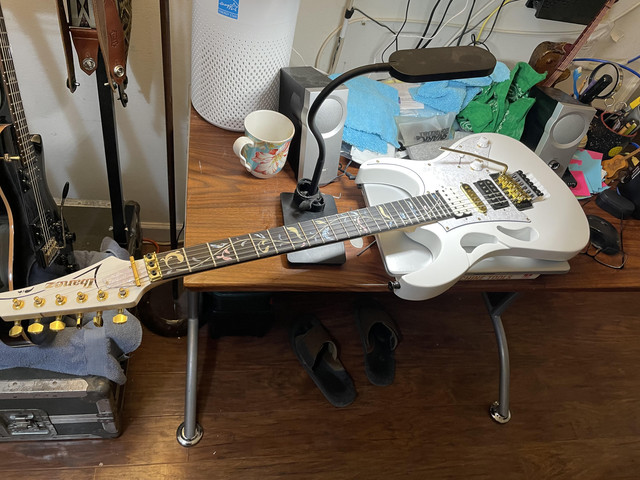
Experience with Temu/Aliexpress Guitars?

This is spot on. A friend of mine bought one of the Martin D45 US custom shop forgeries, and it was shockingly good. The problem is it is good enough to fool many folks into thinking it's a real Martin, and that is the obvious intent. They should not be allowed in the US, and those who bring them into this country should go to prison for long terms.
What's sad it that the guitar I saw and played was an excellent instrument and easily could stand on its own under its own brand and sell for much more money. But they instead chose to offer it as an openly branded Martin Custom Shop US D 45 forgery. It's criminal, and we should stop this cold!!
The problem with your "should be in prison' theory is it only happens to poor people.
 
This is spot on. A friend of mine bought one of the Martin D45 US custom shop forgeries, and it was shockingly good. The problem is it is good enough to fool many folks into thinking it's a real Martin, and that is the obvious intent. They should not be allowed in the US, and those who bring them into this country should go to prison for long terms.
What's sad it that the guitar I saw and played was an excellent instrument and easily could stand on its own under its own brand and sell for much more money. But they instead chose to offer it as an openly branded Martin Custom Shop US D 45 forgery. It's criminal, and we should stop this cold!!


This is a complex issue...

First, I would argue that there's a HUGE difference between buying a copy/replica to mod or enjoy as part of one's own personal collection and trying to pass a fake off as genuine for a profit. Intention is everything in that regard.

Also, it seems the people who already invested in $3K+ Martin and Gibson guitars are the ones who tend to get most upset by this phenomenon. However, that doesn't represent the typical consumer of these "forgeries" by a long shot. Most people buying these low cost copies simply aren't the target demographic for ultra-premium products in the first place.

In other words, Martin is rarely losing out on a real sale because someone bought a $300 Chinese copy off Temu over their $3,000 option. At the end of the day, these $300 copies are really competing in the market segment that includes budget-oriented models from Ibanez, Yamaha, etc., not USA Martins.

There's also a subset of buyers that will go on to buy a real Martin some day because they liked what the budget version brought to the table and they (rightfully or wrongfully) assume the real $3K Martin will be even better.

There's also something to be said about the increasing demand for these well-built replicas over the original products they are copying. It's effectively the market saying "Hey Martin, you sure make a great guitar, but your products are overpriced". Considering most guitar manufacturers have operations overseas these days, there's little reason we're entering an era where mid-grade, Indo-made guitars are netting $1500-$2000. I mean, an entry level, imported Martin with composite sides, a fancy plywood neck, and marginal build quality is $700 these days. It's just corporate greed at all levels. These builders in China are showing buyers that they don't have to pay that kind of money to get a great guitar.

Which raises another issue...there are literally hundreds of small manufacturers creating these products in China, but there's no way most could compete on the open market under their own brand name. In fact, there are already hundreds of Chinese brand names out there that most of us have never heard of. Suggesting a product is "good enough to stand on its own" doesn't mean it actually can. The guitar market is harder to break into than the car market...have you seen many new car brands emerge successfully without bringing entirely new technologies to the table (like Tesla, Rivian, etc)? Not really.

Also, I don't know much about Martin as a company, but similarly perceived "premium" companies like Gibson and Fender are actually pretty shitty corporations who only care about the bottom line, not the actual instruments, their workers, or their customers. They're most concerned with maximizing profit and keeping consumers believing that they are the only brands with "heritage" and that this concept has value. In fact, that exact angle of marketing is the only thing that keeps brands like Fender and Gibson afloat as the quality of their products declines and their prices steadily increase.

To be fair, the consistent onslaught of cheap consumer goods from China has done serious damage to the manufacturing backbone of U.S.-made goods. On the other hand, most U.S.-made products have become overpriced relative to the quality they offer and the efficiency and speed in which they can be manufactured today.

If Martin really wants to combat the counterfeit issue, they should generate better products at the entry level price point. Otherwise, it'll take a full ban on Chinese goods to meaningfully stop the flow of these products into the country and reduce the demand that's ultimately fueling their production.
 
Last edited:
China out-performs the US in about every catagory. And they make most everything now because we asked them to & paid them to starting in the 1970's w/ Nixon.
To suggest they have "stole" anything from the USA is utterly ridiculas except for espionage activity which the USA does as well.
As US companies outsourced the last 50 years China invested in themselves and are now the global leaders in about every catagory including -
weapons.
Can't have it both ways.
You want a guitar buy a fuggin guitar there's a tariff on it wonder where that came from.
The worst criminals are the ones that don't get locked up.
Can't tap dance around this crap.
Anyone thinks they're gonna "make" China do what they want by slapping them w/ taxes ain't based in reality.
China owns the US economy.
China owns the US Treasury.
Never insult an Asian it goes back Centruries.
 
Last edited:
That group needs to be shut down, banned in the US and prosecuted under copyright laws to the full extent of federal law.
This is a complex issue...

First, I would argue that there's a HUGE difference between buying a copy/replica to mod or enjoy as part of one's own personal collection and trying to pass a fake off as genuine for a profit. Intention is everything in that regard.

Also, it seems the people who already invested in $3K+ Martin and Gibson guitars are the ones who tend to get most upset by this phenomenon. However, that doesn't represent the typical consumer of these "forgeries" by a long shot. Most people buying these low cost copies simply aren't the target demographic for ultra-premium products in the first place.

In other words, Martin is rarely losing out on a real sale because someone bought a $300 Chinese copy off Temu over their $3,000 option. At the end of the day, these $300 copies are really competing in the market segment that includes budget-oriented models from Ibanez, Yamaha, etc., not USA Martins.

There's also a subset of buyers that will go on to buy a real Martin some day because they liked what the budget version brought to the table and they (rightfully or wrongfully) assume the real $3K Martin will be even better.

There's also something to be said about the increasing demand for these well-built replicas over the original products they are copying. It's effectively the market saying "Hey Martin, you sure make a great guitar, but your products are overpriced". Considering most guitar manufacturers have operations overseas these days, there's little reason we're entering an era where mid-grade, Indo-made guitars are netting $1500-$2000. I mean, an entry level, imported Martin with composite sides, a fancy plywood neck, and marginal build quality is $700 these days. It's just corporate greed at all levels. These builders in China are showing buyers that they don't have to pay that kind of money to get a great guitar.

Which raises another issue...there are literally hundreds of small manufacturers creating these products in China, but there's no way most could compete on the open market under their own brand name. In fact, there are already hundreds of Chinese brand names out there that most of us have never heard of. Suggesting a product is "good enough to stand on its own" doesn't mean it actually can. The guitar market is harder to break into than the car market...have you seen many new car brands emerge successfully without bringing entirely new technologies to the table (like Tesla, Rivian, etc)? Not really.

Also, I don't know much about Martin as a company, but similarly perceived "premium" companies like Gibson and Fender are actually pretty shitty corporations who only care about the bottom line, not the actual instruments, their workers, or their customers. They're most concerned with maximizing profit and keeping consumers believing that they are the only brands with "heritage" and that this concept has value. In fact, that exact angle of marketing is the only thing that keeps brands like Fender and Gibson afloat as the quality of their products declines and their prices steadily increase.

To be fair, the consistent onslaught of cheap consumer goods from China has done serious damage to the manufacturing backbone of U.S.-made goods. On the other hand, most U.S.-made products have become overpriced relative to the quality they offer and the efficiency and speed in which they can be manufactured today.

If Martin really wants to combat the counterfeit issue, they should generate better products at the entry level price point. Otherwise, it'll take a full ban on Chinese goods to meaningfully stop the flow of these products into the country and reduce the demand that's ultimately fueling their production.

The other issue is there isn't really much Gibson or Martin or even the United States can do. They are made in China, where it is legal and the US has no jurisdiction over their lack of IP laws. Yeah customs does a bust now and then and catches a few at the border, but i really don't think fake guitars is their top priority.
 
First, I would argue that there's a HUGE difference between buying a copy/replica to mod or enjoy as part of one's own personal collection and trying to pass a fake off as genuine for a profit. Intention is everything in that regard.

The way I see it , the problem is that if fakes are being sold anywhere then they're going to eventually going to be passed off as genuine for profit. And that just hurts anyone buying or selling gear. This problem has been getting worse and worse over the years. In a guitar adjacent space - when I was in university if I wanted to record guitar I could buy a used SM57 for like 50$ and be off to the races. Today, I'm afraid to buy a used one because there are so many fakes (even shockingly well crafted fake where the wiring colour inside is correct and they have fake transformers and everything) everywhere, pretty spot on box printing, even fake documentation and QC stickers. This makes me as a consumer afraid to buy the mic used . . . and then afraid to buy the mic new because I know that if I ever want to sell it, it's going to be hard to convince anyone it's real. Granted we're talking about a hundred dollar mic, but the problem exists for anything more expensive too (SD knock-off pickups anyone?).

So, while buying a knock-off with branding and badges seems like it doesn't do any harm if you're going to use it in 'your own personal collection', the problem is that those knock-offs are very likely going to be given to friends, sold (with a full legit description that it's a fake) on the used market, and then end up being passed off by others as real through accident or on purpose. It just sucks all the way around and nobody should be supporting this.
 
Certainly the companies themselves are not hurting because someone spent $100 on a fake. But when things are re-sold and a buyer gets ripped off, that's not good. Hell, I don't like when people buy Warmoth parts and stick Fender stickers on it. You can certainly say 'buyer beware', but why rip someone off? Just be nice.
 
Point in case: I'll never buy guitar strings online, unless it's from a known Australian retailer. So much counterfeits on Amazon, eBay and friends it's become ridiculous. This hurts the brands ultimately, we should try and make a conscious effort to stop buying cheap chinese junk of any sort, whenever we can avoid it.
 
Marketing Solutions 101:

A. Start making your expensive quality widget in a labor controlled country.
B. Send marketing alert that someone is making counterfeit widgets with your logo.
C. Blame bad QC in your new factory on the counterfeits.
D. Rake in profit
 
Point in case: I'll never buy guitar strings online, unless it's from a known Australian retailer. So much counterfeits on Amazon, eBay and friends it's become ridiculous. This hurts the brands ultimately, we should try and make a conscious effort to stop buying cheap chinese junk of any sort, whenever we can avoid it.

The string thing is crazy and I bet 99% on this forum don't understand how bad it is. D'Addario, Ernie Ball, Fender...every type, every gauge...they're ALL affected!

I bet 1/3 of us are buying counterfeit strings online and don't even know it! THAT is the wrong/dishonest part of this whole thing.

It's one thing to knowingly buy counterfeit strings to use on your own instruments.

It's a completely different thing to buy what you are assuming to be authentic strings at retail and sellers aren't disclosing that their strings are fake.

That basically summarizes this whole thread. There's nothing wrong with buying a fake for yourself. But trying to pass a fake off as authentic to someone else is a crime.
 
Last edited:
I buy from Amazon

I have had the last two.packs of D'ADDARIO have blemishes on the strings straight out out of the pack

I contacted D'ADDARIO, and with the serial number and Amazon order number
They were able to identify the shipment to me from them.
And sent me a new package of strings
The last time , this past summer, they sent two packs to replace the one bad package.

They are awesome..
 
This is a complex issue...

First, I would argue that there's a HUGE difference between buying a copy/replica to mod or enjoy as part of one's own personal collection and trying to pass a fake off as genuine for a profit. Intention is everything in that regard.

Also, it seems the people who already invested in $3K+ Martin and Gibson guitars are the ones who tend to get most upset by this phenomenon. However, that doesn't represent the typical consumer of these "forgeries" by a long shot. Most people buying these low cost copies simply aren't the target demographic for ultra-premium products in the first place.

In other words, Martin is rarely losing out on a real sale because someone bought a $300 Chinese copy off Temu over their $3,000 option. At the end of the day, these $300 copies are really competing in the market segment that includes budget-oriented models from Ibanez, Yamaha, etc., not USA Martins.

There's also a subset of buyers that will go on to buy a real Martin some day because they liked what the budget version brought to the table and they (rightfully or wrongfully) assume the real $3K Martin will be even better.

There's also something to be said about the increasing demand for these well-built replicas over the original products they are copying. It's effectively the market saying "Hey Martin, you sure make a great guitar, but your products are overpriced". Considering most guitar manufacturers have operations overseas these days, there's little reason we're entering an era where mid-grade, Indo-made guitars are netting $1500-$2000. I mean, an entry level, imported Martin with composite sides, a fancy plywood neck, and marginal build quality is $700 these days. It's just corporate greed at all levels. These builders in China are showing buyers that they don't have to pay that kind of money to get a great guitar.

Which raises another issue...there are literally hundreds of small manufacturers creating these products in China, but there's no way most could compete on the open market under their own brand name. In fact, there are already hundreds of Chinese brand names out there that most of us have never heard of. Suggesting a product is "good enough to stand on its own" doesn't mean it actually can. The guitar market is harder to break into than the car market...have you seen many new car brands emerge successfully without bringing entirely new technologies to the table (like Tesla, Rivian, etc)? Not really.

Also, I don't know much about Martin as a company, but similarly perceived "premium" companies like Gibson and Fender are actually pretty shitty corporations who only care about the bottom line, not the actual instruments, their workers, or their customers. They're most concerned with maximizing profit and keeping consumers believing that they are the only brands with "heritage" and that this concept has value. In fact, that exact angle of marketing is the only thing that keeps brands like Fender and Gibson afloat as the quality of their products declines and their prices steadily increase.

To be fair, the consistent onslaught of cheap consumer goods from China has done serious damage to the manufacturing backbone of U.S.-made goods. On the other hand, most U.S.-made products have become overpriced relative to the quality they offer and the efficiency and speed in which they can be manufactured today.

If Martin really wants to combat the counterfeit issue, they should generate better products at the entry level price point. Otherwise, it'll take a full ban on Chinese goods to meaningfully stop the flow of these products into the country and reduce the demand that's ultimately fueling their production.
Amen!

The Market has spoken - and per usual, the US manufacturers have ignored it.

I have 6 Gibson Les Pauls, and I only purchased one new (you all know that one...for obvious reasons. That said, I will NOT purchase a new one. The combination of Cost, What I get, and Potential headaches simply is not worth it to me. And I can afford any new one I want.

So if I were to purchase a Chibson, Gibson did not lose sale one from me.

I don't even want to get into US Copyright/Patent/Trademark law. I will say in the US, it is a bit, er, um, different than the rest of the world. Only here could you take something so ubiquitous as a color, on such a common item, like a pickup, and enforce it not being produced for 50 years. (I'm talking to you Larry! Right AT YOU!!!).

I have a set of Duncans that really need to be in a Les Paul. And I have always wondered how close to one of my real ones I could tweet one of these out....

Inspiring Masta'C
 
Last edited:
A customer of mine had a china ibanez stye Pia, and we noticed a few things.

1) frets were soft as butter. Had to be refretted
2) inlay was nice and tight!
3) neck pocket was wide and sloppy.
4) trem cavity and spring cavity were sloppy under all the covers but the sights you could see were kinda neat.
5) the finish was impeccably clean and neat. I have to admit.
6) once upgraded with good hardware, the guitar sounded almost as amazing as the real deal but never kept tune. I fixed that by using a threaded insert and using a domino in the neck, to couple it all tighter together, but still
7) the trussrod buzzes and rattles so much you hear it through the amp
 
A customer of mine had a china ibanez stye Pia, and we noticed a few things.

1) frets were soft as butter. Had to be refretted
2) inlay was nice and tight!
3) neck pocket was wide and sloppy.
4) trem cavity and spring cavity were sloppy under all the covers but the sights you could see were kinda neat.
5) the finish was impeccably clean and neat. I have to admit.
6) once upgraded with good hardware, the guitar sounded almost as amazing as the real deal but never kept tune. I fixed that by using a threaded insert and using a domino in the neck, to couple it all tighter together, but still
7) the trussrod buzzes and rattles so much you hear it through the amp


I have one, neck, body, tuners & frets all fine. Paint nary a blemish.
Once i upgraded the cheap trem & humbuckers its all good.
I got the guitar from a friend.
China products make peoples lives better whether folks admit it or not.
 
Back
Top