

CTN
The Drama Dude
The average vintage strat bridge doesn't really have a sharp/hardened knife edge on the baseplate, and it doesn't have a pivot point designed on the pivot screws either. The baseplate just rides up and down the shaft of the screw, and it's anyone's guess where the bridge ends up after some aggressive tremolo use.
But I wonder if using 6 of the pivot screws from the old floyds which didn't have bushings, if that would help to improve the functionality and "return to pitch" accuracy of your average 6-screw trem.
Or....
A lot of aftermarket 6-screw trems have improved edges on the baseplate but use the same kind of screws as a strat, which renders that edge kinda useless. They might also benefit from using the floyd screws.
These are the ones I'm talking about.
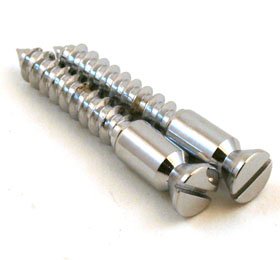
I'm guessing it'd forcibly move the whole bridge whatever fraction of an inch it'd be between the edge of the old screw shafts and the edge of the pivot point of the floyd screws, but as long as there's enough travel left in the saddles, that shouldn't impact intonation ability any significant amount.
Thoughts?
But I wonder if using 6 of the pivot screws from the old floyds which didn't have bushings, if that would help to improve the functionality and "return to pitch" accuracy of your average 6-screw trem.
Or....
A lot of aftermarket 6-screw trems have improved edges on the baseplate but use the same kind of screws as a strat, which renders that edge kinda useless. They might also benefit from using the floyd screws.
These are the ones I'm talking about.
I'm guessing it'd forcibly move the whole bridge whatever fraction of an inch it'd be between the edge of the old screw shafts and the edge of the pivot point of the floyd screws, but as long as there's enough travel left in the saddles, that shouldn't impact intonation ability any significant amount.
Thoughts?


