Improving the functionality of the Avg Strat trem...

CTN

The Drama Dude
The average vintage strat bridge doesn't really have a sharp/hardened knife edge on the baseplate, and it doesn't have a pivot point designed on the pivot screws either. The baseplate just rides up and down the shaft of the screw, and it's anyone's guess where the bridge ends up after some aggressive tremolo use.

But I wonder if using 6 of the pivot screws from the old floyds which didn't have bushings, if that would help to improve the functionality and "return to pitch" accuracy of your average 6-screw trem.

Or....

A lot of aftermarket 6-screw trems have improved edges on the baseplate but use the same kind of screws as a strat, which renders that edge kinda useless. They might also benefit from using the floyd screws.


These are the ones I'm talking about.
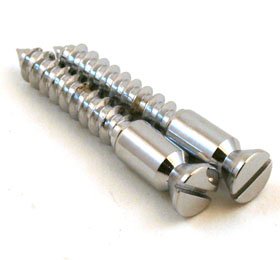
BP-FWS-C.jpg

I'm guessing it'd forcibly move the whole bridge whatever fraction of an inch it'd be between the edge of the old screw shafts and the edge of the pivot point of the floyd screws, but as long as there's enough travel left in the saddles, that shouldn't impact intonation ability any significant amount.

Thoughts?
 
Re: Improving the functionality of the Avg Strat trem...

Callaham at one time had an Am. Std post to vintage bridge conversion kit. Could install the posts in a 6 screw body - But I might as well install a Gotoh 510 2 post. Theres no tone difference in the 6 screw and 2 point versions I can hear.

FWIW - I've read at one time SRV used the vintage bridge with only the 2 outer screws.
 
Last edited:
Re: Improving the functionality of the Avg Strat trem...

I'm sure Wilkinson do an aftermarket 6-screw bridge. Might be worth seeing what that uses for the screws themselves.
 
Re: Improving the functionality of the Avg Strat trem...

I actually tried that on my '62RI strat, removing the 4 inner screws. For some reason, the whole bridge moved forward a bit, jammed right up onto the pickguard.

Not entirely sure the 2 screws could handle the string tension on their own. I'm guessing that's the same reason Floyd Rose moved from the 2 screws to the more solid bushings + bolts system.
 
Re: Improving the functionality of the Avg Strat trem...

I'm sure Wilkinson do an aftermarket 6-screw bridge. Might be worth seeing what that uses for the screws themselves.

they do a few.
I'm actually looking at a few of them for my red strat, but it seems all the screws are regular strat style screws, not the pivoted kind. But all the baseplates have knife edges on the screw holes.
 
Re: Improving the functionality of the Avg Strat trem...

I actually tried that on my '62RI strat, removing the 4 inner screws. For some reason, the whole bridge moved forward a bit, jammed right up onto the pickguard.

Eh?, It must of had incorrect screws for it to do that?
 
Re: Improving the functionality of the Avg Strat trem...

Dan Erlewine has a couple of pretty good chapters on Strat trems in his books The Guitar Player Repair Guide (2nd Ed.) and How to Make Your Electric Guitar Play Great. He covers reducing friction at every point of string contact, as well as several methods for addressing the pivot points. Some of them involve tools and science and stuff.
 
Re: Improving the functionality of the Avg Strat trem...

Eh?, It must of had incorrect screws for it to do that?

it was very, very slight amount of movement forward that it needed to be able to butt up against the pickguard. it basically made it so the p/g was kinda clamped inbetween the bridge and the neck heel.

Maybe the screw holes weren't drilled correctly.

When i put the 4 inner screws back, I didn't have that problem anymore.


LPB: cool beans, i'mma try to track that down.
 
Re: Improving the functionality of the Avg Strat trem...

a permanent fix for strat trems is to replace them with floydz! :)
 
Re: Improving the functionality of the Avg Strat trem...

or worn - or soft wood?

a heavy piece of alder?
I'm not sure. I mean it's no purpleheart or maple, but alder is pretty tough stuff.
I don't thing the screw holes are worn out. I've barely ever touched the trem since acquiring that guitar, except for changing the saddles out.


On the subject of Dan Erlewine's setup tips and mods and such, i tracked down an ebook version of Guitar Player Repair Guide and went through the section on strat trems. He makes some good points about eliminating points of friction along the string path but didn't address the problem of the shifting pivot point along the pivot screws.

I think when i do purchase the new trem unit for my red strat, i'll get some of those floyd rose wood screws too and have a go at it. I think the main difficulty will be to get the pivots points of all 6 screws to be level with each other, but no biggie, I'll just rig up some sort of height gauge and set each one. That's what calipers are for!
 
Re: Improving the functionality of the Avg Strat trem...

a permanent fix for strat trems is to replace them with floydz! :)

I hate playing floyds.
I can set them up great with pinpoint return-to-pitch accuracy, but I just hate playing them.

Also the guitar in question is has a 6-screw vintage style strat trem, and I don't want to modify the body in any way if I don't have to.
 
Re: Improving the functionality of the Avg Strat trem...

Eh?

I rest my palm just in front of the saddles, not on top of them. They don't bug me at all. And because of how I rest my hand, they don't really accumulate any filth at all. Just dust.

What I meant about that statement was that I hate the feel and sound of a floyd. And because the intonation screw-bolts are located just under where I would rest my hand, THEY would accumulate filth.

Also I think floyds are ugly, though I don't mind as much the low profile redesigns that have shorter string-lock bolts sticking out the back.
 
Re: Improving the functionality of the Avg Strat trem...

I like Floyds, but they thin out the sound of the guitar (IMO).

Yeah - looks like Alder might not be as hard as folklore has it.

Thought about chucking the mounting screws in a drill and polishing the unthreaded portion a little smoother, then some teflon lube? Also another trick is to drill out the mounting screws 1 size and re-beveling. Suhr did this when installing Fender bridges.

There was also a cool mod in the Erlewine book using a piece of bent brass - not sure if it actually worked, but I could see a version of it being used to modify the pivot point
 
Re: Improving the functionality of the Avg Strat trem...

The one the spammers gushed about on the forum several months back?? I liked the idea, but the spam turned me off.
 
Re: Improving the functionality of the Avg Strat trem...

I solved "most" of my tuning issues or Trem related issues by replacing my tuning machines with locking tuning machines, I installed a graphite nut & saddles. I use traditional "vintage" bridges as well, now I also do not use it aggressively as some people may, but in general here is how I set my guitar trems up. First off I am using all American made Fender Stratocasters with vintage bridges. I prefer to have the bridge rest on the body. This way if I do break a string (which is rare since I have installed all the graphite) The guitar will stay in tune. Secondly I have graphite nuts saddles which simply allow the strings to slide. It is imperative that the nut slots are adjusted to your particular string gauge. I have locking tuners. So everything moves as it is supposed to & my guitar stay in relatively good tune. I don't think anything with ever stop a guitar from going out of tune slightly. I generally check tuning in between songs so it usually is not an issue.
 
Re: Improving the functionality of the Avg Strat trem...

I like Floyds, but they thin out the sound of the guitar (IMO).

Yeah - looks like Alder might not be as hard as folklore has it.

Thought about chucking the mounting screws in a drill and polishing the unthreaded portion a little smoother, then some teflon lube? Also another trick is to drill out the mounting screws 1 size and re-beveling. Suhr did this when installing Fender bridges.

There was also a cool mod in the Erlewine book using a piece of bent brass - not sure if it actually worked, but I could see a version of it being used to modify the pivot point

Yeah I was watching a video on ye olde y00t00b by an italian luthier who mentioned many of Erlewine's tricks from that book but also noted that you could grind a pivot point into the screws of a vintage strat trem. Would be a pain in the ass getting 6 of them exactly the same though.

The brass pivot bar... seems like a good idea. My only concern with that is lateral movement of the trem. Any aggressive use of the whammy bar could throw off the lateral alignment. Granted, because of the route of the trem block, it can only go so far, but that could be enough to throw the tuning out.

I came across what seems to be a now-defunct trem system called the boogie rail, which operates on a somewhat similar concept. It's a rounded bar/rail thing that screws in where the 6-screws are for a vintage strat, and then the baseplate has a rounded pivot track that fits around the rail. Interesting concept, but like I said, the company seems to be defunct right now and/or redesigning their website indefinitely.

6.satin-and-rail.png

CONCLUSION.png


In any case, I think the floyd screws are at least an idea that's worth testing so I'm gonna do it.

Hey CTN, have you seen the Wudtone trem?

I have. It looks really nicely built and seems to solve a lot of problems (except for the lack of a pivot point on the screw itself) but I cannot rationalize spending that much on a trem alone when the guitar itself is worth just slightly over that much.

I solved "most" of my tuning issues or Trem related issues by replacing my tuning machines with locking tuning machines, I installed a graphite nut & saddles. I use traditional "vintage" bridges as well, now I also do not use it aggressively as some people may, but in general here is how I set my guitar trems up. First off I am using all American made Fender Stratocasters with vintage bridges. I prefer to have the bridge rest on the body. This way if I do break a string (which is rare since I have installed all the graphite) The guitar will stay in tune. Secondly I have graphite nuts saddles which simply allow the strings to slide. It is imperative that the nut slots are adjusted to your particular string gauge. I have locking tuners. So everything moves as it is supposed to & my guitar stay in relatively good tune. I don't think anything with ever stop a guitar from going out of tune slightly. I generally check tuning in between songs so it usually is not an issue.

good points all around.

My plan for this guitar was to change to locking tuners and a graphtech Tusq XL (which is teflon impregnated) nut along with switching the vintage trem to a more accurate wilkinson unit, but the wilkie comes with 6 regular screws and I was wondering if I could improve it still more without resorting to any permanent changes to the guitar. I also have a set of graphtech string saver saddles I could use on it if the steel ones aren't good enough (though I kinda want steel saddles, more for their specific kinda tone than anything else)
 
Re: Improving the functionality of the Avg Strat trem...

Yeah I was watching a video on ye olde y00t00b by an italian luthier who mentioned many of Erlewine's tricks from that book but also noted that you could grind a pivot point into the screws of a vintage strat trem. Would be a pain in the ass getting 6 of them exactly the same though.

The brass pivot bar... seems like a good idea. My only concern with that is lateral movement of the trem. Any aggressive use of the whammy bar could throw off the lateral alignment. Granted, because of the route of the trem block, it can only go so far, but that could be enough to throw the tuning out.

I came across what seems to be a now-defunct trem system called the boogie rail, which operates on a somewhat similar concept. It's a rounded bar/rail thing that screws in where the 6-screws are for a vintage strat, and then the baseplate has a rounded pivot track that fits around the rail. Interesting concept, but like I said, the company seems to be defunct right now and/or redesigning their website indefinitely.

6.satin-and-rail.png

CONCLUSION.png


In any case, I think the floyd screws are at least an idea that's worth testing so I'm gonna do it.


I have. It looks really nicely built and seems to solve a lot of problems (except for the lack of a pivot point on the screw itself) but I cannot rationalize spending that much on a trem alone when the guitar itself is worth just slightly over that much.


good points all around.

My plan for this guitar was to change to locking tuners and a graphtech Tusq XL (which is teflon impregnated) nut along with switching the vintage trem to a more accurate wilkinson unit, but the wilkie comes with 6 regular screws and I was wondering if I could improve it still more without resorting to any permanent changes to the guitar. I also have a set of graphtech string saver saddles I could use on it if the steel ones aren't good enough (though I kinda want steel saddles, more for their specific kinda tone than anything else)

On a vintage trem you have 6 screw but 4 if the 6 are backed if a bit so the two screw work like a fulcrum keeping tension on the bridge is the key
 
Back
Top