Re: My thoughts on Marshall cab
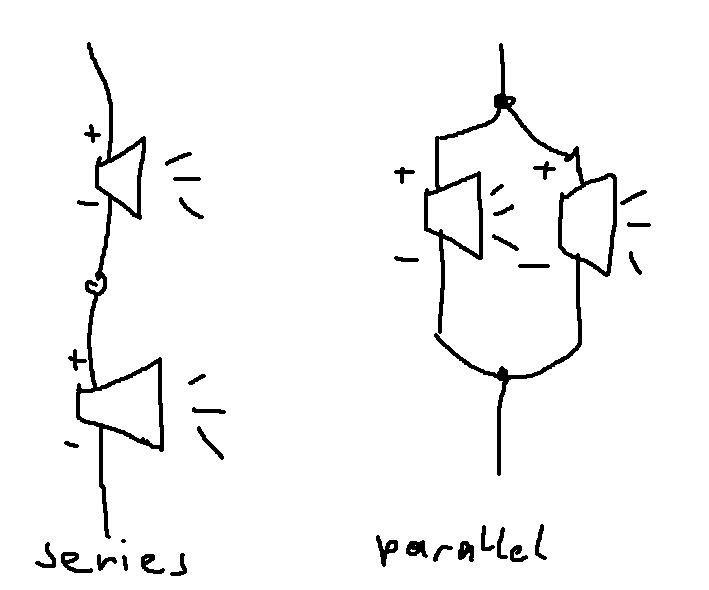
Ok just FYI I created a little graphic (in paint cause I am lazy)
As you can see, if two speakers are connected +@- it's in series, if they are connected +@+ and -@-, it's parallel. Actually it's easy to understand:
If the current has to run through a series of loads, it's wired in series, if it can run trough them 'at the same time' or parallel, it's parallel.
So now how do you get the load:
First, we say Speaker one is R1=8Ohm and speaker two is R2=8Ohm aswell. R is the complete resistance the head will see in your case.
It's easy to explain resistance if you think of the circuit as a highway.
Series is easy.
You have two highway parts, both with 3 tracks, which come one after the other, so you'll have the same traffic resistance on both parts, since they have the same number of tracks, but still, since you have to pass both, the resistance sums up altogether.
Or
Since the current has to run through both loads to get from + to - or actually vice versa, the loads just add up, so it's
R=R1+R2.
Ok now parallel. Imagine you have two highway parts again, both 3 tracks but they run in parallel, meaning the traffic splits up on the two parts which means LOWER resistance for you if you want to drive though (as you'll have more space altogether)
This formula is a bit more tricky: 1/R = 1/R1 + 1/R2 =>
R=1/(1/R1+1/R2)
Now you can also transform it and get
R=(R1*R2)/(R1+R2)
or in your case, for 4x8Ohm:
R = 1/(1/8+1/8+1/8+1/8)=2
Hope that helps.