Short out a component, or open one side?

Liko

Member
Hi guys,

I'm playing around with some wiring designs for a switchable tone circuit, and I have a question for the floor. Simply stated, if you wish to "remove" a component like a resistor or cap from the circuit so that it has no effect, is it better to short that component's terminals so current bypasses it, or to open one end of that component's connections?

Theoretically, there should be no difference between these two approaches, as the resistance in the bypass path will be infinitesimal, so current choosing to go through the relatively high-impedance component anyway will represent a very, very small fraction of total current. However, the only way to guarantee it's zero, and thus that the component is having absolutely no effect on current, is to lift at least one of the component's connections to the circuit in addition to connecting the alternate bypass path.

I can come up with a design that works either way, but it will be easier to assemble (more soldering to terminals instead of chassis or wire-to-wire connections) using a short-out design instead of explicitly lifting one or both sides of the component.
 
Last edited:
Re: Short out a component, or open one side?

It can depend on the particular circuit and the exact location/ function of the component to be 'eliminated' via switching.

If you think about why 'true bypass' is a great improvement over 'non true bypass' (untrue bypass ?) in effects pedals, you'll get the idea. In the early days, the signal was sent either through the pedal to get the effect, or the input was switched directly across to the output for the bypassed (i.e. unaffected) sound. The problem was that the effects circuit, although bypassed by shorting, still formed a path between the signal and ground, changing the impedance, loading down the cicuit and thus changing the sound (often called 'tone suck' as the changes were audibly not favourable).

'True bypass' occurs when a more compex switch is used to disconnect the effect circuit at both the input and output end, meaning the effect circuit is completely disconnected from the signal in bypass mode, there is no connection to ground via the unused effect circuitry, thus the circuit has absolutely no effect on the 'straight-through' signal.

This is why i suggest that more information is needed. Can you post a pic/ drawing of your planned circuit ?
 
Last edited:
Re: Short out a component, or open one side?

I would short a component to ground to take it out of the circuit. I have heard open connections act as radio antennae.

Sent from my MotoE2(4G-LTE) using Tapatalk
 
Re: Short out a component, or open one side?

In most guitar circuits - lift. Usually grounded both ends will ground something you wouldn't want to ground. EX: Say you wanted to remove the tone control from the circuit. If you ground both sides of the capacitor in '50s wiring, you will remove the tone control from the circuit, as well as everything else. You would shunt your hot to ground. Just lift the connection between the two potentiometers and they're disconnected.

I would short a component to ground to take it out of the circuit. I have heard open connections act as radio antennae.

Sent from my MotoE2(4G-LTE) using Tapatalk

If one end of the open connection goes to ground, and nothing in the open section is connected to hot, then this won't happen (assuming you use one solid star ground point). In the case of guitar wiring, the situation you described is highly unlikely.
 
Re: Short out a component, or open one side?

If one end of the open connection goes to ground, and nothing in the open section is connected to hot, then this won't happen (assuming you use one solid star ground point). In the case of guitar wiring, the situation you described is highly unlikely.

But in the unlikely event that you open the circuit but leave one end connected to hot, I think that it can.
 
Re: Short out a component, or open one side?

It can depend on the particular circuit and the exact location/ function of the component to be 'eliminated' via switching.

...

This is why i suggest that more information is needed. Can you post a pic/ drawing of your planned circuit ?

Sure. The circuit in question is designed to essentially switch a tone pot from Fender spec (250k, .022uF) to Gibson spec (500k, .047uF). To do that, the switch chooses between the two cap values, and also puts a 500k pot in parallel to the pot's used terminals, halving the maximum total resistance.

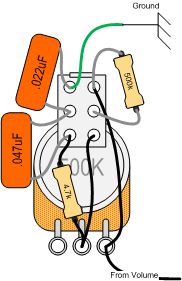
Here's option A, the short-out option:

Dual-Tone Bypass Option.png

With the switch in the up position (lower pairs of terminals connected; remember the pot is upside-down in this diagram), the .047uF cap is bypassed by the switch contacts which effectively jumper that cap, and current instead flows through the .022uF cap. The 500k resistor on the right is also in the circuit between the right and middle terminals. With the switch down (top pairs connected), the .022uF cap is now jumpered by the switch, so current must now flow through the .047uF cap, and the 500kohm resistor is disconnected. Notice how in this design, everything's connected to a switch or pot terminal, and long leads from the pickup or to the grounding point are just wires. I know that the 500k resistor can be used to connect the pot to the switch instead of an extra black wire lead, and that'll probably be the way it is actually wired up.

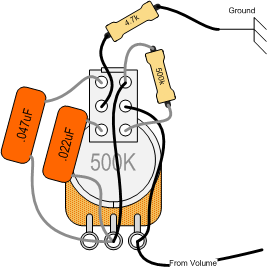
Here's option B, the "lift" option:

Dual-Tone Lift Option.png

Here, with the switch up, the .047uF cap is disconnected at the top switch terminal, and the .022uF cap is connected (as is the resistor). With the switch down, the .022uF cap and resistor are disconnected and the .047uF cap is connected. This provides a much more positive, unambiguous path for current. However, now the 4.7k resistor, which provides a "not quite off" minimum value that avoids the low-mid hump of really low settings, is an odd man out. It cannot be wired terminal-to-terminal in series with the pot and caps; it must either be in between the middle lug and the two caps (requiring tricky wire-to-wire soldering), or it must be inline with the lead from the pickups, or to the ground point (which can be on the pot, I know, but I'd prefer it not be).

Overall, option A allows for cleaner wiring, but a more ambiguous path through the capacitors. Option B is unambiguous regarding which components get current flow, but harder to wire. I would prefer option A unless it would have a detrimental effect on tone. If it will, I'll gut out wiring it according to B (or equivalent).
 
Last edited:
Re: Short out a component, or open one side?

First, Diagram A is completely wrong for what you're trying to accomplish. The capacitors are in series - yielding a total capacitance of .015uF. For the circuit to be completed through the .047uF capacitor, one end must go to ground. The .022uF capacitor is inline before ground. In either position, your only option for capacitance is .015uF - not what you want. To make a 500K pot 250K, you put the 500K resistor in parallel with the outer two lugs - not the wiper. What you're doing is making sure the current from volume control sees at least 500K no matter what - even if the pot is supposed to read "0K", which will make the tone control sound like it is on "0" with a LPF at 21.2314 Hz. The frequency will only get lower as you add more resistance by turning the tone control down. The 4.7K resistor also lowers the frequency and complicates things even more - ditch it as there's no reason for it.

Deciding whether her to ground or lift a component to remove it from the circuit is the least of your worries in the diagram. Take it one step at a time - it's like focusing on what light bulb you'll install in a building when the foundation work for the structure hasn't even begun yet. I'll dissect option B later.
 
Re: Short out a component, or open one side?

First, Diagram A is completely wrong for what you're trying to accomplish. The capacitors are in series - yielding a total capacitance of .015uF. For the circuit to be completed through the .047uF capacitor, one end must go to ground. The .022uF capacitor is inline before ground. In either position, your only option for capacitance is .015uF - not what you want. To make a 500K pot 250K, you put the 500K resistor in parallel with the outer two lugs - not the wiper. What you're doing is making sure the current from volume control sees at least 500K no matter what - even if the pot is supposed to read "0K", which will make the tone control sound like it is on "0" with a LPF at 21.2314 Hz. The frequency will only get lower as you add more resistance by turning the tone control down. The 4.7K resistor also lowers the frequency and complicates things even more - ditch it as there's no reason for it.

Deciding whether her to ground or lift a component to remove it from the circuit is the least of your worries in the diagram. Take it one step at a time - it's like focusing on what light bulb you'll install in a building when the foundation work for the structure hasn't even begun yet. I'll dissect option B later.

Regarding the fixed resistor across the pot, it actually works either way. Jumpering the outer lugs means that the parallel path between center and right lugs through the fixed resistor has the resistance of the fixed resistor, plus the "unused" fraction of the pot's max value, because that's the path the fixed resistor creates through the left terminal. Wiring it my way, this doesn't happen, so the resistance is simply that of the fixed resistor and the setting of the pot. If you graph out the parallel resistance equations for the two variants, they both start at zero and end at 250kohms, but wiring it my way ends up with a slightly flatter curve between these two points so the behavior of the circuit is a little closer to whatever taper the pot has (though there's not much in it either way especially if the pot is audio taper).

As for the caps, I'm aware they're wired in series. Are you aware that there are switch contacts underneath the pins in both diagrams? The idea is for the DPDT switch to short out one cap or the other by providing a parallel path of effectively zero resistance. For instance, if I wanted the .047uF cap, I'd position the switch so that its contacts connect the middle and top terminals of each side, which connects the two terminals of the .022uF cap with an alternate path that has effectively zero impedance. Parallel resistance again; put an arbitrarily high impedance load in parallel with a near-zero impedance conductor and the effective impedance of the two paths is near-zero. Some current will invariably flow through the cap in this configuration (increasing with frequency), which will cause a phase variance between the two paths, but we don't care because all this current is just going to ground anyway.

The question is whether this approach will be effective at "removing" the unused cap from the tone circuit, as is theorized. Your position appears to be that it won't, but your argument doesn't convince me because you don't seem to be taking the switch into account. If you are saying the switch won't have the desired effect, I'll listen to a reasoned explanation.
 
Last edited:
Re: Short out a component, or open one side?

I'm sorry; my bad. I was trying to do two things at once when I last posted. You're completely right, and when I sat down and actually drew out a schematic, Diagram A would work (just one minor point I'll get to). I had a complete brain fart and forgot about the inner connections of the switch, and I missed the jumper wire between the right lug of the potentiometer and the top right lug of the switch - that makes the 500K resistor parallel to whatever resistance the potentiometer is at. In the up position, you're also bypassing the 500K in a different way then grounding it or lifting it - you're shorting it by having both ends of the resistor connected to each other. That's another way to bypass components.

Now I'm looking at B. That also works, and is the one I'd go with. Simpler, will be easier to solder to the switch, easier to follow, etc. Lifting a component here won't act as an antenna either.
 
Back
Top