Liko
Member
Hi guys,
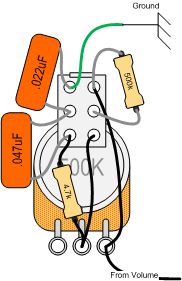
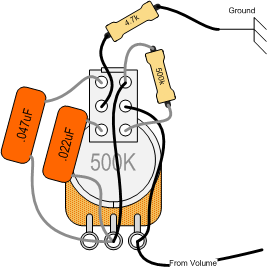
I'm playing around with some wiring designs for a switchable tone circuit, and I have a question for the floor. Simply stated, if you wish to "remove" a component like a resistor or cap from the circuit so that it has no effect, is it better to short that component's terminals so current bypasses it, or to open one end of that component's connections?
Theoretically, there should be no difference between these two approaches, as the resistance in the bypass path will be infinitesimal, so current choosing to go through the relatively high-impedance component anyway will represent a very, very small fraction of total current. However, the only way to guarantee it's zero, and thus that the component is having absolutely no effect on current, is to lift at least one of the component's connections to the circuit in addition to connecting the alternate bypass path.
I can come up with a design that works either way, but it will be easier to assemble (more soldering to terminals instead of chassis or wire-to-wire connections) using a short-out design instead of explicitly lifting one or both sides of the component.
I'm playing around with some wiring designs for a switchable tone circuit, and I have a question for the floor. Simply stated, if you wish to "remove" a component like a resistor or cap from the circuit so that it has no effect, is it better to short that component's terminals so current bypasses it, or to open one end of that component's connections?
Theoretically, there should be no difference between these two approaches, as the resistance in the bypass path will be infinitesimal, so current choosing to go through the relatively high-impedance component anyway will represent a very, very small fraction of total current. However, the only way to guarantee it's zero, and thus that the component is having absolutely no effect on current, is to lift at least one of the component's connections to the circuit in addition to connecting the alternate bypass path.
I can come up with a design that works either way, but it will be easier to assemble (more soldering to terminals instead of chassis or wire-to-wire connections) using a short-out design instead of explicitly lifting one or both sides of the component.
Last edited: