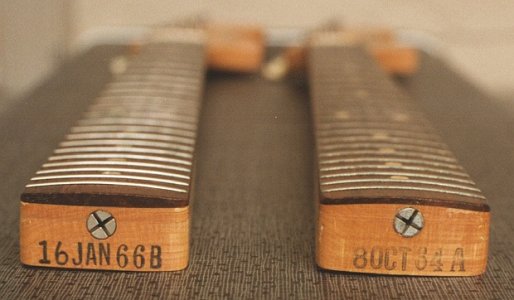
So what is so special about a 62 strat?

TimmyPage

New member
I've noticed this specific year pop up a bunch when it comes to the strat. There have been a bunch of reissues, there are a bunch of great players who are famous for using their 61-63 strats. What was so special about these years, what made them so magical? And just as importantly, what were the actual pickups in these guitars like?
 
Re: So what is so special about a 62 strat?

I'm going to throw this out there... (All my poor understanding of the subject ;)) There were changes from year to year on pre-CBS Strats. The 1954s were Ash with A3 pickups and one piece maple neck. Very quickly the pickups transitioned to A5, then the bodies included alder. In 1959 the Slab Board rosewood/maple neck and 3-ply Pickguard were introduced. Finally in 1963 (I think?) the neck was transitioned into a laminate rosewood fingerboard. Theoretically all of the pickups from the A5 transistion until the wire changed in ~1964 should be similar but obviously they aren't. Magnet formulas changed, total winds and tension changed etc.

HOWEVER... When Fender started reissuing pre-CBS Strats they focused on the 1957 and the 1962 specs. I'm sure someone here has more details why these years were chosen, but for the better part of 30 years a Fender reissue has been a 57 or 62. I think that contributes significantly to the mystique. Notice you can get basically any year reissued from the Custom Shop. They focus on some years as true vintage type RI's and some as more upgraded or hot rodded, but any can be ordered in pure vintage fashion. Again, lots of guys here have a lot more experience with vintage guitars, but my understanding is that if you choose some some 59-62 Strats you'll see as much variance between years as you will in one specific year.

I'm looking forward to learning in this thread too. :)
 
Last edited:
Re: So what is so special about a 62 strat?

It was the last year of the slab board, so it is seen as an "end of an era" type of thing by guitar nerds.

Also, the slab board and the contrasty three-tone sunburst were only available together for about a year to a year and a half in 1961 and 1962. Earlier 3TSB Strats had the slab board, but the sunbursts were less vibrant. These earlier sunbursts used a weak red dye that faded over time, and the black was actually a very dark brown. So these guitars got brownish over time as the red faded. To me, the slab board looks nicer, as does the more vibrant/contrasty 3TSB. So, if you're gonna reissue a guitar with a vibrant yellow/red/black sunburst and a slab board, it has to be a '61 or an early '62 reissue.

As for why Fender chose '57, it's gotta be because it was the last year of the 2TSB...plus the last year of the V neck profile.
 
Last edited:
Re: So what is so special about a 62 strat?

Author A. R. Duchossoir put the question to Fender whilst researching one of his books. The reply was that calling the rosewood 'board re-issue Stratocaster a '62 gave them the option of slab or rounded lam fingerboard construction with no obligation to change the model nomenclature.
 
Re: So what is so special about a 62 strat?

What is the difference between slab and laminate? Just the thickness of the rosewood?
 
Re: So what is so special about a 62 strat?

There seems to be a consensus that every constructional/design change from launch to mid-1962 was a positive evolution. Changes made after mid-1962 are not universally well received.
 
Re: So what is so special about a 62 strat?

I had a BRW slab board, 1960 Strat. Bought it used from an older gentleman, a retired Marine Sgt. (WWII, Korea, Vietnam) in 1973 and paid $150 for it. He told me that it had originally been a S/B, but the kid he'd bought it from had tried to paint it white, like Jimi's Woodstock Strat, and it was done so poorly that the Sarge had it stripped and then painted his favorite color--yep...OD green metallic, c. 1967 Pontiac Bonneville. :)

The guitar had been well played. It came to me strung with Fender 13-56 flatwounds and very low action. I had it set up with 9-42s, and it played and sounded great, though the pickups were very weak. I learned a couple of tricks with the vibrato, and it stayed in tune very well. I sold that guitar after my divorce in 1990, for a tidy profit. I didn't want to sell it, but in reality, the guitar was worn out and needed a lot of servicing. I needed the money, so I let it go.

So, I too am also a big fan of the late '59-'63 Strats, and I keep thinking that I want a Fender Custom Shop model like my old '60--though I doubt I'd go for the Bonneville paint job, LOL!

But when I went looking for another Strat a couple of years later, I was thinking about getting a new American Vintage '62, but I was shown a new G&L Legacy, and I was hooked. When I'd sold my Strat, I'd kept my Music Man Sabre II, which was a better guitar for what I was doing at the time. So I knew about Leo Fender's involvement with Music Man, and then the new company he formed after that: G&L. The Legacy was everything I'd loved about the old Strat, yet it was a better guitar. He'd made some improvement over the original design that fixed some of the problem areas and weaknesses of the Strat--without going the "Super-Strat" route and losing the vintage flavor.

So, I'd love to have my old guitar back, or its clone, but for me the Legacy is a much better choice. Sentimentality aside, the Legacy is everything I wanted my Strat to be--I love the tonal versatility and I love the way they play. In fact, I love these guitars so much, I have 11 of them, and 18 total G&Ls. They don't have the high price of the vintage guitars, or of the new Custom Shop models, but they have excellent quality and value.

Yeah, I do wince a bit every time I see a 1960 Strat posted for sale in Vintage Guitar Magazine for $45,000--but to tell the truth, I'm doing just fine without it.

Bill
 
Re: So what is so special about a 62 strat?

I think the years of 57 and 62 represented the various 'ideals' - maybe having looked at perhaps not only the desirability of certain years, but also the features present. It certainly gives the idea to the newbie that there was '1 50's type strat, and 1 early 60's type strat', where the truth was that specs changed year to year....even the pickups were wound differently.
 
Last edited:
Re: So what is so special about a 62 strat?

I don't mean to post up a storm here tonight, and I won't, but I dig Dylans (sunburst) and Hendrixs'(black) '65. They played them at the famous Monterrey Pop Festival.
 
Re: So what is so special about a 62 strat?

I have a '62 slab reissue and an actual '66 laminate. With regard to the fretboard difference, while it's not exactly apples to apples comparison because one is a reissue but I have to say, for Rosewood necks I've become convinced laminate is better, having slightly better sustain and tone. (I have had several other Strats over the years besides these two to compare so...) I think it's because there's more maple in the neck. The only thing Rosewood does for me is it feels softer under my fingers than maple as a fretboard, so I don't see the need for a slab of it.

My recollection of why people frowned upon the later CBS-era was not the design and construction but the move to more automated assembly line techniques lowering quality and away from hand-built with better attention to fit and finish.

I just read the tone cap up to '62 was paper and oil. After that it was ceramic disc. (For those who believe that changes the sound.) The CRL 3-way switch also changed design ever so slightly from flat-cut soft dark bakelite to a more rigid round-cut bakelite after 1962. Pickups were black-bottomed with rounded-top magnets, copper wire, full-submerged wax potted, surgical tubing for the height springs. After that they were gray bottomed and dated, burgundy wire, later magnet tops were flat, springs for height.

So I think the reason for 1962 is simply a lot changed after that. Up to that year, there was a collection of innovations and particular construction characteristics that are worth collecting into a model. It appears it was just a natural milestone in the evolution of the Strat.
 
Re: So what is so special about a 62 strat?

I think the neck profile of the 62 was more pleasing to most players than the 60 and 61.......based on my experience with vintage and CS Reissues. It seems like there was more taper in the neck and weaker pickups on the 60 and 61. 62 is the year the alder/rosewood strat was perfected IMO.

Out of all the vintage strats I've tried, a white 65 was my favorite. It was owned by someone who came over to buy an amp from me.
 
Re: So what is so special about a 62 strat?

The best Strat I've ever played was a bone stock '63, for the record. It just sounded and felt RIGHT.
 
Back
Top