Super D: Please tell me about it...

Re: Super D: Please tell me about it...

Thanks guys.

I have a soapbar SD among various P90 sized DiMarzio HB's and FWIW, it doesn't sound EXACTLY like a full size one.
The resistance is the same.
The inductance is slightly lower.
The coupling between coils is different (and this difference is made more obvious by the 4 wires conductor).

It has still the Super Dist signature albeit a lil' brighter / tighter as Dave Locher said, but I also find it less lively and more polite than the regular sized one.

A relative advantage (for me) is that a the P90 sized Super Dist is factually a Dual-Sound: it has the related 4 wires cables. And yes, it works well in parallel or split - I have it in an "experimental" Super Strat with 25 pickup positions and it covers A LOT of ground.

Wired in parallel, it should be close enough to your stock mini-HB to allow a tone-matching thx to a few added components (might require a low value cap tuning down the resonant peak but should work anyway).

Good luck in your tone quest. :-)

The SuperD in parallel is great in the neck position. In the bridge you definitely want to run it in series, or use a push/pull to switch between series/split or series/parallel.

FWIW, Paul Gilbert ran a SuperD in parallel back in the early Racer X days.

Very useful information.

:yourock:

I intend to run it using a 500K DPDT push pull pot. And the main thing is to use it together with the neck, the stock 6.15K mini HB... I wonder how the parallel super d in the bridge would compare with the stock 6.45K mini HB. So do you guys foresee any problems with using super d (in parallel mode) together with the neck mini hb?

B
 
Re: Super D: Please tell me about it...

I don't see any problem with the SuperD in parallel with the neck Mini HB. It'll definitely sound different, no doubt about that, but I think it'll work OK. Only way to know if it works for you is to try.
 
Re: Super D: Please tell me about it...

I intend to run it using a 500K DPDT push pull pot. And the main thing is to use it together with the neck, the stock 6.15K mini HB... I wonder how the parallel super d in the bridge would compare with the stock 6.45K mini HB. So do you guys foresee any problems with using super d (in parallel mode) together with the neck mini hb?

B

The output of the super D in parallel should be lower of approximatively 6dB compared to series mode if memory serves me. Shouldn't be a problem if the Super D is close enough to the strings (and as it's a bridge PU in a Gibson scale axe, no problem of Stratitis due to magnetic pull, theoretically).

I'll try to post the screenshot of a comparison between Soapbar DS in parallel and regular mini-HB - I have one mini-HB here measuring 6.5k so the comparison should make sense. :-)
 
Re: Super D: Please tell me about it...

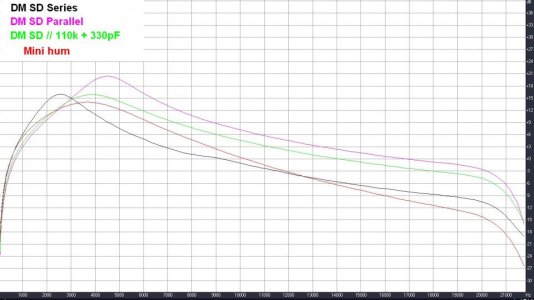
To complete my previous post, I post below the screenshot of a test done on the fly.

DMSD series parallel res cap vs mini hum.jpg

Black line = overall "resonant peak" of a soapbar DM Super Dist in series.

Red line = the resonant peak of a regular 6.5k mini-hum. Its response is flattened by its cover.

Pink line = the Super Dist in parallel. It's higher pitched than the mini-hum and the absence of metal cover makes the response more "peaky".

Green line = quick attempt of tone matching. The DM Super Dist wired in parallel is itself in parallel with a 330pF capacitor and the tone pot is lowered at 110k (doing this helps to mimic the flattening / dulling effect of the cover on the mini-hum).

It's a first and single attempt based on intuition and not a perfect match. It's not a promise of good tone either: depends on the settings / guitar / rest of the rig / player and his preferences.

At least it suggests how the response of a pickup in parallel can be "corrected" to become a bit more "natural" if needed.

FWIW. :-)
 
Re: Super D: Please tell me about it...

To complete my previous post, I post below the screenshot of a test done on the fly.

View attachment 104191

Black line = overall "resonant peak" of a soapbar DM Super Dist in series.

Red line = the resonant peak of a regular 6.5k mini-hum. Its response is flattened by its cover.

Pink line = the Super Dist in parallel. It's higher pitched than the mini-hum and the absence of metal cover makes the response more "peaky".

Green line = quick attempt of tone matching. The DM Super Dist wired in parallel is itself in parallel with a 330pF capacitor and the tone pot is lowered at 110k (doing this helps to mimic the flattening / dulling effect of the cover on the mini-hum).

It's a first and single attempt based on intuition and not a perfect match. It's not a promise of good tone either: depends on the settings / guitar / rest of the rig / player and his preferences.

At least it suggests how the response of a pickup in parallel can be "corrected" to become a bit more "natural" if needed.

FWIW. :-)

Vow! Great information! Thanks.

So running super d parallel gives clearer and janglier sound then the mini HB... Very cool.

I appreciate the info.

B
 
Re: Super D: Please tell me about it...

Vow! Great information! Thanks.

So running super d parallel gives clearer and janglier sound then the mini HB... Very cool.

I appreciate the info.

B
Glad if it helps. :-)

Yes the Super D in parallel will/would be spankier than a mini-hum and it's logical: parallel wiring divides the inductance by 4 approximatively (from 6.7H to 1.7H in this case), which brings us in the Filter'Tron territory, but without cover to tame to tone.

Hence my use of parallel resistance and inductance, in order to make it closer to the stock covered mini-hum (6.5k, 3H of inductance). I often "fine tune" passive pickups like that and it works well.
 
Back
Top