Weird sound change inverting the phase on a Mustang single coil

marcello252

Well-known member
Ok, that's a thing I don't understand I want to share.

I recently had a Squier mustang, it came with 2 humbuckers I didn't like, so I bought a new pickguard with switches and I wired a couple of single coil , SSL5 bridge + SSL1 neck, you know in a mustang the single switch can invert the phase of its pickup.

Being single coils I expected no change in sound, when singularly engaged, inverting the phase. Well, no. I clearly hear a difference comparing the two positions, although very slightly, I'd say in the bass freqs.

does anybody know why? Am I just going nut?
 
Do both switches have the same effect in the same position? IE, is the in phase position always bassier than the out of phase position? Is there a way to do a blind test?

My best guess would be your OOP and IP settings have a different length of wire, with longer wire introducing extra capacitance.
 
btw, first thing I thought was one side of the switch was oxidized , so I sprayed some solvent in, nope, still hear this slightly slightly difference, I can't think it's the length of the internal wire or the solder joints, I'm an old solder fart, I know how to do it properly. And it happens for both switches.
 
My Brian May guitar does this. The company swears, and I agree and understand, it shouldn't even be possible; yet there is an audible difference. The May guitar has the pickups wired in series. My only guess is that the inactive pickups are still hanging on the circuit producing some kind of load or resistance/capacitance that factors when the single pickup phase is flipped by itself. I don't remember if the Mustang wiring is in series or parallel, but that's the only thing I can think of. Regardless of the reason, I can say confidently that it does happen.
 
Brian May hears a difference with Red Special. I hear a difference too with a short scale Strat involving the same kind of switchable OOP wiring... More later about possible explanations but +1 on the tonal difference anyway.
 
I mean , could the distribution of windings matter? I know it sounds colliding with my electronic knowledge, but let's suppose more windings connected to one pole are distribuited on one side of the pickup, top or botton, that way the part of the windings closer to the strings could react in a different way? it seems an explanation concerning snake oil stuff but nothing else comes to my mind
 
I mean , could the distribution of windings matter? I know it sounds colliding with my electronic knowledge, but let's suppose more windings connected to one pole are distribuited on one side of the pickup, top or botton, that way the part of the windings closer to the strings could react in a different way? it seems an explanation concerning snake oil stuff but nothing else comes to my mind
Yeah but it happens with May guitars and they are single coil.
 
I mean , could the distribution of windings matter? I know it sounds colliding with my electronic knowledge, but let's suppose more windings connected to one pole are distribuited on one side of the pickup, top or botton, that way the part of the windings closer to the strings could react in a different way? it seems an explanation concerning snake oil stuff but nothing else comes to my mind
I've done a few quick tests yesterday.

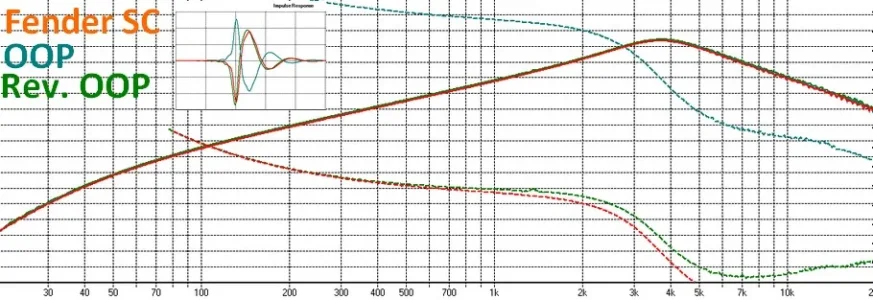
Electrically, there's a tiny difference between a pickup and the same pickup OOP: the resonant peak isn't exactly at the same frequency and hasn't strictly the same Q factor. Impulse responses aren't exactly aligned.

But these differences are so small that they're probably not perceptible. Human ears are meant to be deaf to phase changes anyway.

So, let's search another explanation.

What is the only influence of single coil 2 when only single coil 1 is selected, OOP or not?

Its magnetic field: single coil 2 always interferes with how strings vibrate (the extreme proof of this being "stratitis" and a way less known clue being how height settings of a neck pickup actually alter the harmonics captured by the bridge pickup).

The magnetic field of single coil 1 doesn't change when the pickup is electrically OOP, of course. But if pickup 1 deciphers as negative each move that it was previously deciphering as positive and conversely, it potentially changes how single coil 1 captures vibrations partially conditioned by pickup 2...

I've not tried to set the neck pickup the lowest possible under the strings, in order to hear if the bridge unit keeps sounding different or not when OOP. It might be instructive.

FWIW (mere hypothesis for the moment. I currently lack of time to go further in my experiments and thoughts).

EDIT- Below is the "raw" electrically induced response of the bridge SC in my short scale Strat, normally wired, then OOP, then OOP but with the exciting coil flipped to bring back the PU on phase. Dotted lines show the phase response, BTW. And I've put a reduced pic of the related impulse responses next to the text.

OOPvsNormalRz.webp
 
Last edited:
Back
Top