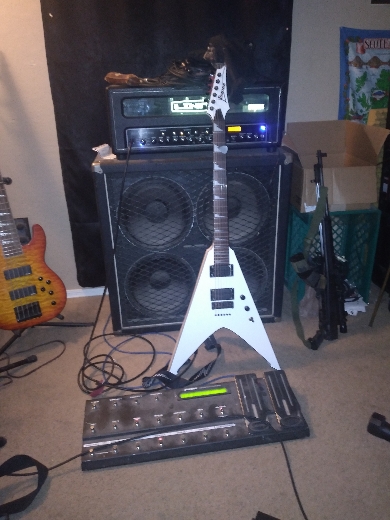
Amp Sims Vs Tube Amps

I thought this, but then I went back and listened to a bunch of 80s rock/metal and realized how far it has to go.

I think alot of it is that people are being conditioned to hearing the perfect "amp sim sound". And in fact you don't need a real amp to make great music. Technically. But if you are making great music, why don't you just use a real amp for the last 2%?

Have you heard any modern iconic guitar music recorded with modelers? I haven't.

They sound great, but even with IRs they are lacking something real.

I think what they are missing is (creative) phase cancellation from multiple mics/rooms/reflections, addressed with board/post/etc. So even if modelers are "perfect", they eliminate the creative production elements and end up sounding samey samey samey. Like how fake **** all kind of look the same.

Accept has recorded their last few records exclusively with Kempers. Many other bands have done so or utilized the Kemper extensively on the making of their records.

I am curious to know what they are "lacking real"? Please clarify
 
Accept has recorded their last few records exclusively with Kempers. Many other bands have done so or utilized the Kemper extensively on the making of their records.

I am curious to know what they are "lacking real"? Please clarify

Go to youtube and recreate an 80's "Headbangers Ball" playlist with all the old hot rod marshall tones. You will hear an incredible variation of tones, imperfections, room resonance, phase cancellations, but together it all works and creates an incredible variation of sounds.

Now listen to your Kemper and ask if it can create the wide variety of tones you just heard. The answer is a resounding NO. Its not that it cant create perfect versions of them, but the point is lost in trying to mine for the "perfect profile". You aren't taking something real and curating it into something that fits the mix. The infinte variations of bad mic placement, bad rooms, bad eq, etc, even if they aren't good, all sound real. With profiles and modelers, the goal is still to get it to sound real (which it does), but you have limited abiliity to stray from the path and still have it sound real. Which limits creative choices and means that everything ends up sounding samey.

Like I said, I play modelers 99% of the time, I like them, but when you look at the whole production landscape, not just a particular tone (profile, preset, etc), the creative potential is limited.

I'm also of the belief that if you write a good song, people shouldn't be listening to the guitar, so my argument doesn't matter that much. But I think there is something to be said for creative juices and how some kid in his bedroom loading a Kemper profile isn't getting the same experience as working with Mutt Lange.
 
Go to youtube and recreate an 80's "Headbangers Ball" playlist with all the old hot rod marshall tones. You will hear an incredible variation of tones, imperfections, room resonance, phase cancellations, but together it all works and creates an incredible variation of sounds.

Now listen to your Kemper and ask if it can create the wide variety of tones you just heard. The answer is a resounding NO. Its not that it cant create perfect versions of them, but the point is lost in trying to mine for the "perfect profile". You aren't taking something real and curating it into something that fits the mix. The infinte variations of bad mic placement, bad rooms, bad eq, etc, even if they aren't good, all sound real. With profiles and modelers, the goal is still to get it to sound real (which it does), but you have limited abiliity to stray from the path and still have it sound real. Which limits creative choices and means that everything ends up sounding samey.

Like I said, I play modelers 99% of the time, I like them, but when you look at the whole production landscape, not just a particular tone (profile, preset, etc), the creative potential is limited.

I'm also of the belief that if you write a good song, people shouldn't be listening to the guitar, so my argument doesn't matter that much. But I think there is something to be said for creative juices and how some kid in his bedroom loading a Kemper profile isn't getting the same experience as working with Mutt Lange.

I get what yo are saying but I don't fully agree. The Kemper captures what it is given (good or bad) in its entirety. The polish sounds you are referring to are most likely from going away from analog and hopping into the digital world. There is also a lot more products and better products available that improve things. The gear back then wasn't what it is today by any means in many cases. New techniques, improved techniques have come to the forefront and some of the old things / ways/ has fallen off a bit. That is the evolution of things (good or bad). To think loading a profile into a Kemper is the same as working with Mutt Lange is a bit foolish and nobody within an inch of their right mind would think such a thing....(at least I hope not). What I have learned along my journey is that about 90% of what you hear is AFTER the amp. Speakers, Cabs, Mic's and their placement is the huge majority of the finished "sound" and "feel" of what we are hearing.
 
  • Like
Reactions: LLL
The sound/tone, touch sensitivity/feel, harmonics, etc. all are really very good with most sims these days. IME the only thing sims don't do yet that tubes amps do consistently is that punch in the chest you get or that blast of air through your pant legs when you're standing in front of it. Emulators and software sims just don't drive speakers the same way.

So if you run an Axe FX or a Kemper or Line 6 (or others) through a 4x12 cabinet at volume you are telling me that you won't feel anything?
 
  • Like
Reactions: LLL
So if you run an Axe FX or a Kemper or Line 6 (or others) through a 4x12 cabinet at volume you are telling me that you won't feel anything?

I probably wouldn't. But I stack all of my OD/Dist in front, so...
 
I get what yo are saying but I don't fully agree. The Kemper captures what it is given (good or bad) in its entirety. The polish sounds you are referring to are most likely from going away from analog and hopping into the digital world. There is also a lot more products and better products available that improve things. The gear back then wasn't what it is today by any means in many cases. New techniques, improved techniques have come to the forefront and some of the old things / ways/ has fallen off a bit. That is the evolution of things (good or bad). To think loading a profile into a Kemper is the same as working with Mutt Lange is a bit foolish and nobody within an inch of their right mind would think such a thing....(at least I hope not). What I have learned along my journey is that about 90% of what you hear is AFTER the amp. Speakers, Cabs, Mic's and their placement is the huge majority of the finished "sound" and "feel" of what we are hearing.

I agree that speaker and mic is what creates the sound. My point was that someone loading a kemper profile is not going to experience the magic of micing a real amp. Imperfections which might appear in recording could be turned into a diamond with right creative choices. That whole interplay is lost when loading a profile.

While we have more tools available now, probably on order of 100 to 1, the universe of unique guitar tones seems to have shrunk.
 
I agree that speaker and mic is what creates the sound. My point was that someone loading a kemper profile is not going to experience the magic of micing a real amp. Imperfections which might appear in recording could be turned into a diamond with right creative choices. That whole interplay is lost when loading a profile.

While we have more tools available now, probably on order of 100 to 1, the universe of unique guitar tones seems to have shrunk.

I agree that loading a profile is not the same as micing an amp from an experience perspective. How could they be? They are both different things. ;) All kidding aside, there are a lot of flawed or mistakes happening when it comes to profiles, IR's and so forth to make things unique. Not everything is perfect in the modeling world. I do understand what you mean though. I think some of the culprits are auto tune, making sure everything is in perfect time, rarely is anything recorded at volume, in a room, live with the whole band so they can get the vibe and the power of the performance. Nothing beats a good performance in my book.

Back to the profiles....it is easier said than done when it comes to getting lightning in a bottle so to speak. If anything, the modeling world has really shown the world how important other things are aside from the amp and how it is dialed. It takes skill and experience to really know what puzzle pieces will deliver the good for what you are looking for. That is no different from the amp to modeler world. Skill and experience isn't necessarily bought. It is acquired through time and experience and learning to ask the right questions and by trying new things. I think a lot of new sounds are out there and obviously available. That doesn't mean we may like them...lol. We gravitate to what we like and feel comfortable with. I also feel one of the biggest culprits in sound familiarity is a speaker issue. EVERYTHING is vintage 30 or greenback it seems with few exceptions of course. Since the speaker and cabinet IS SO IMPORTANT overall in the guitar sound, I feel it would be wise and very beneficial to venture away from the familiarity of those two speakers and take things into a new direction.

The real amp mic'd on record is also a snap shot or a portrait of that moment in time just as much as a modeler is. I am not anti amp by any means. I am a die hard amp guy for sure but I have learned that the Kemper (for me) does some things differently that the others don't and that has bridged a lot of what I once thought were gaps between those two worlds.
 
I agree that loading a profile is not the same as micing an amp from an experience perspective. How could they be? They are both different things. ;) All kidding aside, there are a lot of flawed or mistakes happening when it comes to profiles, IR's and so forth to make things unique. Not everything is perfect in the modeling world. I do understand what you mean though. I think some of the culprits are auto tune, making sure everything is in perfect time, rarely is anything recorded at volume, in a room, live with the whole band so they can get the vibe and the power of the performance. Nothing beats a good performance in my book.

Back to the profiles....it is easier said than done when it comes to getting lightning in a bottle so to speak. If anything, the modeling world has really shown the world how important other things are aside from the amp and how it is dialed. It takes skill and experience to really know what puzzle pieces will deliver the good for what you are looking for. That is no different from the amp to modeler world. Skill and experience isn't necessarily bought. It is acquired through time and experience and learning to ask the right questions and by trying new things. I think a lot of new sounds are out there and obviously available. That doesn't mean we may like them...lol. We gravitate to what we like and feel comfortable with. I also feel one of the biggest culprits in sound familiarity is a speaker issue. EVERYTHING is vintage 30 or greenback it seems with few exceptions of course. Since the speaker and cabinet IS SO IMPORTANT overall in the guitar sound, I feel it would be wise and very beneficial to venture away from the familiarity of those two speakers and take things into a new direction.

The real amp mic'd on record is also a snap shot or a portrait of that moment in time just as much as a modeler is. I am not anti amp by any means. I am a die hard amp guy for sure but I have learned that the Kemper (for me) does some things differently that the others don't and that has bridged a lot of what I once thought were gaps between those two worlds.

I think you used Accept as an example earlier in this thread.

I just haven't heard sounds like this made with digital modelers.

https://youtu.be/B_3TlrZLpQ0?t=174
 
There are Kemper Profiles of the amp he used back then. It is a great sound but I am not so sure you are ONLY talking isolated guitar tone or overall recording tone/vibe and the rawness of that record.

There are alot of factors. There is a slight phasiness which they probably dialed in to taste using multiple mics. There is also a post EQ which accentuates the clack of the pick. And there is just alot of room noise.

The problem with a profile is that you might be able to reverse engineer what they did in that song, but you would never be able to create a song like that with all the flourish of a real tube amp, in a room, with a mixing console. All the "in between sounds", anything that is not the primary, perfect aspect of the amp, just isn't created as well or at all.

The problem with kemper is that a profile starts to fall apart as you deviate by making changes to gain and eq. And its not clear that it has the dynamic range of a real amp. So if the profile isn't doing what your creative juices want, you start clicking through your folder of 1000s profiles instead of changing the mic position or adjusting the board faders/eq. Not even close to being the same thing.

I love modeling for what it is. But its for re-creating, not creating.
 
I just want to add (forum throws error when I try to edit), that all modern guitar music that I've heard in past decade seems to be a re creation of something done decades before. Not an actual creation. Its all derivative now.

For instance, there might be a movie or video game score with an 80s rock guitar.. but they aren't getting creative with the recording process, they are just copping a vibe from another era. And thats what modelers are great at.

I think this is a larger problem with guitar. Everything these days is just a copy. If you give people the tools to copy things and they dont have to be original, you will just get more copies.
 
There are alot of factors. There is a slight phasiness which they probably dialed in to taste using multiple mics. There is also a post EQ which accentuates the clack of the pick. And there is just alot of room noise.

The problem with a profile is that you might be able to reverse engineer what they did in that song, but you would never be able to create a song like that with all the flourish of a real tube amp, in a room, with a mixing console. All the "in between sounds", anything that is not the primary, perfect aspect of the amp, just isn't created as well or at all.

The problem with kemper is that a profile starts to fall apart as you deviate by making changes to gain and eq. And its not clear that it has the dynamic range of a real amp. So if the profile isn't doing what your creative juices want, you start clicking through your folder of 1000s profiles instead of changing the mic position or adjusting the board faders/eq. Not even close to being the same thing.

I love modeling for what it is. But its for re-creating, not creating.

I understand everything you are saying but again, don't fully agree. The Kemper is unlike any other thing. It gets lumped into the modeling world but it isn't a modeler. The Kemper captures the chain of everything you feed it in the profile so there are nuances that you mention that can be captured. Remember, the Kemper is a snap shot of everything so naturally if you begin tweaking things too much you will blur the picture so to speak. At that point, make another profile and capture what you want. Expecting a single profile to be any full amp is misguided.

I have had good results using various IR's or cabs with a profile to get me what I want if I find the profile itself lacking a bit fo what I am after. Like we said earlier, cab, mic, position, etc radically change things so for me, rather than blurring the snapshot I would attack the change via cab, speaker, mic, mic position. I have found that to work better unless I just decide on a different profile altogether.

I don't see how a Kemper can only be used for re-creating and not creating. I have a lot of amps and each amp I have I only probably utilize 5 to 10 tones out of it. It has the potential for millions of sounds but I will be gracious and say I use it for 10. Why not profile each of those 10 sounds and create? The benefit for me is getting everything I use into one box for efficiency sake. Truth be told, With the Kemper profile of my amps I actually have more tonal options for sculpting sound than I do with the amp itself. I am still learning and probably have a very long way to go but I am a far bigger fan of profiling than I am modeling, that I do know. Axe and Line 6 and others make great products but there is nothing like the Kemper in my experience.

While I agree there are a lot of factors as you said those factors can be utilized just as easily on the Kemper. Imagine running it like a regular preamp. Yo can run a line direct , mic a cab or two and use all kinds of mics and speakers and get what you are talking about if you really want to. there are so many ways you can use it.
 
I understand everything you are saying but again, don't fully agree. The Kemper is unlike any other thing. It gets lumped into the modeling world but it isn't a modeler. The Kemper captures the chain of everything you feed it in the profile so there are nuances that you mention that can be captured. Remember, the Kemper is a snap shot of everything so naturally if you begin tweaking things too much you will blur the picture so to speak. At that point, make another profile and capture what you want. Expecting a single profile to be any full amp is misguided.

I mentioned earlier that the dynamic range of the kemper may not be the same as a tube amp. So when you are playing the profile in a room, I presume through studio monitors/IR, you are getting a miked sound with same range as a mic through preamp.

But if you remove the IR and play it through a guitar cab, are you getting the punch and all the eccentricities of a tube amp in room? I just dont know. I suspect not. And its those "eccentricities" that inspire great performances.

I'm not dissing Kemper. But if I was in a band, and I was recording original guitar music, I would absolutely be recording the amp that I played live with.

In fact, these days there is almost no excuse not to. While modeling and profiling has gotten better, its also much easier to record through real amps. Namely reamping. (and load boxes, and hybrid solutions like Torpedo, and cheap high quality mics and preamps, and...) If you don't like the scratch track, send it through your raging stack at 2pm Saturday afternoon, play with mic posisitions, preamp settings, etc. And you will get something damn good.

LIke I said, I think modelers are for recreating, not creating.
 
The sound/tone, touch sensitivity/feel, harmonics, etc. all are really very good with most sims these days. IME the only thing sims don't do yet that tubes amps do consistently is that punch in the chest you get or that blast of air through your pant legs when you're standing in front of it. Emulators and software sims just don't drive speakers the same way.

So if you run an Axe FX or a Kemper or Line 6 (or others) through a 4x12 cabinet at volume you are telling me that you won't feel anything?


I mentioned earlier that the dynamic range of the kemper may not be the same as a tube amp. So when you are playing the profile in a room, I presume through studio monitors/IR, you are getting a miked sound with same range as a mic through preamp.

But if you remove the IR and play it through a guitar cab, are you getting the punch and all the eccentricities of a tube amp in room? I just dont know. I suspect not. And its those "eccentricities" that inspire great performances.

^ This. Top-L's comment gets at what I was saying and noticed with modelers vs actual amps. My experience also matches what Satriani says here about the same thing, starting at 18:27.

 
I mentioned earlier that the dynamic range of the kemper may not be the same as a tube amp. So when you are playing the profile in a room, I presume through studio monitors/IR, you are getting a miked sound with same range as a mic through preamp.

But if you remove the IR and play it through a guitar cab, are you getting the punch and all the eccentricities of a tube amp in room? I just dont know. I suspect not. And its those "eccentricities" that inspire great performances.

I'm not dissing Kemper. But if I was in a band, and I was recording original guitar music, I would absolutely be recording the amp that I played live with.

In fact, these days there is almost no excuse not to. While modeling and profiling has gotten better, its also much easier to record through real amps. Namely reamping. (and load boxes, and hybrid solutions like Torpedo, and cheap high quality mics and preamps, and...) If you don't like the scratch track, send it through your raging stack at 2pm Saturday afternoon, play with mic posisitions, preamp settings, etc. And you will get something damn good.

LIke I said, I think modelers are for recreating, not creating.

I don't play through monitors. I do have a pair of Kemper Cabinets and a plethora or 4x12 cabs so for my sound searching or making I use it like a regular amp or preamp. I don't think things would be the same listening through studio monitors and then comparing that to an amp and cab. I also don't think it would be the same playing a Kemper through studio monitors and then playing the Kemper through cabinets.

I don't believe you are dissing anything nor am I. We are simply having a chat about stuff which is nice and allows folks to see various sides. I will say from my perspective, the gap you mention isn't as wide as I think you feel it may be but that is my opinion. :)

Agree with regular amps. I love using them and I am far more familiar with them than my Kemper stuff. If I am in a workflow situation I can't compete with My Kemper stuff for speed and quality. It just isn't possible. All that said, load boxes, multi amp and cab switchers like Ampete, Delisle, KHE and other new pieces of gear make a lot of things a lot easier than they sed to be. To me, it is all usable and nice to have in your tool belt.
 
  • Like
Reactions: LLL
I don't play through monitors. I do have a pair of Kemper Cabinets and a plethora or 4x12 cabs so for my sound searching or making I use it like a regular amp or preamp. I don't think things would be the same listening through studio monitors and then comparing that to an amp and cab. I also don't think it would be the same playing a Kemper through studio monitors and then playing the Kemper through cabinets.

I don't believe you are dissing anything nor am I. We are simply having a chat about stuff which is nice and allows folks to see various sides. I will say from my perspective, the gap you mention isn't as wide as I think you feel it may be but that is my opinion. :)

Agree with regular amps. I love using them and I am far more familiar with them than my Kemper stuff. If I am in a workflow situation I can't compete with My Kemper stuff for speed and quality. It just isn't possible. All that said, load boxes, multi amp and cab switchers like Ampete, Delisle, KHE and other new pieces of gear make a lot of things a lot easier than they sed to be. To me, it is all usable and nice to have in your tool belt.

I want to make another point about the "accuracy" of a modeler or profiler, when played through an actual amp. Its reasonable that a profile that involves a miced amp will sound the way that mic did when the profile was made. But...

1) Lets say you have a profile of a Fender Twin or any open back amp thats really loud. The magic of open back cab is the room reverberations. The person who designed that amp, the punch of the tubes, the sound bouncing, really puts you in the sound, you can really feel it.

2) Now.. someone creates a profile of that amp, using a mic on the cone, or a combination of mics. Played through a PA it will sound like the miked version of the amp. OK. But how do you recreate the "amp in room" that inspires great performances?

3) OK, so now you create a profile of "just" the Twin preamp, with the intent to play it through a real amp. Maybe you have the kemper head hooked up to a cabinet. Or you use the line out of the Kemper into a "Kabinet". Is it going to sound like the Fender Twin? Be gratifying in the same ways? I don't see any way that its possible. Lets say the head is hooked up to your Marshall 4x12 cab. Not going to sound or feel like a twin. Lets say the head is hooked up to your Kabinet. Maybe its an open back cabinet, so it will be closer... but is it tube? NO. So final answer. You have an actual Fender Twin and you run the Kemper profile to the insert of that amp. It will sound damn close, maybe identical. Except that you cant really adjust the gain or eq controls.. And you've already got the amp, why do you need the Kemper?

Thats why the whole Kemper concept doesnt come together for me.

Playing direct to PA, might as well use a Zoom or Boss or Line6 modeler direct to PA. It doesnt really matter. If you want the real amp sound recorded at home? Use the real amp. If you really want the amp feel on stage, instead of bringing the Kemper and Kabinet, why not just bring the amp? Or two amps (closed back and open back)?

[\procrastination]

Have a great day!
 
Why Is it always one vs the other? Can't they get along under the same roof?
61bb1f0dd8898492ac0f27df6da104f0.jpg


Sent from my SM-A115A using Tapatalk
 
Everything nowadays is a copy of the previous.

But also, everything previous is a copy of the previous before that.

etc...

Music: beg, borrow and/or steal.

There's only so many notes to go around and only so many frequencies.
 
You talk as if you only get inspired performances by an amp being in the room. So Metallica recording at blistering volume in a studio with mic'd cabs in one room and Hetfield sitting in a chair in the control room isn't inspiring or the same "feel"? Maybe to some it is and some it isn't. I would think that is dependent on the person, not the gear.

It seems like we are back and forth on picking and choosing point and scenarios to drive a different point home here.

Here are some of my bottom lines on the Kemper.

1) You can profile the whole signal chain and capture EVERYTHING and when it is put on a record you nor I would probably be able to tell the difference.
2) You can record Di profiles, merged profiles, blended profiles, all kinds of stuff. Getting your sound and being able to turn knobs to do so is not a problem at all. Your tone can be found easily in one if you know what you are doing and want to find your tone there.
3) There are cabs, cab sims, IR's all kinds of things
4) FOH will always be consistent
5) Your tones day in and day out will be consistent from place to place
6) You control your sound and are not at the mercy of a mystery backline
7) Portability....you can essentially profile the world and carry it on a USB stick and download it into a Kemper or have a unit and travel with it in your backpack. You won't be doing that with heads, 4x12's and Fender Twins to get your nightly tones for inspiration.

I could go on but will stop there. None of this is about need really. It is about convenience. I fought the Kemper thing for a decade. I refused to go any direction of a modeler etc but if we are both being honest, they have come a long way and it is undeniable how capable and versatile (maybe even helpful at cost cutting) they are in the practical sense. Is it 100000% identical top to bottom forward to back? Nothing is...but night are identical amps and guitars and cabs. Nothing is identical in those worlds nor will they ever be and nobody really makes a fuss about that.

Admittedly, if I was playing an arena this evening and money was no object, I would bring multiple amps and 4x12's I use for my core tones and weed through my metric $hit ton of pedals and put together a board. I would love it and not feel bad about it. On the same hand, if I was doing that stadium gig in France I would be taking my Kemper rig. The amps are there. The effects are there. The cabs are there. It would save me a whole lot of time and trouble not to mention shipping costs.

YMMV
 
Back
Top