Help me understand EMG pickups

Top-L

Well-known member
I have played for 30+ years. When I was a beginner (Metallica was big) I was using an 81/85 set. From memory the 81 was hot and trebly, it had some sizzle. The 85 was too dark, fat, and undefined to be useful. I didn't like it in the neck or the bridge. I haven't played either in 25 years.

More recently I got a LTD guitar with a 57/66. They are pretty cool for the most part. They seem "passive like", except that the presence seems chopped off. So while they respond and sound credible through most of the register, high notes are missing a little something. This can be addressed with a boost pedal. They work great through some amps, but its obvious they are missing something through other amps.

So my question: Are all EMGs missing this HF content, or is this unique to the 57/66 set? If these were passive pickups I would do something like delete the tone control or use a 1K volume. I am considering swapping the 57 for an 81, but I'm unsure if they all suffer from this muted presence. It feels like the chopped treble is coming from a filter in the pickup instead of the natural qualities of the coils and magnets.
 
All of the classic series EMG share the same preamp. By "classic series" I mean 81, 85, 60, 60A, 58, Hets, and 57/66. Yes, because of the preamp, they all have chopped off presence and low-end. They're very focused in the mids, but not the same way a JB is.

The 81 may come off as brighter than a 57 on a first listen. But if you really listen to them closely, the 57 has more highs while the 81 has more high mids and less low mids, making it come off as more focused and cutting. The 57, IME, is hotter than the 81.

I seem to remember you have the splittable versions of the 57/66, though? Is that you? If so, I have not tried the splittable versions of those, but I have tried the 81TW and the 89, and both sound different from their non-splittable versions.
 
I feel the EMG 60 is a bit brighter and more dynamic. IMO it can be a better neck pickup. I read that it has a narrower sensing area so the geometry is more like mini humbucker or a single sized rails pickup. It’s a popular combination with 81 in the bridge.
 
All of the classic series EMG share the same preamp. By "classic series" I mean 81, 85, 60, 60A, 58, Hets, and 57/66. Yes, because of the preamp, they all have chopped off presence and low-end. They're very focused in the mids, but not the same way a JB is.

The 81 may come off as brighter than a 57 on a first listen. But if you really listen to them closely, the 57 has more highs while the 81 has more high mids and less low mids, making it come off as more focused and cutting. The 57, IME, is hotter than the 81.

I seem to remember you have the splittable versions of the 57/66, though? Is that you? If so, I have not tried the splittable versions of those, but I have tried the 81TW and the 89, and both sound different from their non-splittable versions.
They are splittable. The "single coil" sound is too dark and too hot to be mistaken for single coil. Its lower output so it is useful as a gain switch, but doesn't produce any beautiful sounds.

Thanks for the insight on the built in preamp. That makes sense. I suspected the 81 would have the same thing going on. its a shame the preamp is built into the pickup or it would be possible to mod it and get different sounds.

These pickups do all the lead guitar and metal things I expect them too, but through my 5153 they sound a little bit fake. I have been on the fence about replacing them with passives for a couple years now. They do something unique, which is that they are very clear considering how hot they are. I like them, but I can't swap the guitar with my other ones which makes it a bit of a loner.
 
I feel the EMG 60 is a bit brighter and more dynamic. IMO it can be a better neck pickup. I read that it has a narrower sensing area so the geometry is more like mini humbucker or a single sized rails pickup. It’s a popular combination with 81 in the bridge.
Yeah, the 60 is brighter. I don't know if I'd call it more dynamic. Maybe a little, but it'd be splitting hairs. If you want brighter and more dynamic, I'd go passive altogether.
 
I haven't had EMG's in a while now, but a few years back, I posted a thread on this forum about my EMG's sounding odd. I got some info here where people mention that a component in the preamp was changed around 2018 or so.

I remember I bought a new 57/66 set that sounded super weird. I sold it, and I bought a used scratched up 57/66 set that sounded absolutely killer. I had the same thing happen to me with an 85 I got.

I wish I had recorded clips, but I didn't, so take it for what it is. I also haven't had EMG's in years, so I don't know if they've gone back to sounding "normal".
 
i used emgs in one of my main guitars for most of the 90s and early 2000's. ive said this before, 81/sv/sv. i also had some other emgs but there were all early/mid 90s versions. 81, 85, 60, 89. i havent spent much time with the more modern pups. people keep saying the new versions dont sound like the old ones, but ??? i still have those old 81/sv/sv pups
 
I haven't had EMG's in a while now, but a few years back, I posted a thread on this forum about my EMG's sounding odd. I got some info here where people mention that a component in the preamp was changed around 2018 or so.

I remember I bought a new 57/66 set that sounded super weird. I sold it, and I bought a used scratched up 57/66 set that sounded absolutely killer. I had the same thing happen to me with an 85 I got.

I wish I had recorded clips, but I didn't, so take it for what it is. I also haven't had EMG's in years, so I don't know if they've gone back to sounding "normal".
I don't know. They don't sound weird, just chopped/focused.

I was planning to rip them out before I got the guitar, but they impressed me enough to keep them. But now I realize I don't use that guitar much because it is so different. It works better with one of my amps, but not the others.

Maybe your original set was wired wrong, had the wrong value pot or something? Or could just be defective.
 
Maybe your original set was wired wrong, had the wrong value pot or something? Or could just be defective.
Maybe. But it also coincided with what people told me about the part being changed. And with the other 85 I got which sounded kinda like that.

The thread:
 
Maybe. But it also coincided with what people told me about the part being changed. And with the other 85 I got which sounded kinda like that.

The thread:
"So an update: I really wanted to like this new 57/66 set that I got, but honestly, it's too bright, even compared to my old 81. The 57 has sort of a single coil messiness to the attack that I don't like."

Thanks for the link.

I read that thread, and nothing that my 57 puts out is too bright or has single coil messiness. The LTD guitar in question was made in 2019, so that puts it right in that range where parts could have changed. I don't know what is going on, but my 57 sounds like it does in the YT video of 81 vs 57. To me the 57 sounds like an 81 where they smoothed the frequency response and got rid of that high mid spike you mentioned. But its still the same game.

I think for me the 57/66 is probably the best EMG has to offer and they all have the same "issue". Its a shame because it would be so easy to swap to another EMG because of the harness. They are weird because while I can hear that there are some upper frequencies missing compared to a passive, they do everything I ask and sound balanced for the most part. Its not like harmonics are missing, just something.
 
o my question: Are all EMGs missing this HF content, or is this unique to the 57/66 set?
EMGs (and most other active pickups) are, if anything, characterised by having a broader and more even frequency response than passives of an equivalent output. They use quite weak coils and magnets, and it's the preamp which gives them their output. If you crack open an active EMG humbucker and measure it without the preamp, what you find is something closer to a T-top (81/85) or Filter'Tron (60/60A) than any standard 'metal' passive pickup. Their range extends further into the extreme treble and bass than passives can, and they don't have such defining peaks and valleys. This is why some people feel they sound 'sterile'.

The 57 and 66 (and a handful of other more recent designs) use more standard coils and magnets, along with some EQ shaping in the preamp, to force a bit more 'character'. In most cases this means they do roll off some of the more extreme treble, which most equivalent passive pickups also do not have. If you feel your set has even less high end than most pickups, we can't rule out that there's a fault somewhere. (Or you've just got them too close to the strings or have an acoustically dull guitar, but I think most people would spot that themselves.)

If you'd simply like to swap them for an active EMG with a passive feel but undoubtedly more treble, I recommend the 60A (literally a minibucker in a full-size case), 58 (their first attempt at a standard humbucker sound, actually intended for jazz and close to a SD Phat Cat) or an 89 and keep it in humbucker mode (similar to a 59/Custom Hybrid). Get the 'X' versions so you have the more dynamic and slightly quieter preamp.

All of the classic series EMG share the same preamp
If you buy the standard versions, yes. However, they are all available in 'X' versions, too, which use the modern preamp.

I feel the EMG 60 is a bit brighter and more dynamic. IMO it can be a better neck pickup. I read that it has a narrower sensing area so the geometry is more like mini humbucker or a single sized rails pickup. It’s a popular combination with 81 in the bridge.
The 60 and 60A are basically a minibucker, yes, though since their coils are so weak, it is perhaps better to liken them to a FIlter'Tron. Personally I have always found the common ceramic 60 to be too harsh for even the warmest guitars, but the alnico 5 60A is one of my go-to recommendations to anyone willing to give actives a try. For the bridge I prefer the 89X's humbucker mode, as it's just a touch less boxy, but for the neck I think the 60AX is a perfect all-rounder, similar to how an SD Jazz or DM PAF Pro is used.
 
If you feel your set has even less high end than most pickups, we can't rule out that there's a fault somewhere. (Or you've just got them too close to the strings or have an acoustically dull guitar
I have played for 30+ years. These 57 pickups sound the same as every other demo I've heard on youtube. They have less of the high(est) frequency than typical humbuckers. Its easiest to hear on clean demos. You can find some EMG57 vs. _____ comparisons on youtube. They are very focused in a midrange and as Rex said, the preamp is shaping the tone. That mid forward can be percieved as "bigger" but its not "wider".

I don't want to be confrontational, but what you said about an "acoustically dull guitar" is plain wrong. Acoustically resonant guitars are getting energy from the strings and vibrating it through the body. This actually filters frequencies out of the strings and makes the guitar sound warmer. There isn't "more signal" getting to the pickups because the guitar is resonating. People tend to like the acoustic sound of resonant guitars (raises hand) but most people don't realize that doesn't necessarily give a better plugged tone (subjective).

I'm going to keep using these 57/66 set. They can be dialed very similar to my D-Sonic and Crunch Lab guitars and having diversity in my collection is good. Although I don't think I will buy any more active guitars.
 
Its been 30yrs since I played an EMG. I had one in a single pickup Kramer with a Floyd Rose II.
All i remember is it had an unnatural sustain I didnt like it and never looked back. Can remember if it was a 81 or a 60.
 
If you buy the standard versions, yes. However, they are all available in 'X' versions, too, which use the modern preamp.
The X series preamp is actually not radically different from the regular preamp.

The X series is a couple of resistors different. One of them decreases the gain at the start of the chain, thus giving the preamp more breathing space. The other lowers the resistance (or impedance, I forget what's the right term here), so the pickups' output is less lossy with the pots/wiring, so it raises the level up just a tad.

I don't know if you've tried the X series, but when I tried them, I was disappointed. Not because they sounded bad, but because they didn't sound all that different from the regular series. They sounded like you 18V modded the regulars (which IME is not night and day to begin with), and then dropped the volume just a hair.
 
I don't want to be confrontational, but what you said about an "acoustically dull guitar" is plain wrong. Acoustically resonant guitars are getting energy from the strings and vibrating it through the body. This actually filters frequencies out of the strings and makes the guitar sound warmer. There isn't "more signal" getting to the pickups because the guitar is resonating. People tend to like the acoustic sound of resonant guitars (raises hand) but most people don't realize that doesn't necessarily give a better plugged tone (subjective).

“Acoustically dull” wasn’t my comment, but you have taken the meaning in a very literal sense. Anyway, I mostly agree with what you wrote about the Acoustic aspect, although not everybody has the same understanding. I see it as a loss of vibration energy at certain frequencies and not at others. The whole interpretation of guitar tone from wood and materials is ultra-
subjective and it’s smart to avoid the topic most of the time.

My point is there is more than one way to make a dull sounding guitar. for example with certain woods, structural problems, poorly fitted bridges, certain bridge saddle designs, worn out strings, etc. These type of issues can lead to dull sound whatever way you look at it.
 
Last edited:
The 60 and 60A are basically a minibucker, yes, though since their coils are so weak, it is perhaps better to liken them to a FIlter'Tron.
FWIW, the 81 and the 85 also have the "narrow aperture" (that's how EMG calls them) coils. So inside the cover, those all look like mini humbuckers.
 
According to EMG, resonant frequencies are 2.11khz for the 57 and 1.66khz for the 66.

It matches those of a P.A.F. style neck humbucker (8k/4H) and an overwound bridge one (16k/8H) through a cable with a rather high parasitic capacitance. Around 1200pF...

For the record, in the following video, the 3d sound (through 25' of cable) potentially involves a bridge PU resonating around 2.3khz (still higher than the 57) while the 4th tone (through 100') would translate a resonance @ approximatively 1.2khz (not that much lower than for the 66)...


IOW: EMG 57/66 seem to be voiced to mimic passive humbuckers through a long cable / high capacitive load, probably supposed to emulate the tone darkening conditions in which "vintage" humbuckers were played.

FWIW.
 
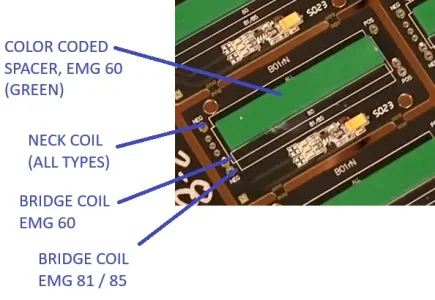
There is a EMG factory tour video on Youtube. At 5:31 it shows that 85, 60, 60A each have a plastic spacer placed flat on the circuit board instead of a magnet. It seems these types have magnets inside the pickup bobbins, so there are NO ferrous components in the design at all. This is similar to a Firebird pickup.

On the other hand, the EMG 81 "PCB assembly" is loaded with a ceramic maget. You can also find pictures online of EMG 81 destructive disassembly showing the construction with steel blades inside each of the pickup bobbins.

 
Last edited:
If you zoom in on the PCB panel that Rob Turner is holding in the video, you can see where the PCB has white printing to identify the different coil positions used on EMG 60, 81, 85 models. Rob explains at 6:08 in the video, that plastic spacers are colour coded to identify each of the different models, such as the green spacer used in the 60A. It appears that EMG 85 has a white spacer, 60 and 60A use a green spacer, while the 81 has a ceramic magnet placed directly on the board.
 

Attachments

  • EMG 60 narrow apeture.webp
    EMG 60 narrow apeture.webp
    37.2 KB · Views: 7
Back
Top