Re: NAD: Laney Ironheart 60H
Just finished playing for what I thought was about 30 minutes, but turns out it was 2 hours.
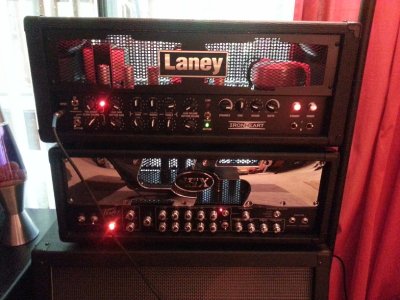
I was playing it through a 4x12 Peavey XXX Slant. (The speakers are like fat V30s, its good for metal and shred, but they dont impart much character in the upper registers.) I also have a JSX cab I will try it with. Played it with a Dean 350f superstrat, standard tuning.
My initial impressions are very good. At first I thought they had nicked the Peavey Ultra/XXX/JSX design because the amps are similar in character/features and they don't sound as different as I thought they would.
Using the amp feels like trying to drive on the left hand side of the road. Even after two hours I don't feel like I "know" the amp, but I'm starting to get it.
I usually record with the JSX run into a Randall Iso cab, miced with a 57. This allows me to choose exactly how much saturation I want. I got the Ironheart because of its "vari-watt" feature and thought it would give me another dimension of saturation, without having to worry about playing too loud into the iso cab.
The most standout feature of the Ironheart60, imo is the Vari-Watt control. This the the basis of the many tonal variations. In use it works almost exactly like a master volume. You turn it clockwise and the amp gets louder. However the higher the Wattage control is set, the more saturation there is, but the saturation remains, even if you turn down the channel volume, so you can get that saturation at lower volume. I don't think there is a power soak in there, it may actually be an analog filter, but it is effective.
I would say that the Ironheart60 is COLDER than the JSX at low volume, and to get the baseline saturation of the JSX requires the control to be turned up pretty high. This emphasizes the mids and tightens things up. So much that you will have to reset the EQ. My feeling is that typical adjustment is to set the Wattage control first to decide the overall character of the amp, and then set the channel volumes independently. (In this sense, it is less effective than a master volume amp. With the JSX, the amp is fairly cold until about "2" on the MV, then it is fully saturated by "6" or so. The sweet spot is around 3-4, but this varies depending on the volume of the pre signal.)
With the ironheart, it doesn't start to sound like a lead guitar amp until the saturation is at least half way up.
The really versatile thing about the Ironheart is that it sounds really percussive on the lower/colder wattage settings, not congested and small like some amps. So you dont really need to open it up to get good sounds. I am not a metal head, but I found that playing pedal note riffs on the low-E string was entertaining and bouncy, they really stand out and it was clear that this amp can do the newer downtuned styles. There are tons of variations in rythym tones you can get from Metallica to experimental huge and percussive. (I suppose people call that death metal...)
From a lead guitar standpoint, once I figured out the Wattage control, I was getting tones closer to what I was looking for.
The boost control is IMO necessary to get the kind of preamp saturation you want in a lead tone. I experiemented with combinations of boost and pre-gain and can't draw many conclusions at this point about the differences in tone, but my feeling is that the boost will give a glassier tone with less hair than the preamp gain. The bad thing about this setup is that there is one boost per amp, and you may find that you need it for both channels depending on what you are doing, so there may be compromises when setting up for a live set. I'm not in love with the boost control, my feeling is that the preamp gain should get enough gain by itself and be able to provide a singing lead tone, with the Ironheart60 you really need to give a little bit of boost to get it to sing. I think the preboost setup is a little awkward, but its nice to have control of input gain, especially in this price range. Versatile, but awkward. Most people would probably have channels that can sing on their own and use boost pedals to control input gain.
The lead and rythym channels are almost identical in tone/gain. With controls set identically, the lead channel has a bit more mid puch, but its mild. Otherwise the rythym channel can get as much gain as the lead channel.
The EQ is not terribly versatile, not like the active EQ on the JSX. They are passive controls with "pull to shift". Still getting my mind around what each one does. The mid pull seems to widen the "Q" of the mid band. The treble pull may be frequency shift. Have to experiment some more, but not thrilled with the EQ, but much of that is because I don't know it yet. To give you an idea of how vague each control is, the many reviews of the amp, no one has been able to definitely demonstrate which each control does- they are subtle. That said, you can get fully scooped and fat tones, just that you may be near either end of the sweep to get what you want.
The Ironheart has a global Dynamics and "tone" stack, which are similar to the JSX resonance/presence. However, the dynamics has little effect on standard tuning and I feel that it will impart bigger effect for downtuned and extreme metal styles. I typically find the lead voice by changing treble/presence and resonance/bass in tandem. This tone control is like presence but seems to have more overlap with treble and the dynamics control seems to be lower than resonance.
The amp has the ability to get mild breakup (which the JSX can't do without a boost pedal) , but the overall tone is dark so you don't get a sweet, singing spongy sound like you would for a fender. It can do blues in a pinch, but the dark character of the amp is everpresent, this is a modern amp.
Lead tones are a bit more versatile than the JSX, if not as polished. There are ways to dial in a glassier, more percussive (more LANEY) style tone, but it doesnt do "hair" as well as the Peavey Ultra circuit. Also, becaue the dynamics control does not seem as effective as the JSX resonance, it may be harder to tighten it up and craft the low end of the tone for shred. I think the resonace operates lower and probably more suited for crafting the low end of metal rythyms.
The amp looks good, is inoffensive, but the quality of materials is a notch below the JSX. The knobs are light plastic and the pots are a bit on the loose side. Chickenheads are easier to adjust. Because the EQ is not that sensitive, you find yourself making big sweeps with the knobs and the knob design doesnt feel great. Also it doesnt have many back panel features, no sweep on the send/return, no impedance switch, just several differnt jacks. No bias test points. Tolex not as thick as Peavey. It has metal corners but a couple mild nicks here and there.
Overall I really like this amp and I feel it is a better metal amp than the JSX, and a bit more tonally versatile (until you add a boost pedal to the mix). The strength of the amp is the wattage control and the ability to play colder and get more open and percussive sounds out of it, or tighter and more saturated, at any volume. (I dont think many people but extreme metalheads will appreciate the coldest settings.) However, the EQ and gain staging is not as polished/intuitive as the JSX, and the craftsmanship is not quite as nice.
I am currently burning in the amp, and as I look over I see the power lamp is fluctuating, like there is a lose filament or something. Its a chinese amp, so I'm not too excited about this. I will definitely look into an extended warranty if I decide to keep it. I'm still not sure if it brings any features to the table that I will personally use, although it can cop the JSX tones.
One last thought, this amp is noisier than the JSX, and probably needs double ended noise suppression. ON the JSX, if you zero the volume, any hiss goes away. With the ironheart, if you zero the volume, the major noise goes away, but there is still background hiss.