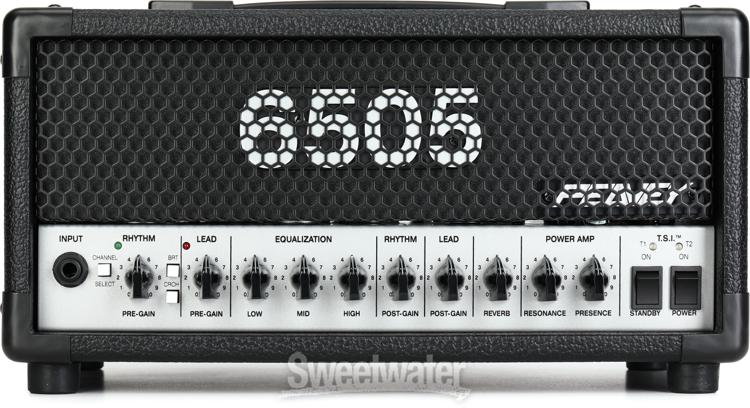
Peavey 6505 Mini

Re: Peavey 6505 Mini

You are correct, a class A amp does not need a PI, but these aren't class A so it needs a PI. Are you assuming that it is class A only because it has EL84s?

A "driver" tube is not the same as a phase inverter and while it is possible to make a PI circuit with a single tube "circuit" by running the non-inverted signal straight to one side of the power tube circuit and running the same signal through an inverting circuit before going to the other side of the power tube circuit, that doesn't make a lot of sense, it that could introduce some slight phase issues (which could be biased out) as well as some amplitude issues (which would require more biasing), so, I don't know of any amps that do that. Everything I have seen uses both sides of a 12A_7 or similar preamp tube to buffer one side and invert the other. I'm also not sure why you would use an EL84 for anything in the preamp, seems like kind of a waste. But, I have been wrong before, and will be again in the future, so if you know of one please share!

Also, it is impossible to only use 1/2 of a EL84, again, it is a single pentode power tube as you can see in the datasheet - http://www.drtube.com/datasheets/el84-jj2003.pdf It can be run in triode mode for less output, but you can't split it.

While the 12A_7 and similar preamp tubes have 2 triode "circuits" (sorry, can't think of a better word for them right now) - http://www.drtube.com/datasheets/12ax7-rca1962.pdf

Again, I gladly admit if I am wrong, but I do need proof...

Upon Googlin' around, I see where you go the "driver" part:

From Wikipedia - It (the EL84) was developed to eliminate the need for a driver tube in radios, and has rather more gain than is usual in a power pentode, producing full output from a relatively small drive signal (the EL84 requires less than 4.4Vrms for 5.7W output compared with 9Vrms for 5.5W from a 6V6 or 8.7Vrms for 11W from an EL34). This eliminated the need for a preamplifier triode in radios, making them cheaper to produce. As the EL84 uses a 9 pin Noval construction, it was also cheap to produce and manufacturers were quick to adopt it in general use, and they are found in many old European valve radios and other audio equipment. A single EL84 was used in low-cost equipment, and a push-pull pair for lower distortion and higher power.

It seems to be using the word "driver" sort of synonymously with "power", what they are actually saying is that the increased sensitivity of the EL84 reduced or nullified the need for a triode driver stage. The EL84 is a power pentode tube, and if used in a push/pull (AB) pair, there has to be a PI of some kind, otherwise both sides would be amplifying the same 1/2 of the signal and you would only get half of the wave form out.

And, finally, down to basic economics, it's a $500 amp with lots of SS in it already with the USB interface, speaker Sim out, etc... I'm sure they are using SS for the PI, it only makes sense. FWIW, I have been an mechanical/electrical design engineer for 25+ years, but again, I will gladly admit if I am wrong, just show me.

I also can't believe I just spent as much time as I did to look stuff up for this on a Saturday...
 
Last edited:
Re: Peavey 6505 Mini

And, finally, down to basic economics, it's a $500 amp with lots of SS in it already with the USB interface, speaker Sim out, etc... I'm sure they are using SS for the PI, it only makes sense. FWIW, I have been an mechanical/electrical design engineer for 25+ years, but again, I will gladly admit if I am wrong, just show me.

USB (and probably speaker sim) would be digital, not solid state, and they'd come after the preamp.
 
Re: Peavey 6505 Mini

The reverb is also digital, FWIW, so the signal going through that goes through an A/D then back through a D/A so it can be mixed back into the signal. All that may be on the same chip now, haven't really looked into it.

According to the Peavey rep in the video, the MSDI (DI out with speaker sim) is tapped after the power section, so the amp has to have an internal load, like the H&K Tubemeisters, Engl Gigmaster 15, Egnater Rebels, etc... So converting that to digital just to add a cab sim doesn't make any sense since it would have to be immediately converted back to analog since it has to feed a lo-z cable jack with an analog signal. There are tons of analog cab sims out there, I still carry an old passive H&K red box in my gig bag, you can buy an active DI box with a cab sim from Behringer for ~$30, and trust me, it's all analog.

The USB is digital communication and the cab sim could be done digitally after the signal is convertered, but why would you do that if you already have a signal that has gone through a cab sim, just convert it to digital and send it out.

I now remember why I quit visiting forums, you guys just want to argue whether you know what you are talking about or not, it's f'ing weird. I just started this thread by posting a link to a new amp that might be cool... Later.
 
Re: Peavey 6505 Mini

The reverb is also digital, FWIW, so the signal going through that goes through an A/D then back through a D/A so it can be mixed back into the signal. All that may be on the same chip now, haven't really looked into it.

According to the Peavey rep in the video, the MSDI (DI out with speaker sim) is tapped after the power section, so the amp has to have an internal load, like the H&K Tubemeisters, Engl Gigmaster 15, Egnater Rebels, etc... So converting that to digital just to add a cab sim doesn't make any sense since it would have to be immediately converted back to analog since it has to feed a lo-z cable jack with an analog signal. There are tons of analog cab sims out there, I still carry an old passive H&K red box in my gig bag, you can buy an active DI box with a cab sim from Behringer for ~$30, and trust me, it's all analog.

The USB is digital communication and the cab sim could be done digitally after the signal is convertered, but why would you do that if you already have a signal that has gone through a cab sim, just convert it to digital and send it out.

I now remember why I quit visiting forums, you guys just want to argue whether you know what you are talking about or not, it's f'ing weird. I just started this thread by posting a link to a new amp that might be cool... Later.

750-6505PlusMiniH_detail3.jpg


I'm just saying that digital isn't the same as analog solid state. That's it.

Your argument was that because they're using digital outputs, they're using solid state in the preamp. That's not necessarily correct.
 
Re: Peavey 6505 Mini

No, I wasn't saying there was digital anything in the preamp, I was just saying there was already SS stuff designed in so it's easy to add a little more.

Let's us a little logic here, they have shrunk down the full size head which uses 5 - 12AX7s. If you look up the 6505 schematic, it uses 4 of the 12AX7s in the preamp, 1 gain stage before the channels, then 5 gain stages in the lead channel and 2 gain stages in the clean/crunch channel (for those playing along, that is 4 of the 5 12AX7s, remember, 2 gain stages in each one). Both side of the last 12AX7 are used for the PI. The effects loop and reverb drivers are, OMG, opamps!!! The horror...

So, you are making a cheaper smaller version of this amp and want to keep the same tone but with less preamp tubes. By reducing the number of 12AX7s from 5 to 3 (or 10 gain stages, circuits, whatever you want to call them to 6), where does it make sense to get rid of them? #1, the PI, since most of the gain is in the preamp, and no one is really pushing the power amps in the "full size" units, solid state will work very nicely in the PI section to send a non-colored signal to the power section. In the old tube amps, the PI actually did contribute to the sound when people were pushing the output sections really hard, but not so much with today's high gain amps where all the distortion is generated in the preamps and the power sections are designed to run clean. My guess for the 2nd place would be the buffer before the signal gets split to the different channels, again, SS does a great job of cleanly amplifying a signal, there are 3 of the 4 missing 12AX7 stages gone. Not sure where they make up the last one with SS, but it's probably the first stage of either the clean/crunch channel or the first stage of the high gain channel, those would make the most sense IMHO. You could also make up some of the gain by making some component changes in the tube circuit. I'm sure they experimented with both approaches and picked the one they felt sounded closest to the original 6505 preamp.

This is the kind of stuff I do on contract for a living... Usually more on the mechanical side, but still. You've probably seen some stuff I've worked on, and some stuff, you probably don't want to, it would mean you are in surgery and they are feeding a catheter into your heart...

Wow, way too much time investment on a Saturday.
 
Re: Peavey 6505 Mini


Hello devastone, Can the speaker defeat be used and then connect the FX send into the ISP Stealth? I know that is a feature of other Preavy amps like the valve king ii, maybe now that I have learned more about preamps I am seing the ligth.

edit: I mean, I know the speaker defeat has been there for the valve king ii line so I wonder if somebody else has triedthat for the existing micro head.
 
Last edited:
Re: Peavey 6505 Mini

Actually, according to the video, the USB and emulated out comes after the poweramp. So they may very well be part of the attenuator circuit, or simply feed off of it.
 
Re: Peavey 6505 Mini

Don't forget the jet city has a better build than the peavey any day of the week.
There are zero connectors on the any wires going to the pcb.
A constant source of problems on a lot of amps.
The peavey high gain channel is a bit of a soldano slo copy in many ways.
The jca 22h is basically a Soldano slo circuit with el84 tubes. A good idea is to try
2 12ay7 tubes in the first two slots. This will give a nice clean channel and tame the slo channel.
Try it and see what it does.
 
Re: Peavey 6505 Mini

IMENTATOR - I don't see why you couldn't do that.

b4578 - I haven't looked into either of these closely, but I would not doubt that the Jet City amps are built better. I miss the old days when all Peavey products were built in the US, everything was solid.
 
Re: Peavey 6505 Mini

Just when I thought I couldn't be any more indecisive about wether I want an Engl Ironball, 6505 1x12 combo, Blackstar HT40, or Splawn Street Rod...
 
Re: Peavey 6505 Mini

Just when I thought I couldn't be any more indecisive about wether I want an Engl Ironball, 6505 1x12 combo, Blackstar HT40, or Splawn Street Rod...

I ended up with the Engl Ironball when I had to make that decision, great amp. But I do have my eye on the 6505 mini as well....
 
Re: Peavey 6505 Mini

Just when I thought I couldn't be any more indecisive about wether I want an Engl Ironball, 6505 1x12 combo, Blackstar HT40, or Splawn Street Rod...

Splawn started making a baby version of the Nitro too, the Nitro SS. Just thought I'd throw another monkey wrench into your decision making. Lol
 
Re: Peavey 6505 Mini

Although, for a recording head in the same price range, there is still the Laney IRT Studio, which seems to be a little more versatile. I guess it would come down to trying both and going with the one that had the tone I liked.
 
Re: Peavey 6505 Mini

Do you guys know where I can get a carry bag for this Mini beast (Like MESA Mini Bag)? Thanks so much!
 
Re: Peavey 6505 Mini

Sounds like an awesome idea for a practice/home studio amp, but there will be a milliom dip****s trying to play in bands with them, count on it. I want to know how much.

Doesn't really work when you think how it's bigger brother counts on clean headroom to do what it does.
I mean, miced is gonna be cool as hell I bet. On it's own? God help you, son.
 
Re: Peavey 6505 Mini

All these new mini amps make me GAS for a high gain amp, my only complaint is they all have line outs but all with cabinet emulation you can't turn off which kinda sucks for recording because most analog cab sims aren't great compared to impulses, it cant be that hard to add a switch to turn it off, especially something like the Mesa Mini Mark V which isn't exactly cheap. On a whole I like the idea of small amps because I like small amps anyway and as a sound guy 120 watts is overkill pretty much always unless you need a clean tone and I can't say that Peavey 6505s are known for a great clear clean channel [/QUOTE]
 
Re: Peavey 6505 Mini

Splawn started making a baby version of the Nitro too, the Nitro SS. Just thought I'd throw another monkey wrench into your decision making. Lol

I hadn't seen the little nitro.. Im afraid to check into it, cuz I cant afford one.. haha
 
Back
Top