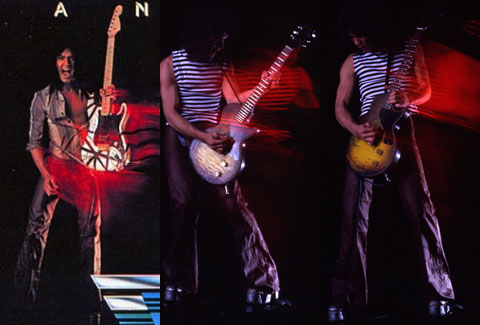
Re: People forget two things when chasing the early Van Halen tone.
From the man himself:
"Ever since the beginning, everything that I picked up off the rack at a music store—even the custom-made stuff—did not do what I wanted it to. It either didn’t have enough of something or it had a bunch of bells and whistles that I didn’t need. A lot of it had to do with the fact that I never took lessons, so I didn’t know right from wrong. I didn’t know there were rules, I just knew what I liked and wanted to feel and hear. This also had a major impact on the way I play, doing things on the guitar that weren’t written in any books.
I destroyed a lot of guitars trying to get them to do what I wanted, but I learned something from every guitar I tore apart and discovered even more things. Things like if the string is not straight from the bridge saddle to the nut, you’re going to have friction. On most guitars the headstock is angled back which compounds the problem. If you take the vibrato bar down the strings loosen from the bridge to the nut to the tuning peg. When you return the bar, the tuning does not return to the same point. So I got a brass nut, made the slots really big and put 3-in-1 oil in the cuts where the string travels through the nut. Then I wound the strings up the tuning peg instead of down so the line from the bridge saddle to the nut to the tuning peg was straight as an arrow. Also, from the back of the guitar where you put the string through the block on a Fender tremolo tailpiece, every time I turned the tuning peg I would grab the ball end and turn it with every turn of the tuning peg, alleviating twist tension within the string itself. It worked really well. These are some of the discoveries I made that allowed me to use a standard vibrato and do the crazy things I do and keep the guitar in tune.
I learned so many things along the way and incorporated all of them into building the “Frankenstein” guitar, which was originally painted black and white. On the first Van Halen record and especially live on tour people were floored by how I could do all these crazy things with a standard Fender tremolo and stay in tune.
I continued to putz with every aspect of a guitar. I even tried winding my own pickups. One thing I never liked about most other guitars is that the front and rear pickups were the same. When I would get the rear pickup sounding great the front one would sound like mud. I didn’t like that, so I tried winding the pickup less and more, using a heavier magnet and a lot of different things. For years I used just one pickup because I couldn’t get the neck pickup to sound the way I wanted it to unless I changed the amp settings that were already dialed for the bridge pickup. I got different sounds through playing techniques.
Then I hooked up with some pickup companies and asked them to make me a different neck pickup. That helped. Then I started experimenting with the distance where the pickup was placed and the way it reacts with the string. I use my finger as a gauge. There’s a point near the saddle where the harmonic is the root. That’s where you want the pole piece centered. I’ve checked other guitars and they just stick the pickups anywhere. That can cause all these dissonant overtones that make you go, “Where the hell did that come from?” Not many people know that. The pickup obviously picks up the sound from the strings. If it’s underneath a dissonant harmonic, it’s going to sound dissonant.
I also couldn’t stand the high annoying feedback squeal that occurs playing at very high volumes. I thought maybe it was the actual coil windings vibrating that caused the feedback. I thought if I dipped a pickup in molten wax, when the wax cooled it would stop the coil windings from vibrating. I took a coffee can, melted paraffin wax, dipped the pickup in the wax and pulled it out right before the bobbins would melt. I didn’t always catch it in time. I ruined a lot of pickups that way. When I got it right . . .it got rid of the squeal. This process I stumbled onto is now known as potting, and it also became a standard process for manufacturing in the industry."