Remind me: what does the copper plated steel bottom plate do for some pickups?

Remind me: what does the copper plated steel bottom plate do for some pickups?

Nice links. Dang, I miss frankfalbo. :bigok:

Maybe I should explain what my "project" is. I didn't want to say anything until I was finished, in case it failed miserably. But it might help, (to get me help), if people knew what I was doing.

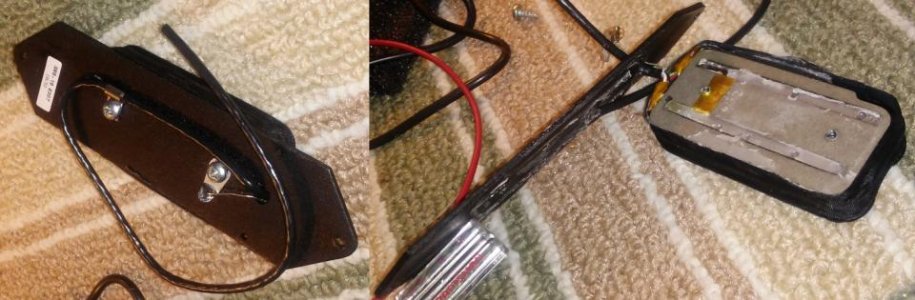
Some of you may be aware of a couple of my posts where I talked about my big "George's Music blowout sale." One of the many items I scored, was this, for $20:

View attachment 98148

A good ole Ric Bass pup. You may notice that, except for the baseplate, it's identical to the CS El Diablo. I layed it and my Diablo side by side, and they do appear identical. But where the Diablo comes in at 22.1k w/A2's, the Ric is 8.6k with A5. My lil gray cells are asking me if this might make a cool El Diablo "neck" pup. The problem with the Ric pup is the weird baseplate. I'm not sure what that material is, but it almost looks like pressed cardboard. It appears to be paper based. (I emailed SD to ask what it is, but haven't received a response yet.) That's where this thread question comes into play. I'm going to trim that down to normal HB'er size, but I'd also like to reinforce it with metal. But I want to minimize any tonal aberrations. For all I know, that Ric pup may already be wound "bright" to give the bass more "snap". I just don't know what a Ric bass sounds like.

So, that's what I'm doing, and that's what my concerns are. Feel free to guide me in the right direction with thoughts, concerns, and other ideas.

Artie

The base is fiberboard, like Fender pickups are made from.

Instead of trimming it, which is pretty hard, just unscrew the baseplate and replace it with one for a humbucker.

Humbucker baseplates are made from nickel silver or brass. You can’t use a magnetic steel plate because it will short out the magnetic circuit, since both ends of the magnet’s poles are on the bottom.

You can get a metal baseplate here:

https://www.mojotone.com/Pickups_x/PickupParts_x/Humbucker-Short-Leg-Frame-Nickel-Silver-49-2mm

And you can also use a fiberboard baseplate

https://www.mojotone.com/Pickups_x/PickupParts_x/Fiberboard-Humbucker-Frame-50mm_2

Just use the 4 screws from the pickup to attach them.

Bass pickups like this are very similar to guitar pickups. My humbucker size bass pickups work fine on guitar.

Sent from my iPhone using Tapatalk
 
Re: Remind me: what does the copper plated steel bottom plate do for some pickups?

I'll be danged. You're right. It does unscrew. :smack:

When I first looked at it, I just thought those screws secured the wire. I then put it back in the box and haven't looked at it again 'til now. Thanks Dave. This project just got a whole lot easier. And do-able.

Ric_base-03.jpg

P.S. That fiberboard frame looks like the ticket. Thanks again for the links.
 
Re: Remind me: what does the copper plated steel bottom plate do for some pickups?

P.S. That fiberboard frame looks like the ticket. Thanks again for the links.

I had that in a corner of my mind and for some cerebral reason, it didn't pop up... So, yes, thx David for the reminder! :-)
 
Re: Remind me: what does the copper plated steel bottom plate do for some pickups?

I went ahead and ordered both just to have options. Only about 4$. (But twice as much for shipping.) We'll see if I actually get them. Mojo's cart software does not inspire confidence. I almost gave up, and went elsewhere.
 
Re: Remind me: what does the copper plated steel bottom plate do for some pickups?

I went ahead and ordered both just to have options. Only about 4$. (But twice as much for shipping.) We'll see if I actually get them. Mojo's cart software does not inspire confidence. I almost gave up, and went elsewhere.

Are you using AdBlock plugins? I recall their shopping cart has an issue with that.

I buy pickup parts from Mojo all the time. Never had a problem with them as a company.


Sent from my iPhone using Tapatalk
 
Re: Remind me: what does the copper plated steel bottom plate do for some pickups?

I am, but what happened was weird. First, it asked me to go back and put in my security code for my CC. Which I had. Then it didn't like my "back order" selection. Then it sent me back to select my shipping method. Again, I had, but this time my cheapest option was almost $20. That's when I about gave up. So I started over, and everything seemed to go ok. I'll admit that this may have something to do with using Opera as my browser. Sometimes it doesn't play nice with shopping carts. I shoulda just used Firefox or Chrome.
 
Re: Remind me: what does the copper plated steel bottom plate do for some pickups?

Well dang. The fiberboard plate is back ordered. Since I'll never use this Ric baseplate again, I'm going to try to shape it. Now that I can remove it, it shouldn't be too hard to cut. I think I have every Dremel tool and attachment ever made. ;)
 
Re: Remind me: what does the copper plated steel bottom plate do for some pickups?

Please explain your meaning.

Are you assuming something? Are you being sarcastic?
Sarcastic. Why waste your time trying something for yourself when there's an Internet forum with readily packaged opinions?
 
Re: Remind me: what does the copper plated steel bottom plate do for some pickups?

Well dang. The fiberboard plate is back ordered. Since I'll never use this Ric baseplate again, I'm going to try to shape it. Now that I can remove it, it shouldn't be too hard to cut. I think I have every Dremel tool and attachment ever made. ;)

I’m eager to see your HB on its custom modified BP, Artie! :-)


Non important FOOTNOTE related to your initial question…

Now that dust has settled down a bit, I’d like to share a slice of some experimental results stored in my computer.

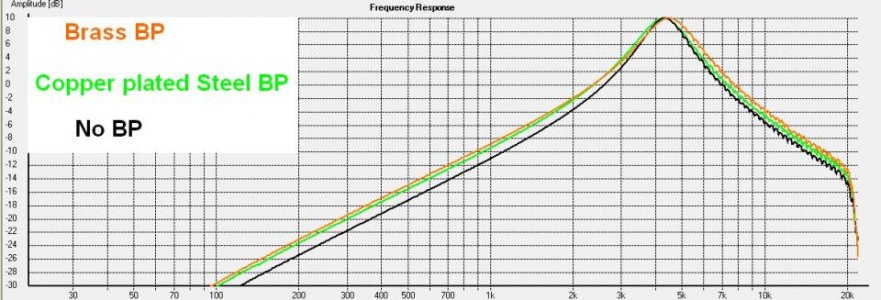
Below is the resonant peak of a Fender single coil with A5 rods in three situations: 1) upon the brass baseplate of a cheap humbucker. 2) Above a magnetic copper Steel baseplate coming from a Telecaster bridge PU. 3) without any baseplate.

BrassBpvVCopPlatStlBpVsNoBp.jpg

The 2dB of “beef” due to the Tele baseplate are understandable (at least to me).

More surprisingly, the most apparent “beef” is due in this case to the magnetically inert brass BP… it translates the kind of aural experience that people might have when they tinker with BP’s.


Now, dear readers, please, let’s keep in mind that…

-I could have posted other tests showing a way more subtle difference or no apparent difference at all: IME, it depends partly on how the experiments are done and with which testing rig [Same problem with other specs BTW: for example, DiMarzio “Dual-Resonance” won’t appear in resonant peaks measured in an inadequate way, intentionally or not… ]

-even in experimental conditions allowing to see such things, the results obtained will depend IME on the pickups and/or parts tested… For example, the SAME brass baseplate than above won’t change much the resonant peak(s) of such or such humbucker fitted with it… BUT it will increase what a frequency analyzer deciphers as distortion… while this apparent (measured) distortion might be decreased by the mentioned plate under the vertical rods of the evoked single coil (!)…

-even the last observation above doesn’t authorize me to generalize about the tonal effects (or not) of baseplates in single coils or humbuckers: IME, it’s largely a question of concrete configuration, depending on the magnetic circuit involved in each case ( FEMM simulations being there to suggest what I mean here).


Anyway: IF the variability of the few experimental results obtained here reflects a variety of empirical findings for guitar players, it’s not surprising to read opposite opinions about the effects of baseplates. :-)

FWIW (my 2 cents of the morning, before a working day).
 
Re: Remind me: what does the copper plated steel bottom plate do for some pickups?

Sarcastic. Why waste your time trying something for yourself when there's an Internet forum with readily packaged opinions?

I did not mean to discourage anyone from tinkering. I was simply pointing them to a good source for better info on the subject than most online will/can provide, and sharing my own conclusions based on my own tinkering, and on the info and testing provided by others that I trust.

According to any seemingly reasonable test I've seen (and I consider Freefrog's to be up there, and his conclusion to be very balanced/fair), the difference is, at most, barely audible, and at least, inaudible (i.e. under 1 dB of change), in a sonically pure environment. Throw that into a mix, and even the barely audible results will get lost. I don't conclude, nor does anyone conclude in any good test that I've seen, that the specs (e.g. inductance) are not altered at all. I simply believe that the end results of said alteration won't really change anything for anyone in the "real world."

FWIW, one of my favorite Strat pickups (the DiMarzio Red Velvet) has a baseplate. It's a great "Tele in Strat package" pickup. But then again, it's also an approx. 8.5K pickup...i.e. about 30 percent overwound from a typical old Strat pickup. Which of those changes over a vintage style Strat pickup is really providing the vast tonal change over that vintage style Strat pickup? It's without question the more Tele-Like wind, not the baseplate.
 
Last edited:
Re: Remind me: what does the copper plated steel bottom plate do for some pickups?

Little technical sidenote: Duncan got back to me. The baseplate is Forbon. From Wiki:

Forbon is a vulcanized fiber that was created in the early 1900s by the NVF company. It was used on the original pickups that Leo Fender (founder of Fender Guitars) created for the Stratocaster, Telecaster, and the Precision Bass. It is still used on reissue guitar and bass models from that era. Lollar Pickups and The Seymour Duncan Pickup Company also use Forbon on many of their pickups, such as early Fender style replacement pickups. Forbon is still sold by the NVF company.
 
Re: Remind me: what does the copper plated steel bottom plate do for some pickups?

I know I'm late to the party, but I recall reading somewhere that the Dimebucker is built the way it is (plastic baseplate) is to minimize the amount of metal in the pickup. This allows the end product to have high output and a high resonant peak. Based on that, I'm assuming that a non-metallic baseplate would get you more clarity and top end response.
 
Re: Remind me: what does the copper plated steel bottom plate do for some pickups?

That makes sense. Since the fiberboard is back-ordered, I'm going to reshape the original baseboard. Should work fine.
 
Re: Remind me: what does the copper plated steel bottom plate do for some pickups?

I know I'm late to the party, but I recall reading somewhere that the Dimebucker is built the way it is (plastic baseplate) is to minimize the amount of metal in the pickup. This allows the end product to have high output and a high resonant peak.

Yes. It was the principle behind the pickups designed by Bill Lawrence. :-)

Based on that, I'm assuming that a non-metallic baseplate would get you more clarity and top end response.

IMHO and IME, it depends of the metallic content of other components... Eddy currents will be minimized by the absence of baseplate with thin blades as magnetic poles. Not so much with wider blades or with the usual array of slugs/screws/keeper bars. Not to mention the influence of the "magnetic windows" obtained with the whole... That's why I was saying above that the sonic influence (or not) of baseplates is really "design dependent" - and even "product dependent", in fact: under the same coils, two baseplates of different thickness and/or composition won't necessarily play (or not) the same "role"...

FWIW. Sorry if I seem to repeat myself - LOL. Maybe the best thing would be to shut my mouth and to share what Bill Lawrence was saying: http://www.billlawrence.com/Pages/Pickupology/External Interference.htm

:-)
 
Last edited:
Back
Top