
You are using an out of date browser. It may not display this or other websites correctly.
You should upgrade or use an alternative browser.
You should upgrade or use an alternative browser.
String Trees, Or No?
- Thread starter Kais
- Start date

kramersteen
PowerMetalRaph
Re: String Trees, Or No?
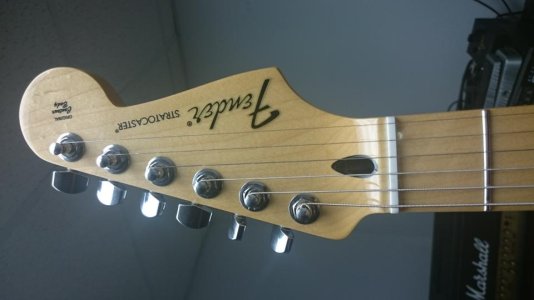
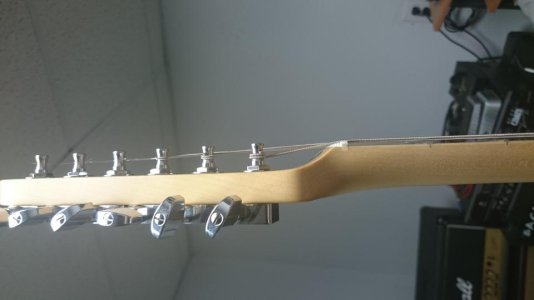
looks like it has a bit of angle there so don't bother unless it gives you trouble.
looks like it has a bit of angle there so don't bother unless it gives you trouble.


DreX
New member
Re: String Trees, Or No?
Fender most likely left it/them off to allow for preference. As is, the break angle on the high B and E will be weak, it might cause weaker sustain, or the strings might pop out. You can probably cheat and get away without string trees if you wind the string around the tuner in such a way that it winds downwars towards the headstock so that it will have as steep and angle possible relative to the fret board. There are some tuners that deliberately put the string very close to the headstock for this reason.
Fender most likely left it/them off to allow for preference. As is, the break angle on the high B and E will be weak, it might cause weaker sustain, or the strings might pop out. You can probably cheat and get away without string trees if you wind the string around the tuner in such a way that it winds downwars towards the headstock so that it will have as steep and angle possible relative to the fret board. There are some tuners that deliberately put the string very close to the headstock for this reason.

crusty philtrum
Vintageologist
Re: String Trees, Or No?
My main Strat has Gotoh height-adjustable pole tuners. I tweaked them to get the strings as close as is possible to the face of the headstock (any lower and the strings won't fit through the holes). Despite having done that, there is still not enough tension, and there is loss of tone and sustain (and the top E pops out of the nut on occasion). The top strings just don't have as much strength of tone as they should have. I need to fit string trees for at least the top E and B strings, and probably also the G string.
I have no doubt that many players who insist on ridiculously low action and play with a lot of dirt all the time will put up with that. People who play cleaner styles will notice the difference and won't endure the loss of tone that makes at least the top two strings sound wimpy.
My experiment has proved that the only way to get the proper angles required will be by using an angled-back headstock, or using string trees on a regular Strat headstock, even if the top strings enter the tuner posts at the lowest-possible point (i.e. as close to the face of the headstock as possible).
Fender most likely left it/them off to allow for preference. As is, the break angle on the high B and E will be weak, it might cause weaker sustain, or the strings might pop out. You can probably cheat and get away without string trees if you wind the string around the tuner in such a way that it winds downwars towards the headstock so that it will have as steep and angle possible relative to the fret board. There are some tuners that deliberately put the string very close to the headstock for this reason.
My main Strat has Gotoh height-adjustable pole tuners. I tweaked them to get the strings as close as is possible to the face of the headstock (any lower and the strings won't fit through the holes). Despite having done that, there is still not enough tension, and there is loss of tone and sustain (and the top E pops out of the nut on occasion). The top strings just don't have as much strength of tone as they should have. I need to fit string trees for at least the top E and B strings, and probably also the G string.
I have no doubt that many players who insist on ridiculously low action and play with a lot of dirt all the time will put up with that. People who play cleaner styles will notice the difference and won't endure the loss of tone that makes at least the top two strings sound wimpy.
My experiment has proved that the only way to get the proper angles required will be by using an angled-back headstock, or using string trees on a regular Strat headstock, even if the top strings enter the tuner posts at the lowest-possible point (i.e. as close to the face of the headstock as possible).
DreX
New member
Re: String Trees, Or No?
My personal experience with this working out is with the Deluxe Strat with a roller nut and some locking tuners with very low string tie off points:

I've tried bypassing the string trees on regular Strats and had it not work out, but it works OK as it is on the Deluxe. I bet the relatively thin point of the rolling tuners allows for a milder angle, since there's going to be more pressure relative to the area of contact.
My personal experience with this working out is with the Deluxe Strat with a roller nut and some locking tuners with very low string tie off points:
I've tried bypassing the string trees on regular Strats and had it not work out, but it works OK as it is on the Deluxe. I bet the relatively thin point of the rolling tuners allows for a milder angle, since there's going to be more pressure relative to the area of contact.
kramersteen
PowerMetalRaph
Re: String Trees, Or No?


crusty philtrum
Vintageologist
Re: String Trees, Or No?
That's what i love about this place. Broad, sweeping statements with nothing to back them up, trump some people's personal practical experiences, often garnered over a period of years and even decades.
The internet has a lot to answer for.
Simple answer...no...you have graduated tuners...no need for sting trees.
That's what i love about this place. Broad, sweeping statements with nothing to back them up, trump some people's personal practical experiences, often garnered over a period of years and even decades.
The internet has a lot to answer for.
David Collins
New member
Re: String Trees, Or No?
In line with what Philtrum said -
There are several functions a nut must perform. The obvious first is to set spacing and height above the fret plane, and keep strings in place when plucking or bending. Next is to perform as a boundary point for the wave, and this is where problems occur on Fender style headstocks with no strings trees.
When a wave travels along a string and reaches a boundary point (nut/saddle/fret), there is potential for various degrees of the energy to be reflected back, transferred through, or transmitted beyond. If a string has suitable downward pressure and the rest point is broad enough, most of the energy will be reflected back, with of course some being transmitted through to the neck as well, but very little transmitted beyond to the strings beyond the nut. In my professional opinion, a tree-less Fender style nut simply does not have enough downward pressure to create a suitably firm boundary point on the upper strings, even with the strings wound low on staggered posts.
Ideally the string should see an immediate angle of at least 5° where it first contacts the nut. Less than this and the boundary point can become somewhat blurred, extending beyond the face by a slight amount (varying with amplitude and frequency) rather than seeing it as a finite point. Then once past the initial face of the nut this angle needs to curve slowly to a slightly steeper angle in order to keep the string in contact (in a flat slot the string will arc slightly beyond the end points and float over rather than rest on the base). Without this arc and a suitable increase in angle behind the nut to the tuners, you can loose a lot of energy as well as experience back buzz.
Fender has addressed this in some models with their roller nut and staggered tuners, but this really just masks the more obvious symptoms rather than addressing the core problem. The angle is still so shallow that downward pressure at the nut is insufficient to create a firm boundary point, and this combined with the very narrow point of contact allows a good deal of energy to be lost beyond the nut. Then to address the symptoms of back buzz and excessive ringing, they include a pad behind the rollers to dampen and mute this lost energy. For some players with a light attack and/or high distortion it may not present any issues, but is still far from ideal in my opinion.
Leo did not design these necks for any special tone or ideals of engineering. It was simply a way to cut cost/waste by being able to manufacture necks from standard, readily available 5/4 maple stock. String trees were then added for obvious reason of necessity. The E/B tree is a must in my opinion, and the G/D tree an option, which if omitted can work pretty much fine as long as the G slot is cut absolutely perfect. Often times this leaves the G string with no more than 7-9° total angle when wrapped low on the post, which can work but leaves no room for slop or error in cutting the nut slot.
I will often polish out the underside of conventional stamped string trees to minimize friction for players who use a lot of tremolo and bending, but once this is done there should be no more tuning stability issues with a string tree as there would be without. It's really something I consider a must have though, at least for a vast majority of players. Some players' styles and demands can get by without it if the nut slots are cut to extremely tight tolerances, but then again, I see absolutely no reason not to have one anyway.
In line with what Philtrum said -
There are several functions a nut must perform. The obvious first is to set spacing and height above the fret plane, and keep strings in place when plucking or bending. Next is to perform as a boundary point for the wave, and this is where problems occur on Fender style headstocks with no strings trees.
When a wave travels along a string and reaches a boundary point (nut/saddle/fret), there is potential for various degrees of the energy to be reflected back, transferred through, or transmitted beyond. If a string has suitable downward pressure and the rest point is broad enough, most of the energy will be reflected back, with of course some being transmitted through to the neck as well, but very little transmitted beyond to the strings beyond the nut. In my professional opinion, a tree-less Fender style nut simply does not have enough downward pressure to create a suitably firm boundary point on the upper strings, even with the strings wound low on staggered posts.
Ideally the string should see an immediate angle of at least 5° where it first contacts the nut. Less than this and the boundary point can become somewhat blurred, extending beyond the face by a slight amount (varying with amplitude and frequency) rather than seeing it as a finite point. Then once past the initial face of the nut this angle needs to curve slowly to a slightly steeper angle in order to keep the string in contact (in a flat slot the string will arc slightly beyond the end points and float over rather than rest on the base). Without this arc and a suitable increase in angle behind the nut to the tuners, you can loose a lot of energy as well as experience back buzz.
Fender has addressed this in some models with their roller nut and staggered tuners, but this really just masks the more obvious symptoms rather than addressing the core problem. The angle is still so shallow that downward pressure at the nut is insufficient to create a firm boundary point, and this combined with the very narrow point of contact allows a good deal of energy to be lost beyond the nut. Then to address the symptoms of back buzz and excessive ringing, they include a pad behind the rollers to dampen and mute this lost energy. For some players with a light attack and/or high distortion it may not present any issues, but is still far from ideal in my opinion.
Leo did not design these necks for any special tone or ideals of engineering. It was simply a way to cut cost/waste by being able to manufacture necks from standard, readily available 5/4 maple stock. String trees were then added for obvious reason of necessity. The E/B tree is a must in my opinion, and the G/D tree an option, which if omitted can work pretty much fine as long as the G slot is cut absolutely perfect. Often times this leaves the G string with no more than 7-9° total angle when wrapped low on the post, which can work but leaves no room for slop or error in cutting the nut slot.
I will often polish out the underside of conventional stamped string trees to minimize friction for players who use a lot of tremolo and bending, but once this is done there should be no more tuning stability issues with a string tree as there would be without. It's really something I consider a must have though, at least for a vast majority of players. Some players' styles and demands can get by without it if the nut slots are cut to extremely tight tolerances, but then again, I see absolutely no reason not to have one anyway.
Last edited:

uOpt
Something Cool
Re: String Trees, Or No?
Something is odd here.
Those guitars are supposed to have staggered tuners, that means the string holes for the higher strings are lower on the tuner. Then you don't need string trees.
But the picture in the OP shows same tuner string hole height.
Myself I am a believer in strong string trees. I have seen terrible damage to sound from string partially lifting out of the nut as you play the open string. The string is keeping things in tune. The 4+2 headstock in combination with staggered tuners like on a Music Man does well IMHO.
Something is odd here.
Those guitars are supposed to have staggered tuners, that means the string holes for the higher strings are lower on the tuner. Then you don't need string trees.
But the picture in the OP shows same tuner string hole height.
Myself I am a believer in strong string trees. I have seen terrible damage to sound from string partially lifting out of the nut as you play the open string. The string is keeping things in tune. The 4+2 headstock in combination with staggered tuners like on a Music Man does well IMHO.
uOpt
Something Cool
Re: String Trees, Or No?
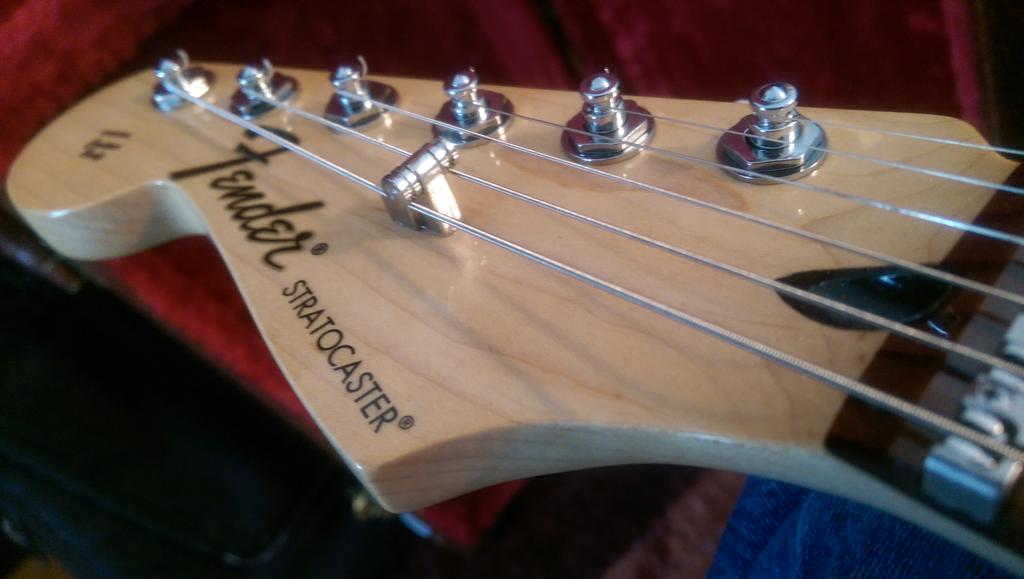
That one has staggered tuners. The height of the post is the same, but you can see the string guide, and where the holes are. The one in the OP does not.
I would say the OP needs to do something either way.
My personal experience with this working out is with the Deluxe Strat with a roller nut and some locking tuners with very low string tie off points:
I've tried bypassing the string trees on regular Strats and had it not work out, but it works OK as it is on the Deluxe. I bet the relatively thin point of the rolling tuners allows for a milder angle, since there's going to be more pressure relative to the area of contact.
That one has staggered tuners. The height of the post is the same, but you can see the string guide, and where the holes are. The one in the OP does not.
I would say the OP needs to do something either way.
DreX
New member
Re: String Trees, Or No?
"locking tuners with very low string tie off points"
That one has staggered tuners. The height of the post is the same, but you can see the string guide, and where the holes are. The one in the OP does not.
I would say the OP needs to do something either way.
"locking tuners with very low string tie off points"

treyhaislip
Well-known member
Re: String Trees, Or No?
I've had them on all of my Strats but just thought about it and didn't have them on my Les Pauls. My dad is a firm believer in roller string trees...whatever it takes to stay in tune works for me!
I've had them on all of my Strats but just thought about it and didn't have them on my Les Pauls. My dad is a firm believer in roller string trees...whatever it takes to stay in tune works for me!


Kais
New member
Re: String Trees, Or No?
Nice observations gents. In the op, those tuners came from another strat that had 2 string trees, so that would be why they aren't staggered. And like I said, the picture was a new neck I purchased last week. From everyone's comments, it seems that string trees wouldn't hurt. Yes it would be extra holes in the headstock, but I don't think that really matters.
Next debate is the classic style string trees, or the modern roller style? I'm primarily a strat player and those types seem to be the most popular. I'l thinking the roller style might have a very slight advantage
Nice observations gents. In the op, those tuners came from another strat that had 2 string trees, so that would be why they aren't staggered. And like I said, the picture was a new neck I purchased last week. From everyone's comments, it seems that string trees wouldn't hurt. Yes it would be extra holes in the headstock, but I don't think that really matters.
Next debate is the classic style string trees, or the modern roller style? I'm primarily a strat player and those types seem to be the most popular. I'l thinking the roller style might have a very slight advantage
DreX
New member
Re: String Trees, Or No?
I'd only get the classic butterfly string tree if you were trying to make it vintage correct. I haven't had any tuning issues with vintage or modern string trees. I only have one 70's era Strat with two string trees and while I haven't had issues with that one either string tree, I imagine it's more likely that the wound D will hang up, rather than the unwound G B and E. I bet string trees are like nuts in that they are usually only a problem if they're defective or damaged where the string makes contact.
I'd only get the classic butterfly string tree if you were trying to make it vintage correct. I haven't had any tuning issues with vintage or modern string trees. I only have one 70's era Strat with two string trees and while I haven't had issues with that one either string tree, I imagine it's more likely that the wound D will hang up, rather than the unwound G B and E. I bet string trees are like nuts in that they are usually only a problem if they're defective or damaged where the string makes contact.

Similar threads


- Replies
- 7
- Views
- 541

- Replies
- 13
- Views
- 1K

