Re: Ever have a guitar that just won't....
I've owned 80-some guitars in my career, and currently sit at 55. And I'm feeling your pain--I've had several guitars over the years that somehow seemed to be "less than the sum of its parts". It can be very disappointing and totally frustrating. I've got one or two around here right now that I'm agonizing over. OTOH, its always great to find a cheap pawnshop prize that simply blows you away, no matter what the name on the headstock.
I had one guitar back in the '70s, a Gibson ES-150DCN that I struggled with for six years before giving up on it. Wouldn't play in tune, wouldn't stay in tune. It would neck dive. It would feedback like crazy, and never really sounded that good through the amp I was using at the time (mostly the amp's fault). I finally gave up on it, and traded it off on a guitar that fit my needs better and that I love dearly. But, I took a big loss on it. Some of the problems would be fixable today, but back then good luthiers were few and far between. It was beautiful, but it never lived up to the promise of its spec sheet, like a beautiful blonde with a hot body who's a lousy lover. Very disappointing.
I bought a new Peavey Horizon II in 1990. Absolutely beautiful guitar, one of the best made guitars I've ever owned. And unlike the ES-150DCN, no real issues--just a guitar that didn't work for me. A couple of small nits in the design that I could never work through. It went away, and I've always felt guilty that it didn't work--but the young man I sold it to was very happy to have it and played the heck out of it. Win-Win.
I do have a success story, though. When I got my first G&L Comanche, I had a devil of a time with those Z-Coil pickups. It took a few Zen moments and some Jedi mind tricks to figure out how to set my tones. It wasn't the guitar, it was me having to throw out my playbook and learning how I could get the most out of that guitar. We get along famously now. Those guitars just kick ass; I'm SO glad I worked it out.
But, I currently have a Gibson Historic R9 that I love to look at but hate to play--the neck is just too big for me. I'm going to talk to a guy about possibly having the neck shaved a bit, but I think it's on the way out--better to cut my losses on this. It's a player-grade guitar, but I love the tone and the flame is to die for. Still, that neck ruins it for me, so it's probably time to sell.
It's hard for me to let go of a guitar sometimes. And I just hate it when I've bought a guitar and it turns out to be a mistake. Makes me not trust my judgment, and that's not a fun space to be in.
=======================
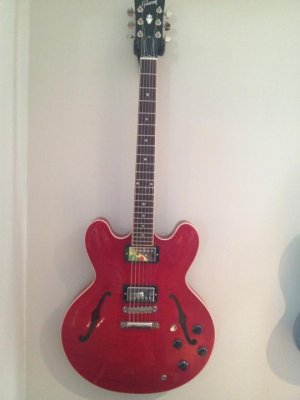
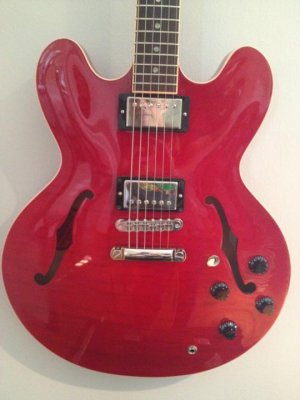
I think the first thing to do is to sit down and honestly appraise the guitar. Not its value, but you need to ask yourself if you really like the 335 design. Is it comfortable to hold? Does the neck feel good? is it an appropriate instrument for the music I play? If you like small-bodied SGs with fat necks, 24 frets and play in a Norwegian Death Metal band, the 335 might not be for you. But if you're comfortable with the Slim Taper neck and the bigger body of the 335; if are doing Classic Rock, Blues, light Jazz, Fusion, Americana, Pop--then you have a guitar that can be very effective at those styles.
Having owned so many guitar over the years, I've learned that certain things work for me, and some things don't. I don't care for Bigsbys, and I don't have any need at all for a Floyd Rose equipped guitar. I prefer solid bodies over hollow bodies--I don't like the trapeze tailpiece, and abhor the screeching feedback that you get with a full hollow. I used to play vintage Fenders, but these days I like the 12" radius and medium jumbo frets of my G&Ls--and they have the best vibrato, too. I want a guitar that plays in tune and stays in tune. I don't do guitars with 24-fret necks. I like classic shapes--an Explorer or a Vee would be fine, but that's about as pointy as I get. I like guitars with 2HBs; I like guitars with three single coils. So the point is, you have to define what works for you, and then try to figure out whether the 335 fits into that matrix.
So my guitar collection right now is very large, but it is basically large because of all the duplicates I have. There's 18 G&Ls, 11 LPs, 10 Martin dreads and 3 ES-335s--because those guitars fit my criteria and that's what I like to play. I don't have a Ric, a Gretsch, an Ovation, a Jazz box, a Parker, Jackson or Charvel super-strat--I buy what works for me.
So, if you think there's some redeeming value to your 335 and it is going to fit your criteria and your musical style, then the next step is to take it to a luthier and have some of these issues addressed. The very first thing I do to every Gibson I buy is to put strap locks on--these days I prefer Schallers. If the guitar came from Gibson and you haven't had it setup, then you'll probably need to have the nut filed a bit. It the nut action is too high, the guitar will not play in tune in the First Position. Make sure that the tuner bushings are tight, but DO NOT OVER-TIGHTEN! The truss rod needs to be adjusted to fit your playing style and have positive tension on the nut. (I hit hard, so I like a little extra relief.) I use 10-46 D'Addario XL strings on my Gibsons, same as the factory gauge. I find that sticking to the factory gauge works best for Gibson guitars.
One of the things you will need to do is have the saddles on your bridge properly radiused. The saddles should be set to follow the radius of the fingerboard, which is usually 12". A lot of folks think that the ABR-1 and Nashville bridges come this way from that factory, but IME they always need some touch up. The luthier should know how to use and have a radius gauge and have the proper files--and know what you're talking about. If he doesn't, find a better luthier. You'll want to have it done using the gauge of strings you'll be using.
If your guitar has the ABR-1 bridge, inspect it very carefully. When I bought one of y 335s, one of the saddle adjustment screws had popped up out of the frame and caused terrible tuning instability. I took the bridge off, and applied pressure with a flat-blade screwdriver to reseat the screw in the frame and it's been perfect ever since. Not a problem with the Nashville bridge, but it can be a real head-scratcher with the ABR-1.
Finally, the frets should be checked that they are firmly seated and then leveled and crowned , if needed. The newer Gibsons are Pleked and are usually very good, but occasionally one gets through that is less than ideal.
Pickup adjustment can be somewhat of a black art. I tend to have the Classic '57 pickups set lower on my 335s, with the pole-pieces raised, to give a slightly clearer tone. And then I try to balance neck and bridge for equal volume. Small adjustments can make big changes.
There are different models of these guitars, and they have made some spec changes over the last few years. I like the '57 Classics in my 335s, but some of the newer guitars use a different set. Some folks like the MHS pickups, and some don't. The ABR-1 bridge is traditional on a 335, but I'm seeing new guitars come with Nashville bridges.
Set up can be tricky, and going by the book doesn't always give the best results. It seems that each one of my guitars has a sweet spot, a point where it plays the best, regardless of where I think it should be. Remember how I said I like a little extra relief and 10-46 strings? Well, got a couple that play best with an almost flat fingerboard, and a couple that have a preference for 9-46 strings. You kinda have to develop a feel for what's right, listen to what the guitar is telling you and throw out the instruction manual.
BTW, I would love to see pictures of this guitar and I'd love to know what year it is. Who knows, maybe I need another 335, LOL!
Good luck!
Bill